Showing posts with label graves. Show all posts

Tuesday, August 07, 2018

Crazy Dead Romans!

If you go down to Canary Wharf today you’re in for a big surprise. At the Museum of London Docklands there is an exhibition called Roman Dead. In a dimly lit room, you will find over a dozen real (!) skeletons along with ashes of the dead. You will also see tombstones, inscriptions, funeral urns along with hundreds of grave goods (personal objects buried with the dead). It may sound gruesome, but it’s utterly fascinating. Some of the things in the Roman Dead Exhibition might make you agree with Obelix (from the Asterix graphic novels), when he taps his head and declares, ‘These Romans are crazy!’

I have been obsessed with the ancient world for over forty years. I have been writing books set in the Classical world for nearly twenty years. What first attracted me to study the ancient Greeks and Romans was how much like us they seemed from their literature. But the more I learn about them, the less I find I know. Yes, they are like us in many ways. But they are also unlike us in many other fascinating ways. Here are some of the objects that made me go ‘What on earth were the Romans doing with THAT?’

IRON RATTLES
Several rattles have been found in or near Roman burials, suggesting that they were shaken at funerals. Imagine shaking a rattle at a modern funeral! The Roman Dead exhibition even provides a hands-on shakeable rattle near three tubs containing different things you might have smelled at a funeral (bay leaves, frankincense and mastic). This type of rattle was called a sistrum and was especially popular in ceremonies for the Egyptian-Roman goddess Isis. We know that other instruments might have been played, and that mourners might have cried out the name of the deceased. One theory is that the noise kept away the ghosts and evil spirits that presumably haunted the graveyard. 

A TINY JET DIE
Die! 
No, I’m not telling you to go kill yourself. I’m giving you the singular of the word ‘dice’. A tiny die is one of many objects in the exhibition made of Whitby Jet. This rare substance was considered to have magical properties in Roman times. It looks like stone but in fact it is ancient fossilised wood from the Jurassic era. The Romans didn’t know that. But they did know that when you rub jet against wool or skin it attracts a static charge and can move hair and other small particles without touching theme. Romans didn’t know the scientific explanation. They believed jet to be a magical substance that could keep away evil. So maybe this was a good luck charm to keep away evil spirits as the soul of the dead person made the journey to the underworld. But why a die?

FACE POTS
This pot with a face on it looks jolly, doesn’t it? But it’s an urn to hold ashes of the dead! One theory is that pots like this represent a death-mask of the deceased. Another theory suggests that head pots could stand in for the heads of defeated enemies because some Romans and lots of Celts liked to chop off the heads of their enemies so they wouldn’t be able to have a happy afterlife! Then, to make sure the restless spirit didn’t haunt them, they would drop the head into a pit or stream. In another part of the museum you will see actual skulls of decapitated people, almost certainly either hated enemies or vile criminals. 

SKULL ON HER LAP
What on earth is going on here? We have the complete skeleton of a woman aged between 36 and 45 found deep underground at Hooper Street, Tower Hamlets. She was buried in a wooden coffin on a bed of chalk powder. Some time after she was buried, but before she turned to bone, someone dug her up again, removed the top of her skull and placed it over her pelvis! Then the coffin was reburied and rocks were piled on top. Among the rocks was a copper-alloy key. Was the key part of the reburial? Or accidentally dropped? Why was she buried on a bed of chalk? But most importantly, why was the top part of her skull placed over her pelvis? Maybe the newly positioned skull, rocks and key (along with a ceremony we can’t guess at) were designed to stop her spirit from haunting those still above earth, like those heads dropped in pits or water. 

MASSIVE SARCOPHAGUS
This sarcophagus (the word means flesh eater in Greek!) was found in Southwark (south London) only last year. It inspired the exhibition. It weighs two and a half tons and was brought a great distance. That must have cost a lot of sesterces! Why put a body inside such a heavy stone box? Roman magic expert Adam Parker believes that many things done to a body were to protect the living from its ghost but also perhaps to protect the body from being dug up and used for magic. We know from authors like Pliny the Younger and Apuleius that witches used body parts in their spells. Is that what’s going on here? Or was the lady buried in this sarcophagus a Christian who believed in a bodily resurrection and wanted to keep her corpse intact? We have no idea! 

COPPER KEY
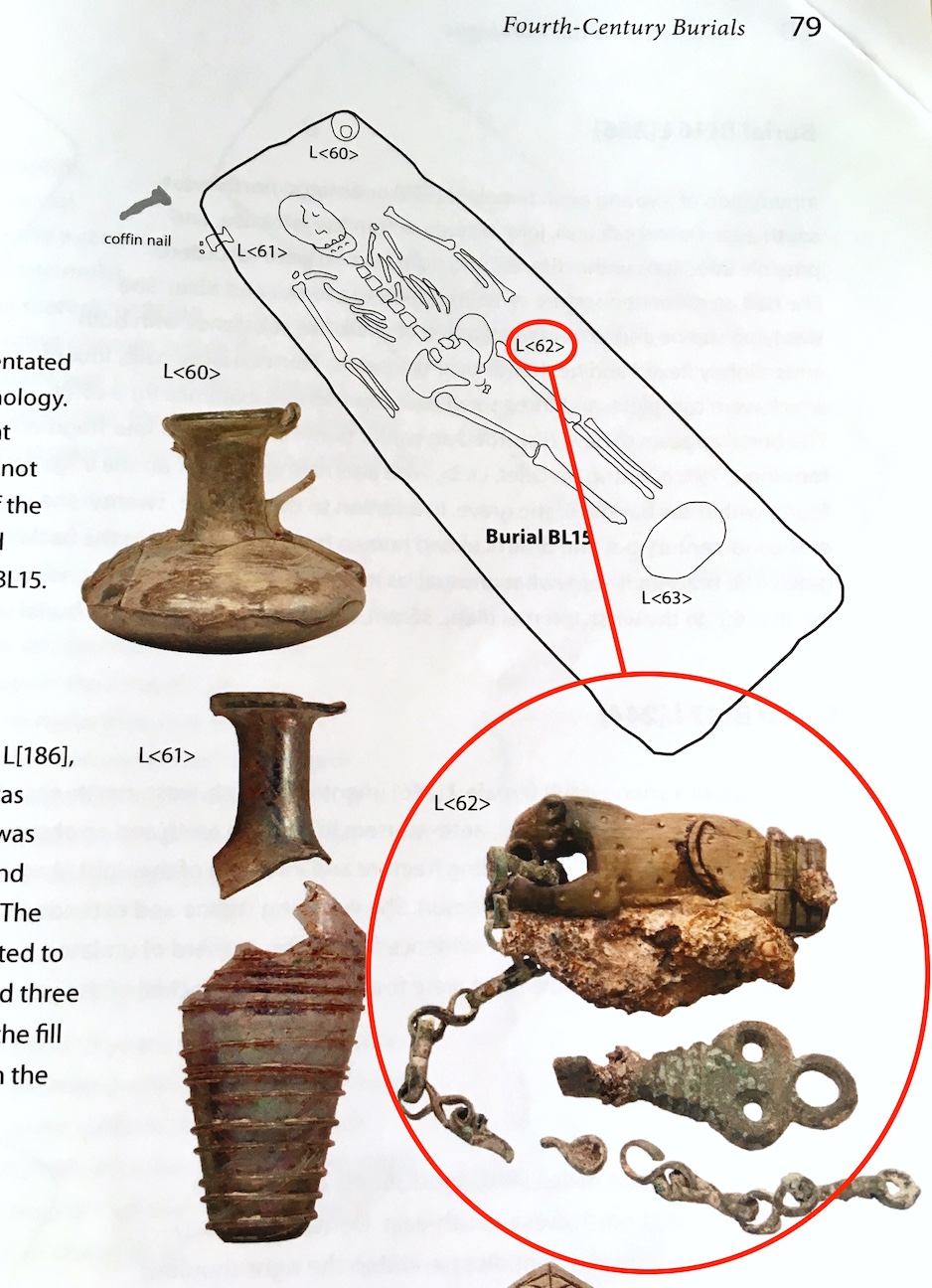
Also from Southwark comes a small copper-alloy key which you can see in one of the cases. It was found near the left hip of a girl’s skeleton. She is called the Lant Street Teen because of the location of her grave and because her age at death was estimated to be fourteen. She was also buried with a wooden box, two small glass bottles and a folding knife. Because of the richness of her grave goods, samples of her bones were tested. Her DNA tells us she was of European ancestry and had blue eyes. But the isotopes in her teeth indicate that she lived in the southern Mediterranean – possibly North Africa – until she was nine, when she made the long journey to Londinium. Her skeleton is not in the Roman Dead exhibition because it is used in workshops for schoolchildren at the Museum of London’s Barbican site! 


In Roman times most keys looked more like big combs on a handle than modern keys. They fit into a pattern of holes to lift up a crossbeam on the inside of the door. Unlike the big iron key on the left, the Lant Street Teens copper-alloy key also has little teeth. But what did it open? Surely not a door; it’s far too delicate. Perhaps it opened the box that was found at the girl’s feet? But although the box had copper-alloy decoration, no lock was found. Was the key a magic charm of some sort, like the one found in the stones piled on the Hooper Street Woman’s grave? What was the key for?

IVORY KNIFE
Also belonging to the Lant Street Teen and found next to the copper-alloy key at her left hip was a folding knife with an iron blade and an ivory handle carved into the shape of a leopard. I have noticed that small folding knives like these are often found in the graves of women. In life, they would have been useful for personal grooming, eating and cloth- making. Several other folding knives found in Romano-British graves have fierce animals on them. Why? Why would a girl have a hunting hound or big cat on her knife handle? Perhaps these show the knife can ‘bite’. Or perhaps the animals on the handles symbolically protect their owner and keep away evil. Therefore a knife like this might have dual purpose of being a tool but also protective, making it a practical version of a lucky rabbit’s foot. But we don’t really have the faintest clue. 


The blue-eyed fourteen-year-old girl who owned these items fascinated me so much that I am writing a book about her called The Time Travel Diaries. In this book an eccentric bazillionaire is also obsessed with her. His boffins have accidentally invented a time machine. Unfortunately, he can’t go back so he recruits a twelve-year-old London schoolboy to go back to third century Londinium (using Londons Mithraeum as a portal) in order to find her. In this book, I tried to imagine what Roman London would really have been like. 

I will be reading chapters from The Time Travel Diaries at a FREE family event on Saturday 18 August 2018. And I will also be telling you lots more amazing things I have learned about these Crazy Dead Romans, including the answers to some of the questions I raised in this blog post. For more information and to get your name on the list for my free event, go HERE.

P.S. Thanks to MOLA, London’s Mithraeum and Juliette Harrisson for huge support (and some of the photos!) 

Friday, April 26, 2013

You Can Be an Archaeologist Detective!


My friend Dr. Hella Eckardt (no, that's not her) is a brilliant archaeologist. She knows that the graves of dead people from Roman times provide lots of clues about how they lived. Over the past few years, she and her clever colleagues have studied over 150 skeletons from Roman Britain (between 200-400 CE).

Recently Hella and a team from the University of Reading chose four of the 150 graves to investigate in detail. Together with webmasters from the Runnymede Trust, they have now designed a website that allows schoolchildren (and anybody else) to “look into” those graves and make their own deductions. You can look at the bones of four individuals, including a little girl. You can hear what experts have to say about what the bones, teeth and grave goods tell us.

Then you can make your own deductions and even write a story if you like. That’s what I did. I took the clues the experts gave me and made up a possible story for each of the four. I even got to help name them! We called the little girl Savariana. The young man is Brucco, the exotic and rich young woman from Africa is Julia Tertia and the man from the Black Sea region is Piscarius.

Yesterday a panel of experts spoke to over two hundred schoolchildren in year 3 (aged 8 and 9) at the Museum of London. The children came specially to help us “launch” the new Romans Revealed website.


The speakers were introduced by Dr. Nina Sprigge (far right in the picture below). Her job is to enthuse teachers and schoolkids about the museum's collections and she does a great job.

The children and their teachers got to hear Hella (in the middle) talk about how diverse Roman Britain was, with goods and people coming from all over the empire.

They got to hear Dr. Caroline McDonald (far left below) tell us about all the bones in the vaults of the Museum of London: they have over 17,000 skeletons!

Caroline McDonald, Hella Eckardt, Nina Sprigge & the Spitalfields Lady!

Debbie Weekes-Bernard from the Runnymede Trust brought some booklets with ideas for exciting lessons teachers can build around this new website.

Valentine Hansen & me
Valentine Hansen played the part of an ex-soldier in Britannia. He taught the children to say "hello" in Latin and what it meant to have three names.

I got to speak too! I briefly told the kids how I get ideas by playing with my replica Roman objects, including my infamous Roman bottom wiper: a sponge on a stick! (Learn more HERE!)

Dr. Helen Forte was there, too. She is a Latin teacher but also illustrates the Minimus Primary Latin course and some of my books. She did some of her marvellous drawings for the Romans Revealed website.

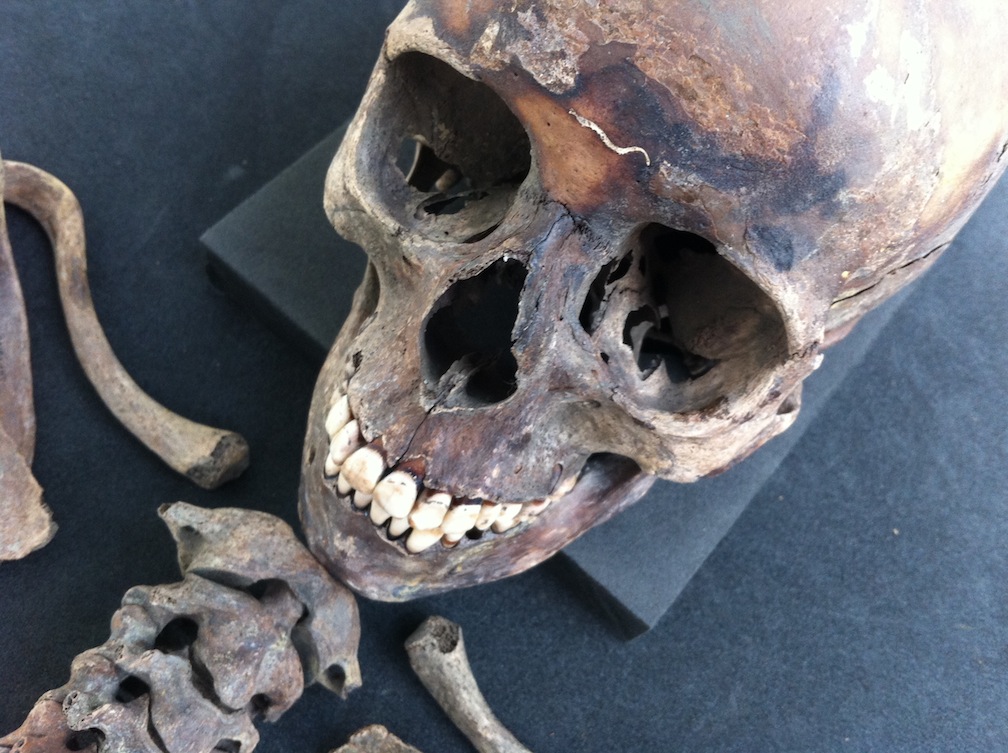
But the oldest guest by far was a woman from Rome. She was two thousand years old. You guessed it! She is the skeleton. Although visitors to the Romans Revealed website will only examine virtual bones on the Romans Revealed website, the Museum of London had brought out real bones!

Valentine examines a reconstruction of the Spitalfields Lady

The so-called Spitalfields Lady is probably the most famous of the 17,000 skeletons in the Museum of London vaults. We think she used to look like the bust in the picture up above.

Spitalfields Lady today
But today she looks like THIS! (right)

Dr. Becky Redfern, a researcher at the Museum of London, told us that we can tell by her teeth that she was born in Spain but then grew up in Rome! She then came to Londinium (the Roman name for London) where she sadly died. She was very rich and you can see the objects buried with her in the Museum of London Roman gallery.

You can't see a real skeleton like the Spitalfields Lady unless you visit the Museum of London, but you can visit four other skeletons by a click of the mouse. Have fun and tell me what you think of it!

Romans Revealed!

Caroline Lawrence writes historical fiction for children with kid detectives. She has written over twenty books set in first century Rome including The Roman Mystery Scrolls series – illustrated by Helen Forte – which would be perfect for kids in year 3 or up studying the Romans! 
Carrying on from the Roman Mysteries, the Roman Quests series set in Roman Britain launched in May 2016 with Escape from Rome.