Tuesday, February 14, 2012

Romance in Ancient Rome - a Quiz


Cupid on a crab

I) St Valentine was most probably
a) a Jewish priest
b) a Roman soldier
c) a Greek freedman
d) a Byzantine emperor

II) The Lupercalia was a mid-February Roman fertility festival. Which of these was NOT a feature?
a) setting doves free
b) half-naked youths
c) goat sacrifice
d) striking people with leather thongs

III) In first century Rome, the most popular month for marriage was
a) April
b) May
c) June
d) July


14 yr old Miriam the bride
IV) Who was Cupid's mother?
a) Minerva (Athena)
b) Venus (Aphrodite)
c) Juno (Hera)
d) Helen of Troy

V) When Pliny the 'Younger' was older he married
a) a besotted 14-year-old girl
b) his niece
c) the Emperor Domitian's niece
d) Cleopatra's niece

VI) The Romans believed the best finger for a wedding ring was
a) the middle finger of the left hand
b) the middle finger of the right hand (the left was unlucky)
c) the fourth finger of the left hand (like today)
d) the fourth finger of the right hand (the left was unlucky)

VII) The legal age for a girl to marry in first century Rome was
a) 10
b) 12
c) 14
d) 16


The Sirens of Surrentum
VIII) The legal age for a girl to become betrothed (engaged) in first century Rome was
a) any age
b) not younger than 6
c) not younger than 8
d) not younger than 10 (decreed Augustus)

IX) The most common cause of death among young women in ancient Rome was
a) malaria
b) measles
c) Latin
d) childbirth

X) The word 'genuine' comes from the Latin
a) genu 'knee' - because the father took his newborn on his knee to acknowledge it was his.
b) genus 'noble birth' - because if you were of noble birth you were a genuine aristocrat.
c) gens 'family' - because only the genuine members of the family could inherit.
d) genius 'guardian spirit' - because this spirit only protected the genuine family members.


Flaccus gives Flavia a love-poem
Bonus fact: Did you know the words 'Roman' and 'Romance' are linked? Also, Roma backwards is amor!

[If you want to learn more about Roman romance, read The Roman Mysteries, especially The Sirens of Surrentum, which has kissing from the very first line. You might also want to check out a blog I wrote about Romantic Roman Artefacts. Some of the pictures in this blog are from the Roman Mysteries TV series, available on iTunesUKCarrying on from the Roman Mysteries, the Roman Quests series set in Roman Britain launched in May 2016 with Escape from Rome.]

P.S. The answers: 1 (b); 2 (a); 3 (c); 4 (b); 5 (a); 6 (c); 7 (b); 8 (d); 9 (d); 10 (a)

Tuesday, February 07, 2012

Tinker Tailor Votive Willies

Caroline Lawrence with the artefact
It is a snapping cold day in February and I am hot on the trail of a Roman artefact from Rome's ancient port of Ostia, the setting of most of my Roman Mysteries series of books. The artefact – a small marble relief of four women and a baby – first came to my attention when someone posted it on an Ostia Facebook Group. We were all very excited because none of us had ever seen it before! A few quick emails told us that it was part of the Wellcome Trust Collection with the Science Museum. It was in storage at a museum repository in West London. As the only member of the Ostia Group based there, I volunteered to go and have a look. My motive was not unselfish: as an author of historical detective stories this is exactly the sort of object that can give me an entire plot line!

East Wing of Blythe House 1924
So on 2 February 2012, I take the train from Clapham Junction to Kensington Olympia, then walk to 23 Blythe Road. I've been to this part of London many times, (and even done a couple of book signings at Brook Green Books), but I never knew about the Victorian treasure box that is Blythe House. Built around the year 1900, its original purpose was to house the Post Office Savings Bank. At one time over a thousand female clerks worked here, segregated from their male counterparts for propriety's sake. They all used to enter via the East (i.e. back) Wing.

East Wing of Blythe House 2012
In 1979 the British Government bought part of Blythe House to use as extra storage space for the British Museum, the Victorian & Albert, and the Science Museum with the Wellcome Trust. The late Sir Roy Strong, director of the V&A called Blythe House "a marvellous building" and said it "should be not just a dumping ground but an exciting new complex for the public." It is a marvellous building. Still attached to the West Kensington Postal sorting office and minus the smokestacks visible in earlier photos, the distinctive red and white brickwork makes it look like a glorious confection of Lego blocks.

Shivering in my down parka, I arrive at the east wing of Blythe House, the same entrance used by all those female clerks. I go to a turnstile called Gate A and press the call button. Anyone can visit, but you have to make an appointment first. I have been put in touch with Ms. Katie Maggs and she has kindly agreed to meet me and show me the artefact. The place is maze-like even before I get inside, but I manage to find reception up some outside stairs. I check in with a porter behind a window. He gives me a yellow plastic pass. Katie meets me a few minutes later. She is young, warm, friendly and informative. With a degree in Classics from the University of Warwick followed by two MAs from University College London, one in Museum Studies and one in History of Medicine, she is the perfect person to tell me about the unusual artefact I'm about to examine.

As Katie leads me down a succession of corridors, stairs and passageways, I get a strong sense of deja vu. I've never been here before, but it seems terribly familiar. There is an odd 1970s institutional feel; it reminds me of the recent film version of Tinker, Tailor, Soldier, Spy.

'This place has an odd 1970s institutional feel,' I say. 'It's like something out of Tinker, Tailor, Soldier, Spy.'

'That's because they filmed it here,' says Katie. 'They spent four days here last September.'

Toby Jones (Alleline) & Ciarán Hinds (Bland) on the roof of Blythe House

As a film buff and big fan of the movie, this is an added bonus to my visit! I learn that other movies and TV series were filmed here, (e.g. Minder and The New Avengers). You can also see an atmospheric short film called The Phantom Museum set in the maze of corridors, stairwells and storerooms at Blythe House.

Katie points out the willies
Our first stop is a nondescript door in one of those corridors. Katie has taken me here to pick up gloves, but really - bless her generous heart - she wants to show me some of the ancient treasures stored here. Henry Wellcome, an American adventurer and medical archaeologist, collected over a million objects to do with ancient life and especially medicine. The cream of his collection is on show in a permanent collection called Medicine Man at the Wellcome Collection near Euston, but there are plenty more goodies here in Blythe House. This particular room is full of shelves of clay body parts. These are the objects Romans dedicated to their gods if they wanted healing for a specific part of the body. I see dozens of heads, hands, feet, wombs, babies, breasts, & willies.

Yes, willies. If you couldn't wee or do other useful things with your dangly bits, or if you had some sort of boil or spot, you would dedicate a clay model of the appendage to the appropriate god. And you would pray very, very hard.

Votive eyes (& lead slingbullets?)
On the shelves I also see plaster casts of objects, e.g. a big bunch of votive intestines and the famous Babylonian divination liver in the British Museum. There are a couple of charming pigs. Why pigs? It was an agrarian society, deeply concerned with food and survival. If a farmer had a sick pig, he would offer a votive to the god. In addition to the large and medium objects on shelves, there are also drawers with smaller objects: grotesque faces, wooden nit combs, Etruscan false teeth, a flint knife, marbles, tiny votive statues and votive eyes, some of which look suspiciously like lead sling-bullets.

funeral slab with plug and hole
One funerary object in particular captures my attention: an inscribed slab with a plug over a carved hole into which the mourner could pour a libation of wine to refresh the ashes of the dead lying beneath. I knew about this custom but never realised that there was a special type of slab to make this easier. (I told my hairdresser about these libation slabs the day after my visit and she said a friend of hers often goes to his dad's grave with two beers. He drinks one himself and pours out the other in slurps for his father. I guess we're not so different from the Romans, after all.)

Henry Wellcome in Indian headdress
Henry Solomon Wellcome had a fascinating life. Born in a frontier log cabin in Almond, Wisconsin in the year 1853, his interest in archaeology was sparked by the find of an Indian arrowhead when he was only four. Five years later, his family moved west in a covered wagon and were caught up in a bloody Sioux uprising in Minnesota. Nine-year-old Henry helped his pharmacist uncle Jacob tend those wounded by arrows and tomahawks. These two incidents sparked his abiding interest in "primitive" peoples. Henry gained his love of medicine from working in his uncle's pharmacy. Later, he studied medicine, grew a moustache and went on an expedition to South America in search of quinine bark. In 1880 he moved to London to set up a pharmaceutical business with a friend. From then on, England was his base for travel all over the world. He met famous explorers, associated with cultured socialites and married the beautiful daughter of Dr. Barnardo. But his main fame is for all the artefacts he collected himself and through others, over a million during his lifetime. He was finally knighted and died at the ripe old age of 83, leaving his collection to the Wellcome Foundation, the Trust he himself established.

My three passions are the Romans, the Wild West and movies. In the oft-filmed Blythe House with its many Roman artefacts collected by an American born in the Wild West, those passions have come together in a delightful way. At the end of my hour with the charming and generous Katie, I am excited and enthused. And I haven't even told you about the object of my visit. That I must leave for another blog (which you can find HERE.)

P.S. You can find hundreds more fascinating objects on the Science Museum's great interactive website, Brought to Life. There is also a superb site devoted to Henry Wellcome. And, oh, all right! As you've made it to the end of this post, here is a picture of some votive willies. If you want to make your own investigation, start here.

Saturday, December 31, 2011

Ancient Roman New Year

Two-faced Janus
How did Romans celebrate the new year?

Like us, the Romans celebrated the new year on January 1st, which they called the Kalends of January or Iani Kalendai. The two-faced god Janus was lord of this day. January is named after him. He is the god of beginnings and ends and his name means "gate" or "door". In times of war the gates of his temple were kept open and in peacetime they were barred.

Here are ten things ancient Romans might have done on the first of January.

1. try to think good thoughts all day long
2. greet each other cheerfully, avoid gossip or negative speech
3. sprinkle saffron on the hearth, as incense
4. sacrifice to Janus before any other god in household shrine
5. join or watch a procession to the Capitoline hill, where
6. priest would sacrifice a heifer and
7. swear in the officials elected to serve in that year
8. do a bit of business
9. give honey, dates, coins to friends, family, patrons, clients
10. pray to the god Janus for peace

We know these things from many places but especially from the Roman poet Ovid, who wrote a whole book on Roman Festivals. This book was called Fasti, which literally means 'a register of public holidays'. Boring, huh? But Ovid knew how to make it exciting.

In the first book he invokes "Two-headed Janus, the only one of the gods who can see your own back..." when the god himself suddenly appears to him in a vision!

Ovid is terrified. He feels his hair stiffen and his bosom freeze but he manages to choke out a couple of questions about the meaning of the festival.

[N.B. The following Q and A is paraphrased]

Ovid: Why do you have two-faces?
Janus: I sit at Heaven's Gate and supervise the comings and goings of everybody including Jupiter himself. I need two faces or I'd get my neck in a twist. 

Ovid: Why does the new year begin in midwinter and not in spring when everything is fresh and new?
Janus: Midwinter marks the death of the old sun and the beginning of the new. The year takes its start from that point. 

Ovid: It's forbidden to do business or file a lawsuit on most festivals, but not on January 1st. Why not?
Janus: So idleness won't set the pattern for the whole year. Start as you mean to go on. Do a little business. 


Roman honey - a good omen
Ovid: Why do I offer wine and incense to you first, before any of the other gods?
Janus: I'm the door and the doorman. You get access to them via me. 

Ovid: Why do we wish each other 'Happy New Year!' and say only positive things today?
Janus: Omens are linked with beginnings. On this first day of the year, the ears of the gods are open and your words carry more weight.
oil-lamp with New Year greeting
Ovid: Why is it traditional for people to give each other dates, figs and jars of honey today?
Janus: They are all good omens, ensuring that the whole course of the year will be as sweet as its beginning. 

Ovid: I see why sweet things are given, but tell me the reason for the gift of money.
Janus (laughing): How little you know about the age you live in if you think honey is sweeter than cash in hand!

Ovid: One last thing. Why is there a ship on the back of some coins?
Janus: Now you're pulling my leg, aren't you?


HAPPY NEW YEAR!
faustum annum novum (tibi precor)
http://flavias.blogspot.co.uk/2011/12/ancient-roman-new-year.html
The Two-Faced God
[To to read some fun stories about an 8-year-old soothsayer's apprentice in the Roman port of Ostia, try The Two-Faced God. To read the entire conversation between Ovid and Janus, check out Frazer's translation from the Loeb. To see more about inscribed oil-lamps and tableware, go HERE.]

Monday, December 12, 2011

Saloon Archaeology Museum in Reno

tickets from Piper's Opera House
On the fifth floor of the Ansari Business Building at the University of Nevada's Reno campus is a gem of a museum, currently showing a fascinating exhibition of Western Archaeology. The University of Nevada, Reno Anthropology Research Museum is part of the Anthropology Department. At the time of writing (December 2011) the exhibition called Archaeology of the Mining West features artifacts from saloon digs at Virginia City, the Silver Boom town featured in the 1960s TV show Bonanza and now in my new Western Mysteries series of books for kids aged 9+. (There is also a small case of items from one of the excavations of the ill-fated Donner Party, where pioneers had to resort to cannibalism to survive.)

Jessica Axsom with pictures of a dig
I first heard about the museum from Dr. Jessica Axsom (left), an archaeologist at the Nevada State Historic Preservation Office in Carson City. Every morning for a week in November of 2011, Jessica gave me access to their little reading room so I could do research. On the last day she showed me a whole box of artifacts from Battle Mountain, (where my great-grandmother Corinne Prince was born in the 1870s.) Jessica also showed me pictures of her dig in the Chinatown area of Virginia City, where my books are set. She didn't have any artifacts from Virginia City, but she told me I could see some at the small Anthropology museum in Reno.

Ansari Business Building
Jessica told me to ask for Sarah Heffner, a graduate student in charge of the Virginia City exhibition. A few hours before we were due to fly out of Reno, my sister and husband and I drove to the impressive campus, found the Ansari Business Building and went up to the 5th floor. We were lucky enough to ride up in the elevator with someone who knew Sarah and she kindly took us to the museum. Serendipity: Sarah was there! The museum is literally one room with about half a dozen cases and a research room tucked behind. It is manned by graduate students like Sarah, a "Museum Technician", and volunteers like Robert. (The exhibit itself was designed by a Museum Training for Anthropologists class.)

Sarah Heffner, Caroline & volunteer Robert

antique bottles
A glass case explained that Dr. Donald Hardesty is the recently retired professor of archaeology who was responsible for excavating sites of the Pony Express, the Donner Party and various saloons in Virginia City. In the four or five cases devoted to artefacts found in his digs, I was thrilled to see items from various saloons around Virginia City. The Boston Saloon is particularly fascinating because it is the first African-American Saloon ever excavated. As Dr. Hardesty says, "Archaeology is another way of travelling into the past." Entering the Boston Saloon you might have seen a gaslit space filled with pipe smoke, the smell of lamb chops and fine wine, and the sound of trombone music above the babble of happy voices. (To find out how they deduced this, have a look at this 2-part film clip.)

cases in the small museum

Also on display were artifacts found on the site of Piper's Corner Bar, (later Piper's Opera House), the Hibernia Brewery and O'Brien & Costello's Shooting Gallery & Saloon. It was thrilling to see tickets from the Opera House, poker chips charred by Virginia City's great fire of 1875 and gun shells from beneath the saloon shooting-gallery. There was even evidence of children found in some of the saloons: marbles and a doll's arm! Yes, Virginia City was a wild place, even for kids.

toys from Piper's Opera House Saloon

Artifacts from saloons included bottles, bungs, white and red clay pipes, dice, animal bones, oyster shells, buttons, bullets, coins and even a tooth powder box. A water filter made in London and a glazed earthenware spittoon were represented by photos. There was also a case devoted to the Chinese population of Virginia City, (Sarah Heffner's special subject), including Chinese coins, pottery, tiny medicine bottles, a bone toothbrush and an opium pipe. It was a delightful half hour travelling back in the past. If you have any interest in the archaeology of the Wild West – or Virginia City – and find yourself on the Reno campus, I urge you to go along to the University of Nevada, Reno Anthropology Research Museum. Just tell them Caroline Lawrence sent you!

P.S. You can see more about Saloon Archaeology HERE and you can find out about the Western Mysteries HERE.

Monday, October 31, 2011

Twain's Bloody Massacre

Insensitive, moi?
Was a real life incident in July 1863 part inspiration for one of Mark Twain's most famous newspaper hoax articles?

[Warning: I am about to quote some fairly graphic descriptions of death by Bowie knife]

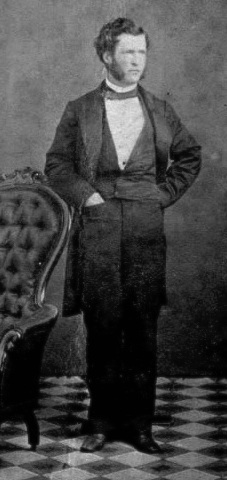
Before Mark Twain was a genial, white-haired, much-beloved raconteur, he was a hard-drinking, hot-tempered, pipe-puffing reporter with "mutton chop" sideburns and no mustache. (left) He lived in Virginia City (famous for being the setting of the TV series Bonanza) and he wrote for the Territorial Enterprise Newspaper. The Comstock, as that region was called, was wild and woolly, full of "thieves, murderers, desperadoes, ladies, children, lawyers, Christians, Indians, Spaniards, gamblers, sharpers, coyotes, poets, preachers, and jackass rabbits." Despite this rich vein of journalistic gold, Sam Clemens – who had not yet adopted the pseudonym Mark Twain – was not afraid of slandering local residents or even of making up hoax stories to fill blank pages of the paper.

His first hoax, early in October of 1862, was an article about a Petrified Man found in the Nevada desert east of Virgina City. Twain describes a prospector with a wooden leg who was found turned to stone at a place called Gravelly Ford. He describes the man's position, and if any of his readers had bothered to adopt the pose – or even mentally visualise it – they would have realised immediately that Twain was joshing them. (He even signed that article "Josh") One of his main aims in writing this hoax piece was to vex an enemy of his, a man named George Sewall with whom he was feuding. And he succeeded. People generally do not expect the printed word to be an outright lie.

A year later, Twain wrote another hoax, a truly grisly piece about a man living in Empire City who supposedly kills and mutilates his family, cuts his own throat from ear to ear, then rides three miles before dropping dead on the steps of a Carson City saloon. Once again, careful readers would have read the clues and figured out that this story wasn't true. After all, how can a man ride three miles with his throat cut from ear to ear? (see map above right)

But readers of the morning paper pushed away their breakfasts in horror upon reading Twain's grisly report of the unhinged father's murder and mutilation of his family.

Territorial Enterprise readers put off their breakfast by Twain's gory article

Territorial Enterprise, October 28, 1863

A BLOODY MASSACRE NEAR CARSON
From Abram Curry, who arrived here yesterday afternoon from Carson, we have learned the following particulars concerning a bloody massacre which was committed in Ormsby county night before last. It seems that during the past six months a man named P. Hopkins, or Philip Hopkins, has been residing with his family in the old log house just at the edge of the great pine forest which lies between Empire City and Dutch Nick's... About ten o'clock on Monday evening Hopkins dashed into Carson on horseback, with his throat cut from ear to ear, and bearing in his hand a reeking scalp from which the warm, smoking blood was still dripping, and fell in a dying condition in front of the Magnolia saloon... [even more graphically bloody details follow, which you can read HERE.]

The Journals of Alfred Doten

I've been reading (and re-reading) the Journals of Alfred Doten as part of researching my Western Mysteries stories set in and around Virginia City in the early 1860s. Like Mark Twain, Alf Doten was a failed prospector turned journalist. Throughout his life he kept meticulous and detailed journals, recounting the weather, cost of things and concrete details of life in the California gold fields and later on the Comstock, in Nevada.

This morning over breakfast I pushed away my own yogurt and strawberries in dismay as I read Doten's sad and distressing entry for 16 July 1863.

July 16 - About 8 oclock this evening a man by the name of Patrick Comerford committed suicide at the Mineral Hill tunnel, some 2 miles below here [Como, Nevada]. He was living near the mouth of tunnel with some half dozen others - he went into the tunnel and with a bowie knife he cut his throat - first ripped it up from upper part of breast bone to his chin & then cut across nearly from ear to ear, severing the jugular, windpipe &c - did the job securely - his partners heard him groan and went in and found him - he died in a few minutes - one of them immediately came up to town &c told the story - several people went down there - Briar went - he acted as Coroner and the jury gave verdict in accordance with the facts - he was an Irishman and about 35 or 40 yrs old - no reason could be assigned for the rash act - he seemed to be all right enough but somewhat troubled in his mind, and at times somewhat abstracted 
Journal of Alfred Doten p 719

As a writer who constantly draws inspiration from things I read and hear about, I am pretty sure that poor Patrick Comerfield's bloody suicide in July 1863 was partly the inspiration for Twain's "Bloody Massacre" hoax, written three months later. The gruesome details of Comerford's suicide must have spread like wildfire even if not reported by local papers.

Thus it is not too surprising that many Comstockers believed Twain's similar but greatly embellished account of a bloody suicide by Bowie knife. In fact, the article caused such horror and outrage that, Twain had to print this retraction the very next day:

Territorial Enterprise, October 29, 1863
I TAKE IT ALL BACK
The story published in the Enterprise reciting the slaughter of a family near Empire was all a fiction. It was understood to be such by all acquainted with the locality in which the alleged affair occurred. In the first place, Empire City and Dutch Nick's are one, and in the next there is no "great pine forest" nearer than the Sierra Nevada mountains, etc. 

[For more retrospection about this hoax read Mark Twain's Sketches New and Old.]

You would think Twain might have learnt his lesson, but no. Six months later, in May of 1864, he wrote a different sort of hoax, this one about the Ladies of Carson City. As a result of this third hoax the hot-blooded young reporter was challenged to a duel by pistol and had to flee Nevada. But that's another story.

[The second book in my Western Mysteries series, out June 2012, was originally going to be called The Case of the Petrified Man, but had to be re-named The Case of the Good-Looking Corpse as the first title was not considered exciting enough for kids. Like many writers of the past, I am still getting inspiration from events of the bloody Comstock as recorded by Sam Clemens, Alf Doten and many others.]

Sunday, October 16, 2011

Etruscan Book of Thunder


Menrva (Etruscan Minerva) with thunder
Back in the 1970's, undergraduate Jean MacIntosh Turfa first discovered an unusual Etruscan Book of Omens when a fire alarm drove her out of her usual library at Bryn Mawr College. Or so she told us at the Eva Lorant Memorial lecture at the British Museum on Friday 14 October, 2011.

Exiled from her usual library, and not one to waste valuable research time, Turfa went to Bryn Mawr's Classics library instead. It was there that she found an article which led her to the Etruscan Brontoscopic Calendar, an almanac telling what the rumble of thunder signifies on any given day of the year.

Brontoscopic?!?

Brontos means "thunder" in Ancient Greek. (Any 8-year-old boy will tell you brontosaurus means "thunder lizard")
Scopic means "seeing" and by association "prediction", so...
Brontoscopic means PREDICTION BY THUNDER.

Yes, thunder was considered a means of prophecy in ancient times.

Etruscan civilisation flourished c. 850 BC-AD 50
The Etruscans were the slightly mysterious people already living in Italy before Aeneas and his band settled on the banks of the Tiber. Their language was like no other language ever known anywhere. They had no alphabet until the Greeks came around 750 BC and then they borrowed that one. The territory of the Etruscans was Etruria, modern Tuscany, the region south of the Arno and north of the Tiber. (see map) Some of their famous towns are Tarquinia, Cerveteri and Veii (just 12 miles north of Rome). This region was rich in copper and tin and it made the Etruscans prosperous.

The Etruscans believed the gods spoke through natural phenomena, like lightning or deformed animals. Some of their wisest members learned how to interpret omens. (An omen is any event regarded as a portent for good or evil. The word omen is Latin for "sign".)

In ancient Rome, if you wanted to know what the future held in store for you, your first stop would probably be an Etruscan soothsayer. There were two types of soothsayers.


Etruscan model of a liver for divination
The Haruspex looked at entrails of a sacrificed animal, especially the liver. The Etruscans gave us that famous bronze model of a liver known as the "Piacenza Liver". (right)

The Augur looked abnormal phenomena in the celestial sphere. Not just the flights of birds, but also clouds, rainbows, eclipses... and thunder. Hence the Etruscan Brontoscopic Calendar. 

WHEN WAS IT WRITTEN?

Yes, they had cosmic rays back then
The fifty years between 850 and 800 BC experienced an unusal bombardment of COSMIC RAYS. There is actually a name for this phenomenon: The Halstatt Minimum. Although it sounds like the title of an episode of The Big Bang Theory, it refers to lively solar flare activity which can skew results of carbon dating and also cause storms with thunder and lightning. This might have been when the Brontoscopic Calendar was first composed. The Etruscans had no written language as yet, but it could have been passed from one soothsayer to another verbally.

WHO WROTE IT?


Etruscan adult and child (Louvre)
The original author might have been a mysterious godlike child. Tages, AKA the Puer Senex ("old man boy") was a strange grey-haired child of great wisdom and bad teeth who sprang up from a ploughed furrow. Cicero sarcastically called him the "Dug Up Boy". The actual bones of Tages might have been found in a special tomb in Tarquinia (Etruscan territory). If this is indeed the skeleton of the Puer Senex, they show he had a brain tumour that might have given him visions and hallucinations. Was he the author? As writing hadn't yet reached the Etruscans in 850 BC, perhaps he gave the oral version.

Then, after the Etruscans adopted the Greek alphabet a century later, it might have been written down on papyrus, cloth or metal. In the first century BC it was translated from Etruscan into Latin by a contemporary of Julius Caesar named Publius Nigidius Figulus. Six hundred years after that, Figulus's Latin version was translated into Byzantine Greek by a scholar named John the Lydian at the court of Justinian. And that is how it has come down to us.

WHAT DOES IT SAY?

The Etruscan Brontoscopic Calendar is a kind of almanac. It assumes that for every day of the year in Etruria, thunder has a different meaning. All the entries begin with the same phrase ει βροντηση - "If it thunders..." The formula goes: If it thunders, then such and such will happen. For example:

June 1 - If it thunders, then there will be a destruction of crops except barley...

In her lecture, Dr. Turfa said boring agricultural entries like the one above show that Etruscan Brontoscopic Calendar is almost certainly genuine. If it was a Roman or Byzantine forgery, then Figulus or John the Lydian would have spiced it up a bit. However, the almanac is mostly concerned with crops and animals, i.e. FOOD. (Those of us in the affluent 21st century forget just how hard it was to keep food on the table in ancient times.) There are also a lot of mentions of threatening wars and assassination of leaders.

The Thunder Omen
Here are some of my favourite predictions from the Etruscan Brontoscopic Calendar, ones which might appear in The Roman Mysteries Scrolls my series about a funny soothsayer named Floridius and his apprentice, an ex-beggar-boy Threptus.

June 15 - If it thunders, feathered creatures shall be injured during the summer and fishes shall perish. 
June 28 - If it thunders, there will be drought and a plague of poisonous reptiles. 
August 5 - If it thunders, it means women will be wiser than men. 
August 19 - If it thunders, women and slaves will dare to commit murder. 
October 7 - If it thunders, there will be fewer beans but more wine.
October 23 - If it thunders, the people will be of marvellously good cheer. 
December 15 - If it thunders, many will set out for war, but few will return. 
December 29 - If it thunders, there will be a healthy leanness of bodies. 
January 22 - If it thunders, there will be plenty but also an abundance of mice and deer.

Dr. Turfa's lecture touched on many other fascinating topics such as Caesar's revision of the calendar, an eruption of Vesuvius c. 1780 BC and the earliest chicken wing to be found in Europe (in a hut near Castelgandolfo). Many of her erudite nuggets will no doubt appear in her forthcoming book, Divining the Etruscan World: The Brontoscopic Calendar and Religious Practice. But you can see the thunder omens for each day in an appendix of The Religion of the Etruscans (right) and also HERE.

[The first of the Roman Mysteries Scrolls series for kids 7+ is The Sewer Demon. Other titles include The Poisoned Honey Cake and The Thunder Omen. The 17+ books in the existing Roman Mysteries series are perfect for children aged 9+, especially those studying Romans as a topic in Key Stage 2. The Roman Mysteries are available on DVD and also Amazon Prime.]

Thursday, September 22, 2011

ABC of the Western Mysteries

A basic GLOSSARY for British children reading the Western Mysteries who might not know what a Desperado or a Stagecoach is... or where Nevada and Utah are.

America in 1862

A is for America - the country across the Atlantic Ocean where people speak English with funny accents. It is also known as the United States, but in 1862, the states only went halfway across America with a few on the west coast. A great chunk of land in the west was called "Territory". Towns in the Territories were often lawless and wild.

Is P.K. a Desperado?
B is for Ball & Blackpowder - this is what old-fashioned bullets were made of. You also needed lint and a tiny little metal cap that you put on the back of each hole in the cylinder of your Revolver to make a spark which set off the powder and get the ball flying towards its target. Later on they put the cap and ball and powder in one metal case called a cartridge. This is what we now call a Bullet.
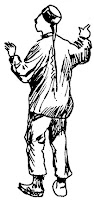
A Chinese Youth
C is for Chinese (not Cowboys) - in the early 1860s, when The Western Mysteries are set, there were far more Chinese out west than Cowboys. Cattle drives did not begin in earnest until 1866.

D is for Desperado - a desperate person who is usually on the run after committing murder, robbery or other serious crime.

E is for Emigrants - most of the people who flooded to America in the 1800s were emigrants from Euorpean countries like England, Scotland, Ireland, Germany, France, Russia, etc. And, of course, the thousands from China.

F is for Frontier - the place in the American West where settled land gave way to wilderness populated by wild animals and Native American tribes.

A Gunslinger
G is for Gunslingers - almost everybody carried a firearm in the 1860s out west, even women & kids.

H is for Horses - The West in the early 1860s was a world mostly driven and powered by animals with hooves: horses, mules & oxen.

An Indian Tomahawk
I is for Indians or Native Americans - the tribes of people already living in North America when the emigrants arrived were as varied as the people from European countries, sometimes more so.

J is for Jackrabbit, also coyote, grizzly bear, prairie dog, buffalo and all the other unique wildlife found in the West.

A Kerosene Lamp
K is for kerosene or coal-oil, which is what folk used to light their lamps. They used candles, too. In 1862 gas had not quite reached Virginia City.

L is for Lincoln - who was president between 1861 and 1865 when America was fighting a terrible Civil War over slavery and freedom.

26-year-old Mark Twain
M is for Mark Twain - his real name was Sam Clemens and he was one of America's greatest authors and humorists. He joined the Civil War for about two weeks then headed west to Nevada Territory with his brother Orion, who had been appointed secretary to the governor. After trying his hand at prospecting, Mark Twain became a reporter in Virginia City where he remained for two and a half years. Many years later he wrote Tom Sawyer & Huckleberry Finn, among others.

N is for Nevada - then a "Territory" and now the triangular state to the right of California, (see maps). It is full of deserts, mountains and minerals.

O is for Ore - rock and/or dirt containing precious metals or minerals. The Gold Rush in 1849 brought a huge wave of people to California, then ten years later the Silver Boom brought thousands Nevada, to the Comstock Lode beneath Mount Davidson.

P is for Pinkerton - the first detective agency in the world. The founder, a Scotsman named Allan Pinkerton, coined the phrase "Private Eye". Their head office was in Chicago, Illinois (one of the high-up states in the middle).

A Quartz Stamp Mill
Q is for quartz stamp mill - a machine with heavy iron pistons that crushed quartz so that silver and gold could be extracted.

R is for religious revival - America was going through a great Christian revival in the 1860s and almost everybody was deeply devout.

S is for stagecoach - a large, closed carriage pulled by four to six horses; it was used to carry passengers, goods and mail on a regular route. Sometimes you could ride on top.

T is for tobacco - like religion, almost everybody had tobacco. They either smoked it, sniffed it or chewed it. Those who chewed usually spit their tobacco-tinted saliva into vessels called spittoons. Ew.

A Stagecoach

U is for Utah - now the state to the right of Nevada on a map, then it was a "Territory", a part of America which did not yet have the full rights of the other states.

Nevada Territory 1862
V is for Virginia City - the mile-high city on a steep mountain above a buried "ledge" of silver called the Comstock Lode.

W is for Washoe - the region around Virginia City, named after a lake to the west (see map) and also a tribe of Indians who lived there.

X is for "X marks the Spot" - Prospectors were people who prospected or "looked out for" areas where gold or silver could be found. Then they "staked their claim" i.e. announced it as theirs. They guarded their claims with bowie knives, revolvers, rifles... and their lives.

Y is for Yankee or Yank - slang for somebody from the northern states or on the Union side of the Civil War. A person on the other (Confederate) side was often called a Reb or Rebel.

Washoe Zephyr
Z is for Zephyr - by definition a warm and gentle breeze. In Virginia City, a Washoe Zephyr was what people jokingly called the gale force wind that sometimes swept over the mountains and threatened to uproot trees and houses.

If you would like to read a book with all these words and a heck of a lot of adventure, get The Case of the Deadly Desperados by Caroline Lawrence. It is available in hardback, Kindle and unabridged audiobook format. Suitable for children aged 9+. Perfect for American history at Key Stages 2 & 3.

Thanks to Richard Russell Lawrence, who did the maps & drawings, all based on primary sources...