Showing posts with label 1860s. Show all posts

Saturday, May 07, 2011

Old Carson City


Caroline at the B St B&B
Carolyn Eichin of the B Street B&B is an extraordinary woman. Not only is she a superb cook, preparing the best breakfasts Richard and I have ever eaten, but she's an expert on Nevada history. She and her charming husband Chris told us about a lecture at the Nevada Textiles Archive in Carson City on the morning of Wednesday 3 May. After our exhausting adventure at Bodie it's nice to drive a couple of miles and hear about women's bonnets and men's top hats. I'm not allowed to post any pictures but I get some good ideas for hats to plonk on my characters' heads.

Nevada State Museum
After the lecture we're shown the archives and delight in other period pieces of clothing. Then it's off to the Nevada State Museum, a modern black glass building next to the Carson City Mint. It's a great exhibition with lots of the types of artefacts I love. Some sarsaparilla bottles, a stereoscopic viewer with an 1860s photo of Devil's Gate (on the road to Virginia City) and lots of buttons. I'm especially excited about the hundreds of buttons because in the second Western Mystery we discover that P.K. Pinkerton, my hero, is obsessed with collecting things. Like bugs, bullets and buttons. There is also a Smith & Wesson 7-shooter, P.K.'s gun. (see bottom of this blog for pix)

Orion Clemens house in Carson City
After the museum we take the walking tour of Old Carson City. Chris mentioned it as something worthwhile and is it ever! Especially on a beautiful spring day like today. They give us a map at the museum, but even if you didn't have the walking map you can follow the handy blue line painted onto the sidewalk. I especially wanted to see the house Orion Clemens lived in. He was Mark Twain's older brother, and secretary to Governor Nye in the early 1860s.

horsehead hitching post 
We also see the house from John Wayne's final film, The Shootist, along with houses belonging to characters who might appear in future Western Mysteries. After the challenge of high-altitude Bodie it is a joy to stroll through the leafy Victorian neighborhood of Old Carson City.

Back to Virginia City in time for tea at the B Street B&B. Carolyn gives me an 1974 dissertation on Police, Water and Fire Departments in early Virginia City so I can get to grips with the structure of the town in the early 1860s. There aren't many places in the world where you can eat homemade tropical fruit macaroons and peruse a scholarly article both provided by the same talented lady. The B Street B&B is simply superb.


P.K. is partial to sarsaparilla
Badges weren't known in Virginia City until 1874
P.K. is obsessed with collecting things... like buttons
Stereoscopic viewer with picture of Devil's Gate
A Smith & Wesson 7-shooter just like P.K.'s


Saturday, January 09, 2010

Mystery of Topless Twain


by Caroline Lawrence, author of the Western Mysteries

I was reading Paul Fatout's Mark Twain in Virginia City the other day and came across this interesting observation: 'Among the many pictures of Mark Twain, not one is smiling...'

I looked through my own archives and found that indeed, there seem to be no pictures of Mark Twain smiling. How surprising for America's foremost humorist, dry humorist notwithstanding...

One explanation might be that Twain's bushy mustache - adopted in around 1864 - hid any upturning of the corners of the mouth.

Another explanation might be that like certain actors of the 60's - the 1960's, that is: not the 1860's - he had bad teeth and was loath to expose them. My dad once told me that is why the French actor Jean-Louis Trintignant rarely smiled.

scar on his upper lip?
Or do I detect a scar on the right upper lip in this photo of him still in his teens? Where did he get the scar? Was it an embarrassing reminder of something?

Another explanation might be that Victorian subjects did not often smile for photos.

However, neither did they take off their shirts to reveal manly, hairy chests.

When I tweeted for help, asking if there really were no pictures of him smiling, @TwainHouse came up with the startling image at the top of this post. (I have used my usual photoshop filter to make it look more striking. You can see the original, undoctored image HERE.)

Now I know that American photographers of the 1860s - 1890s often photographed corpses and bawdy girls, but never have I seen a topless literary lion like Mark Twain.

Why, oh why?
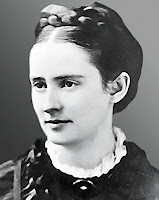
Olivia "Livy" Clemens
Had he just emerged from a hot mine? Or a hot bath?

Was this a medical picture for the benefit of his doctor?

Was it a romantic Valentine's Day photo for his wife, Livy?

Was it because he lost a bet? Or won a bet?

Maybe he was just proud to be in such good shape at the age of 48 or 49.

One clue might be the date of the photo.

@mtpo, the Mark Twain Project at the Bancroft Library in Berkeley, say the photo was taken in 1884 by Towlueson in Hartford, Connecticut. What was Mark Twain doing in 1884? According to the excellent TIMELINE at Mark Twain House, he was on a lecture tour. Huckleberry Finn was to be published in the last month of that year. Could it be that Mark Twain decided to take his own raft trip down the Mississippi?

Perhaps someone from The Mark Twain Project or the Mark Twain House will enlighten me.

In the meantime, I can't help recalling one of Mark Twain's funniest quips: 'Clothes make the man. Naked people have little or no influence on society.'

[The Case of the Deadly Desperados features the 26-year-old reporter Sam Clemens who will soon  take the nom de plume Mark Twain. This Western Mystery for kids aged 9 - 90 is available in hardback, Kindle and audio download. It will be published by G.P. Putnam's Sons in the USA in February.]

Monday, December 14, 2009

Stagecoach #2

In the 1860's there were at least half a dozen stage coaches in and out of Virginia City every day.

In a book called Resources of the Pacific Slope, J. Ross Browne gives details of the routes of a dozen stages in the 1860's. For example, Route #1 went to Sacramento California via the Donner Pass and North Lake Tahoe. It cost $20 to Sacramento but $25 back because that was the most popular direction of travel in the 60's. Another stage went down to Dayton and from there to Como across the Carson Valley. Some stagecoaches went up to an area called Humboldt and from there to Salt Lake City and the east.

As our time in Virginia City is now over, we decide to follow Stagecoach Route #2 to California. J. Ross Brown tells us exactly which towns it passed through: Gold Hill, Silver City, Empire, Carson City, Genoa, Van Sickles Station, then up the Kingsway Grade to Dagget Pass at the summit and down into California via Strawberry, Placerville and Shingle Springs, all the way to Sacramento.


It's a beautiful September morning as we get in our convertible 'stagecoach' and set out from Virginia City to follow this route. We leave at 10.00am, and five minutes later we go over the hump called 'The Divide' which marks the boundary between Virginia City and Gold Hill. The Civil War re-enactors staged a mock battle here in a quarry beside the train tracks. Of course the Civil War never got this far west, and the V&T train wasn't here in 1862, when my first book will be set. However, the Gold Hill Hotel was. It's the oldest hotel in Nevada. Sam Clemens, Dan De Quille and Alf Doten all ate there.

Down the hot, winding road through a pair of dramatic rocks (above) called Devil's Gate. This was a popular place for bandits to lie in wait to rob the stage. An old illustration exaggerates the size of the rocks by putting tiny people between them. Exaggeration was rife in the 1860's... We breathe a sigh of relief as we pass through Devil's Gate into Silver City without incident.

As we pass an abandoned mine just out of Silver City we wave to our friend 'Irish'. He runs the Comstock Gold Mine and Stamp Mill and we met him when he demonstrated how the ore stamps worked and sounded. He is a colourful character who first came to Virginia City as a 16 year old in 1958. LIke many others, the popular TV show Bonanza was what brought this region to his attention. He went back to California to be a roadie for The Grateful Dead and Willie Nelson, but now he has ended up back here in a fabulous 'boys' fort' type of dwelling on the golden, sage-dotted hills.

After Silver City, the road flattens out into the wide flat Carson River Valley. We join Highway 50 here. If we were to go left we would reach Dayton, which might be Nevada's oldest town. My great-grandmother Corinne Prince grew up there. Her father was a teamster, one of those men who drove eight to twelve-mule carriages with loads of ore going out and timber coming back. Corinne probably went to school in the Dayton School house, which was built in 1863 and is now a museum.

But our 'stagecoach' doesn't go left to Dayton. It goes right, west, to Empire. We can't really see any signs of old Empire; New Empire is a suburb of Carson City. But in Carson City we see the old mint, where my great-grandmother worked for a while, and the governor's mansion. Stages might have changed teams here in Carson, as it's about 20 miles from Virginia City.

A road west takes you towards the Sierra Nevada mountains, which are barren and rounded and steep on this side. Then the flat road curves south to Genoa. Originally known as Mormon Station, Genoa is a pleasant surprise. It's green and shady with excellent information about the pioneers and local characters like Snowshoe Joe, who was a mail carrier. Genoa and Dayton have a little rivalry going on as to which of them is the oldest town. Let's just say they are both old, founded in 1851. Richard and I stop for an espresso on the rocks at the delightful Genoa Coffee & Candy Company. We go to see the famous hanging tree before setting out south with a 'fresh team of horses.'

There are hot springs south of Genoa and today David Walley's Hot Springs is a popular place to get married. Half a mile south, on the right of the road, is Van Sickles Station Ranch, now a private residence. Van Sickles was a commissioner and in the early 60's his hotel was the first port of call once you crossed the mountains. With hot water and good food, it must have been a joy for the weary traveller. In winter you could sledge down the eastern Sierras. Van Sickles was famous for shooting a desperado called Sam Brown who had killed half a dozen men. After Sam fired on Van Sickles, the hotel owner went after him with a shotbun. He was later tried and a jury passed a verdict of 'self-defense'.

The eastern side of the Sierra Nevada mountains come straight down and stop dramatically at the flat plain of the Carson Valley. One minute you're on the flat, the next you're climbing the Kingsbury Grade. This wagon road was built by two men named Kingsbury and MacDonald in 1860, it shortened the distance between Virginia City and Sacramento by 15 miles. The road cost $585,000 to build and the builders charged a toll to pay for the road. A wagon and four horses had to pay $17.50 for a round trip from Shingle Springs to Van Sickles Station. The Pony Express used this road, too, for the short period of its existence between 1860 and 1861.

The four-horse team strains as it pulls our stagecoach and up over sparsely wooded eastern slopes with dizzy views down to the flat Carson Valley. Once over Dagget Pass, tall pines and smooth grey granite boulders take over. The summit is over 7400 feet, then down to Lake Tahoe, blue and peaceful in the warm September sun. When we were in Virginia City, we took a ten minute stagecoach ride with Gary. What you don't realise until you try riding as a passenger in one is how claustrophobic it can be. You can't see what's coming and the scenery whizzes by. If you were sitting facing backwards it might have been quite disconcerting. Not good for people who are easily travel-sick. The idea of taking a bone-rattling stagecoach all this way is almost inconceivable. Especially knowing that they sometimes travelled at night around the precipitous bends. Eeek!


After the pass, Richard and I stop at South Lake Tahoe for lunch. In the 1860's people were often malnourished because fresh fruit and veg were almost impossible to find apart from the autumn. We know from J. Ross Browne and others that staple foods were corn-meal, lard, bacon, eggs, potatoes, cabbage, cheese, sugar and coffee, When Sam Clemens arrived in Virginia City in 1862, a man called Rollin M. Daggett remarked that he 'had been living on alkali water and whang leather...' This is an exaggeration, of course, but gives you an idea of the monotony of food back then.

Strawberry was one of the most famous stopping places on the western Sierra Nevada Mountains. There were no strawberries there, but according to some reports, a man called Berry owned the inn and he had straw for the horses. Another article by J. Ross Browne, first published in Harper's Monthly Magazine, December 1860 documents the first wave of prospectors coming over the Sierra Nevadas to mine gold and silver on the Comstock. Some of his most hilarious anecdotes take place at Strawberry.

The illustration above right shows 'Dinner at Strawberry', an illustration from 'A Peep at Washoe'. A light at length glimmered through the pines, first faint and flickering, then a full blaze, then half a dozen brilliant lights, which proved to be camp fires under the tree, and soon we stood in front of a large and substantial log-house. This was the famous Strawberry', known throughout the length and breadth of the land as the best stopping-place on the route to Washoe...

Soon the road shows glimpses of the American River on the left. Further down in Coloma gold was discovered for the first time in 1848 with the cry: 'Gold. Gold in the American River!' The road down the western Sierra Nevadas is a much gentler grade. It takes us into the hot valley and Placerville, which was once known as Hangtown. Placerville was named after 'placer' mining, the method where you pan for gold in an open stream or creek. Placerville's Main Street still has buildings dating back to the 1850's and you can see Stage Coach Alley. You can also get a hot dog at Hangville Hot Dogs. This was another staging place for horses. After Placerville it is on to Shingle Springs.

We tried to find the old train station at Shingle Springs but only founded traces of the old track in a cutting of earth red with iron. The train arrived here in 1865, but until then you would carry on in your stagecoach to Sacramento, another 30 miles on. At last you could emerge and take a different method of transport: boats plied daily from here to San Francisco. I'll bet plenty of travellers vowed never to sit in a stage coach again!

TIPS FOR STAGECOACH TRAVELERS

The best seat inside a stage is the one next to the driver. Even if you have a tendency to sea-sickness when riding backwards - you'll get over it and will get less jolts and jostling. Don't let "sly elph" trade you his mid-seat>

In cold weather, don't ride with tight-fitting boots, shoes or gloves. When the driver asks you to get off and walk, do so without grumbling, he won't request it unless absolutely necessary. If the team runs away - sit still and take your chances. If you jump, nine out of ten times you will get hurt.


In very cold weather abstain entirely from liquor when on the road, because you will freeze twice as quickly when under its influence.

Don't growl at the food received at the station - stage companies generally provide the best they can get.

Don't keep the stage waiting. Don't smoke a strong pipe inside the coach. Spit on the leeward side... Don't lean or lop over neighbours when sleeping. Take small change to pay expenses. Never shoot on the road as the noise might frighten the horses. Don't discuss politics or religion.

Don't point out where murders have been committed, especially if there are women passengers.

Don't lag at the wash basin. Don't grease your hair, because travel is dusty. Don't imagine for a moment that you are going on a picnic. Expect annoyances, discomfort and some hardships. (Omaha Herald 1877)


P.S. Listen to a fun audio account of a young Englishman's stage journey across America in 1859 on the Wells Fargo History site.