Showing posts with label Hector. Show all posts

Wednesday, June 20, 2018

The Sherlock Holmes of Roman Kent

Hector the dog, an archaeologist's best friend
by Caroline Lawrence

‘There’s a bit of ragstone,’ says Simon Elliott for perhaps the fifth time that morning. It is Tuesday 19 June, 2018. He and his wife Sara are taking me on a tour of Roman features near their home in East Farleigh near Maidstone on the River Medway in Kent. 

I first met Simon at the Guildhall Library in London when I attended one of his lectures on Roman London, (the setting of my own fictional work in progress.) A tall man with a big voice, vast knowledge and accessible nature, he would make a great tour guide. 


Blocks from a Roman villa?
After picking me up from the train station Simon and Sara drive me across the Medway to the ancient parish church of East Farleigh. Simon points out nicely incised blocks that make up the gate to the churchyard. ‘Those probably come from one of the Roman villas nearby,’ he says. 

‘The incisions in the stone help the plaster stick,’ adds Sara, his wife and (today) our driver. 

‘And these blocks of ragstone on top of the churchyard wall show water-wear. I think they might have been part of a Roman lock and weir system.’


A beam-slot visible above tufa block
He takes me to the church itself and points out things on the outer wall. Mainly built of small regular blocks of ragstone, Simon shows me some odd-shaped stones probably from the Roman Villa at East Farleigh. These include a long block of tufa (not tuff volcanic rock, but a type of limestone favoured by Roman in bathhouses because it is light and porous) and also a block with a visible beam-slot. 

As we leave the church he points to a big shrub. ‘There’s a bit of ragstone,’ he says happily. I never would have noticed. 


Simon promoting his book on Severus
Simon Elliott came to archaeology late in life. A management consultant, he always loved history and his first passion was Alexander the Great. But living in East Farleigh he was sucked down the ‘rabbit hole of the Roman occupation in Britain’ when he learned it was the site of at least five quarries supplying stone to Roman London. Realising that nobody had done much to consolidate theories about who owned and ran these quarries, and how they worked, Simon went back to university as a mature student. 

In 2011 he got an MA from University College London and now, in 2018, he is about to publish Ragstone to Riches, a popularised version of his PhD thesis on the Roman quarries of Kentish ragstone. An amateur in the best sense of the word – he loves what he does – he is opening up a whole new aspect on the world of Roman Kent. 


slide from one of Simon Elliott's lectures
In the past ten years Simon has made several possible discoveries in and around East Farleigh: a possible canal from a giant quarry to the Medway, two Roman roads, a Roman cemetery and a Roman milestone. A few years ago he also discovered the so-called Medway stones (four big chunks of ragstone recovered from a possible wreck) and has a theory that Romans installed locks and weirs to make the Medway deep enough for boats to carry stone on a two-day trip to London. Another of his theories posits the playing-card shape of a field near him as a marching fortress turned headquarters for the quarrying industry. 

He has even come up with a new theory about the site of the Battle of Medway, Aulus Plautius’ important victory against the Britons in AD 43. 

This ‘amateur’ is now beginning to make a living from Roman archaeology. In the past few years he has published four acclaimed non-fiction books, got himself a gig as a tour guide with posh Andante Tours and is now making TV documentaries.


Simon and Caroline by the walled garden of Timbers
Our next stop after the Norman church is ‘Timbers’, a house with beautiful gardens that include part of a massive quarry, the so-called Dean Street Quarry. Known to older locals as ‘The Roman Quarry’ Simon’s theory is that this was one of the main sources of the stone from which London was built. By previous agreement with the owner we are allowed access. 

Simon takes me through a beautifully landscaped back yard. It includes a Roman-style walled garden with geometric beds, a rectangular pond and even a giant amphora. We pass ancient cherry and black walnut trees. 


panoramic view of the Dean Street Quarry looking east

‘I’m about to take you into the hole where most of the stone from Roman London comes from. This is a big reveal,’ Simon promises. ‘If you want to film anything, film this.’ 
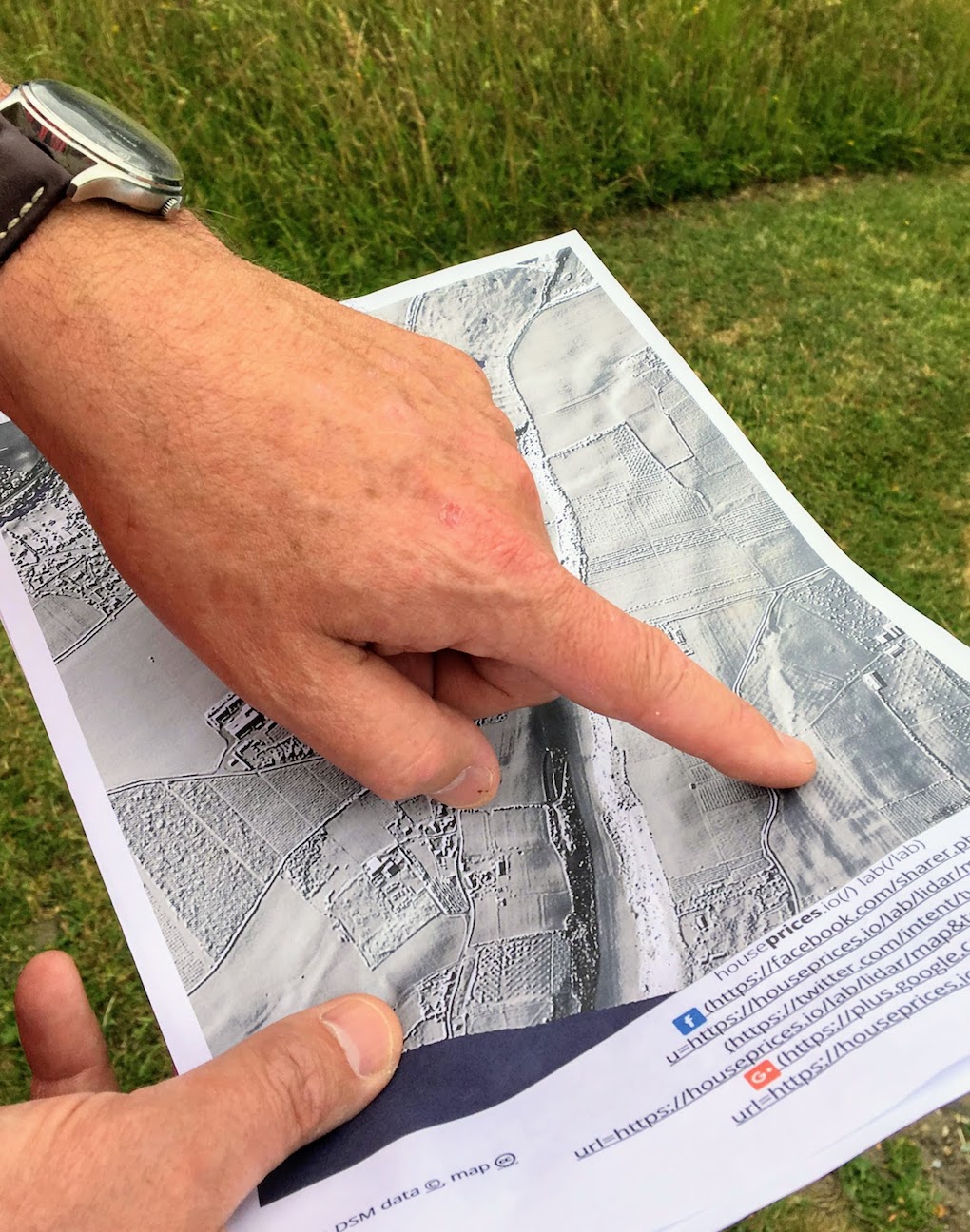

LIDAR shows quarry as a long channel
He’s right. We step through a gate (and across a threshold of anti-badger wire) and onto the top of a steep grassy slope that plunges down into a narrow mini-valley stretching north and south. This lush valley was once the quarry used by the Romans on a monumental scale. 

Sara, working late the night before, waits in the car and Simon takes me down the steep hillside to where a groundsman is using a tractor mower to cut the grass. This part of the back garden is beautifully landscaped but the opposite side of the quarry, where it slopes up again, is thickly wooded. Sunshine barely makes it through here. 


Clambering up part of the wooded incline, Simon shows me how the slopes would have been terraced. 

‘There’s a bit of ragstone,’ he says. ‘You can see it is obviously quarried and ready to be moved. I always say this quarry was the ancient version of IKEA, with flat pack stones ready to be transported.’

This is the sort of exploration I could never do unless I had access to a kind expert with a car, someone who knows the area. 

One of the reasons Simon knows the area so well is because he takes his dog Hector on long walks and is often discovering things. 

‘You have a great back yard,’ I comment as we puff up the hill back to the gardens of ‘Timbers’. 

‘It’s a big back yard,’ he replies. ‘The problem with being an archaeologist is that you’re always looking down.’ 

At one point, while looking down, he finds a piece of (possibly Roman) iron slag in a wheat field and is as excited as a child with a new toy. ‘Look what I found!’ he tells his wife Sara. ‘Iron slag!’ 

‘Yes, dear,’ she says indulgently, and shoots me a twinkly look. 

Horseshoe shaped bend in the River Medway
Later, over lunch, they tell me they got married at London Zoo, where they had their first date. They have two children at University. Alexander is doing War Studies and Elizabeth, studying chemistry, has done some of the illustrations for Simon’s books. 

We have an excellent meal of hamburgers and steak sandwiches at the Horseshoe Pub, possibly named after the horseshoe-shaped bend taken by the river Medway, visible on Simon’s Quarry Tour map. Simon’s theory is that the commander Plautius crossed at the southern end of the horseshoe, above the tidal flow and therefore on drier ground. 

After lunch Simon takes me to see traces of a road that might have connected the quarry to an opulent Roman villa, one of four or five in the immediate area. We walk past apple and pear orchards, as well as ancient cherry trees. Apart from Simon’s fascinating commentary I hear only the sound of birdsong and the crunch of our feet. 


Possible wheel rut in foreground
‘There!’ he says. ‘See the stones? That’s a Roman Road.’ 

‘Is this Watling Street?’

‘No. This is my Roman Road.’

‘What, you discovered it?

‘Yes, I did. While walking my dog Hector. Look! You can even see the wheel rut in that stone.’ 

He’s right. I see a rut just like the wheel ruts in the big hexagonal paving stones of Pompeii. ‘Has anyone ever noticed this road before?’ I ask.

‘Very few of the locals knew this was here,’ says Simon. ‘Not even the farmer.’ 

‘What did he say when you told him?’


Roman milestone? Or tombstone?
‘He was blown away. He also owns the land with the milestone.’

‘And did you find the milestone as well?’ 

‘Yes. Hector chased rabbit into the windbreak. When I followed him in, I tripped on the neck of a Roman amphora, one of several that held cremated remains. My milestone might be a tombstone,’ he adds. ‘We won’t know until we excavate it.’ 

The best time to explore is late October, when the vegetation has died down, but I ask to see the milestone/tombstone now, so Simon gamely leads the way along a springy vegetal path of brambles and burrs between a field and the windbreak. Happily, he finds the stone. 


Roman ash heap with critter holes & cherry
Following a path through another windbreak, this one marking the northern Roman road, Simon points out circular patches where nothing grows. ‘Those mark ash heaps, he says, ‘the sites of charcoal burning, iron manufacture, or both.’ By one of these barren circles I see another old cherry and am reminded that this is a tree brought to Britain by the Romans. 

Sometimes I confess I can’t see what Simon points out. Is he only seeing what he wants to see? Or is it really there? His theories will soon be proven or disproven by excavation at close range and LIDAR (3-D laser scanning) from a great height. Plus he told me that he has a lengthy list of sites to investigate as he continues his career as an historian and archaeologist, including a possible Roman villa near a local church. 


I suspect his theories will be proved correct. Sherlock Holmes famously tells Doctor Watson, ‘You see but you do not observe.’ I am like Doctor Watson; I see, but don’t notice. Simon Elliott notices everything.

Simon Elliott’s new book about Septimius Severus in Scotland is out now. Caroline is working on a novel for children set in 3rd century Roman London.


Sunday, November 03, 2013

Andromache's Plea

On Saturday 2 November 2013, Heffers bookshop sponsored the Second Classics Fact, Fiction and Children's Literary Festival, featuring luminaries like Mary Beard, Simon Scarrow and Lindsey Davis. One of the events was a balloon debate. Five of us were asked to plead the case of a character from Classical mythology and all but one of us would be chucked out of the balloon. I spent several hours crafting a moving plea for my chosen heroine, Andromache. I even brought a black scarf to throw over my head à la Leighton's moving painting.

Andromache in exile by Frederick Lord Leighton

I am Andromache. My name means Battle of Men
Though perhaps it should be battle of brothers
I had seven of them: a quiver full.
I had to be strong, growing up with that lot.
I heard them plan hunting trips as I sat at my loom
And my shuttle became a hunting spear 
in the thickets of warp and weft.

I heard them plan raiding expeditions as I sat at my spindle
And my winding skein was a file of men on a mountain path.

I saw them slaughtered by Achilles in one afternoon
Along with my father
While my hands were red up to the elbows
In a simmering cauldron of dying beetles 
with its floating strands of yarn. 

My life unraveled; the woe unwove me.
And when Artemis slew my mother
Nothing was left but an empty loom
A bare frame of my life… A taut spare web of grief.

Then you came, Hector. 
You became not just my husband,
But my father, my mother, my brothers.
You let me weave my unraveling weft 
into your strong warp.
And we became a new tapestry together. 
You took me away a place of happy memories
Made hateful by the son of Peleus
And you brought me to high-towered Troy.

We had a son, a little lord of the citadel.
I called him Astyanax, you called him Scamandrius
After the river where we once picnicked
A buzzing, honey-scented afternoon, among the asphodel.

My brothers taught me about the hunt
But you taught me about war.
You, and your house of strong women:
Hecuba, the matriarch
Cassandra, never afraid to speak her mind
Helen, the sister-in-law from Hades
Sparta, rather… Same thing.
And at the end Polyxena, who boldly went to her sacrifice.

The last time I saw you Hector, the time
you frightened our son with you horsehair plume
I begged you not to seek the thick of battle 
making me a widow and our son an orphan
But to guard the part of the wall by the wild fig tree
Where three attempts had previously been made
By the crafty Greeks. But did you listen to my strategy? 
No. You went out
And got yourself killed by Achilles.

Not long after that, they took our little boy up
the last remaining tower to throw him off.
But before they could lay hands on him,
he stepped into air of his own volition.
Lord of the citadel to the very end.
More courageous than a thousand Greeks.

And now the son of the man who killed my husband
My father and my seven brothers
Has taken me as his prize.
The psychopath son of Achilles, Neoptolemus: 
Red-haired, hot-headed, cold-blooded Pyrrhus. 

Hector foretold my future: 
To ply the loom for another woman
And carry a heavy water jug to and from the fountain.
Jostled by laughing children and happy families.
To remain childless 
or worse yet, bear children 
to a man whose house murdered my house.

I am a “paragon of misery”. 
I do not fear death. I pray for it.
Like my brave little boy, 
I would throw myself from the ramparts of Troy
Or even from your balloon. 
That would be true bravery.
But if you judge me worthy, 
I will do something even braver: 
I will live. 


props did not help me!
How did I do? Well, Prof Paul Cartledge cannily chose the Odysseus' faithful dog, Argos. How many British would vote to save a poor pooch being tossed from the balloon? A goodly number. Ruth Downie chose Dido and won the vote of all women who've ever been lied to and abandoned by a cad like Aeneas. (Quite a few, as it turned out.) Rugby-loving, football-referencing Harry Sidebottom plumped for Hector: thick but noble, (and doomed). He got a robust number of masculine votes. But the deserved winner was witty, Diet-Coke-fuelled Natalie Haynes, who moonlights as a stand up comic and Booker Prize Judge. She made a moving and impassioned plea for Odysseus.

As for me, Andromache, I got tossed out first.