Showing posts with label MOLA. Show all posts

Tuesday, August 07, 2018

Crazy Dead Romans!

If you go down to Canary Wharf today you’re in for a big surprise. At the Museum of London Docklands there is an exhibition called Roman Dead. In a dimly lit room, you will find over a dozen real (!) skeletons along with ashes of the dead. You will also see tombstones, inscriptions, funeral urns along with hundreds of grave goods (personal objects buried with the dead). It may sound gruesome, but it’s utterly fascinating. Some of the things in the Roman Dead Exhibition might make you agree with Obelix (from the Asterix graphic novels), when he taps his head and declares, ‘These Romans are crazy!’

I have been obsessed with the ancient world for over forty years. I have been writing books set in the Classical world for nearly twenty years. What first attracted me to study the ancient Greeks and Romans was how much like us they seemed from their literature. But the more I learn about them, the less I find I know. Yes, they are like us in many ways. But they are also unlike us in many other fascinating ways. Here are some of the objects that made me go ‘What on earth were the Romans doing with THAT?’

IRON RATTLES
Several rattles have been found in or near Roman burials, suggesting that they were shaken at funerals. Imagine shaking a rattle at a modern funeral! The Roman Dead exhibition even provides a hands-on shakeable rattle near three tubs containing different things you might have smelled at a funeral (bay leaves, frankincense and mastic). This type of rattle was called a sistrum and was especially popular in ceremonies for the Egyptian-Roman goddess Isis. We know that other instruments might have been played, and that mourners might have cried out the name of the deceased. One theory is that the noise kept away the ghosts and evil spirits that presumably haunted the graveyard. 

A TINY JET DIE
Die! 
No, I’m not telling you to go kill yourself. I’m giving you the singular of the word ‘dice’. A tiny die is one of many objects in the exhibition made of Whitby Jet. This rare substance was considered to have magical properties in Roman times. It looks like stone but in fact it is ancient fossilised wood from the Jurassic era. The Romans didn’t know that. But they did know that when you rub jet against wool or skin it attracts a static charge and can move hair and other small particles without touching theme. Romans didn’t know the scientific explanation. They believed jet to be a magical substance that could keep away evil. So maybe this was a good luck charm to keep away evil spirits as the soul of the dead person made the journey to the underworld. But why a die?

FACE POTS
This pot with a face on it looks jolly, doesn’t it? But it’s an urn to hold ashes of the dead! One theory is that pots like this represent a death-mask of the deceased. Another theory suggests that head pots could stand in for the heads of defeated enemies because some Romans and lots of Celts liked to chop off the heads of their enemies so they wouldn’t be able to have a happy afterlife! Then, to make sure the restless spirit didn’t haunt them, they would drop the head into a pit or stream. In another part of the museum you will see actual skulls of decapitated people, almost certainly either hated enemies or vile criminals. 

SKULL ON HER LAP
What on earth is going on here? We have the complete skeleton of a woman aged between 36 and 45 found deep underground at Hooper Street, Tower Hamlets. She was buried in a wooden coffin on a bed of chalk powder. Some time after she was buried, but before she turned to bone, someone dug her up again, removed the top of her skull and placed it over her pelvis! Then the coffin was reburied and rocks were piled on top. Among the rocks was a copper-alloy key. Was the key part of the reburial? Or accidentally dropped? Why was she buried on a bed of chalk? But most importantly, why was the top part of her skull placed over her pelvis? Maybe the newly positioned skull, rocks and key (along with a ceremony we can’t guess at) were designed to stop her spirit from haunting those still above earth, like those heads dropped in pits or water. 

MASSIVE SARCOPHAGUS
This sarcophagus (the word means ‘flesh eater’ in Greek!) was found in Southwark (south London) only last year. It inspired the exhibition. It weighs two and a half tons and was brought a great distance. That must have cost a lot of sesterces! Why put a body inside such a heavy stone box? Roman magic expert Adam Parker believes that many things done to a body were to protect the living from its ghost but also perhaps to protect the body from being dug up and used for magic. We know from authors like Pliny the Younger and Apuleius that witches used body parts in their spells. Is that what’s going on here? Or was the lady buried in this sarcophagus a Christian who believed in a bodily resurrection and wanted to keep her corpse intact? We have no idea! 

COPPER KEY
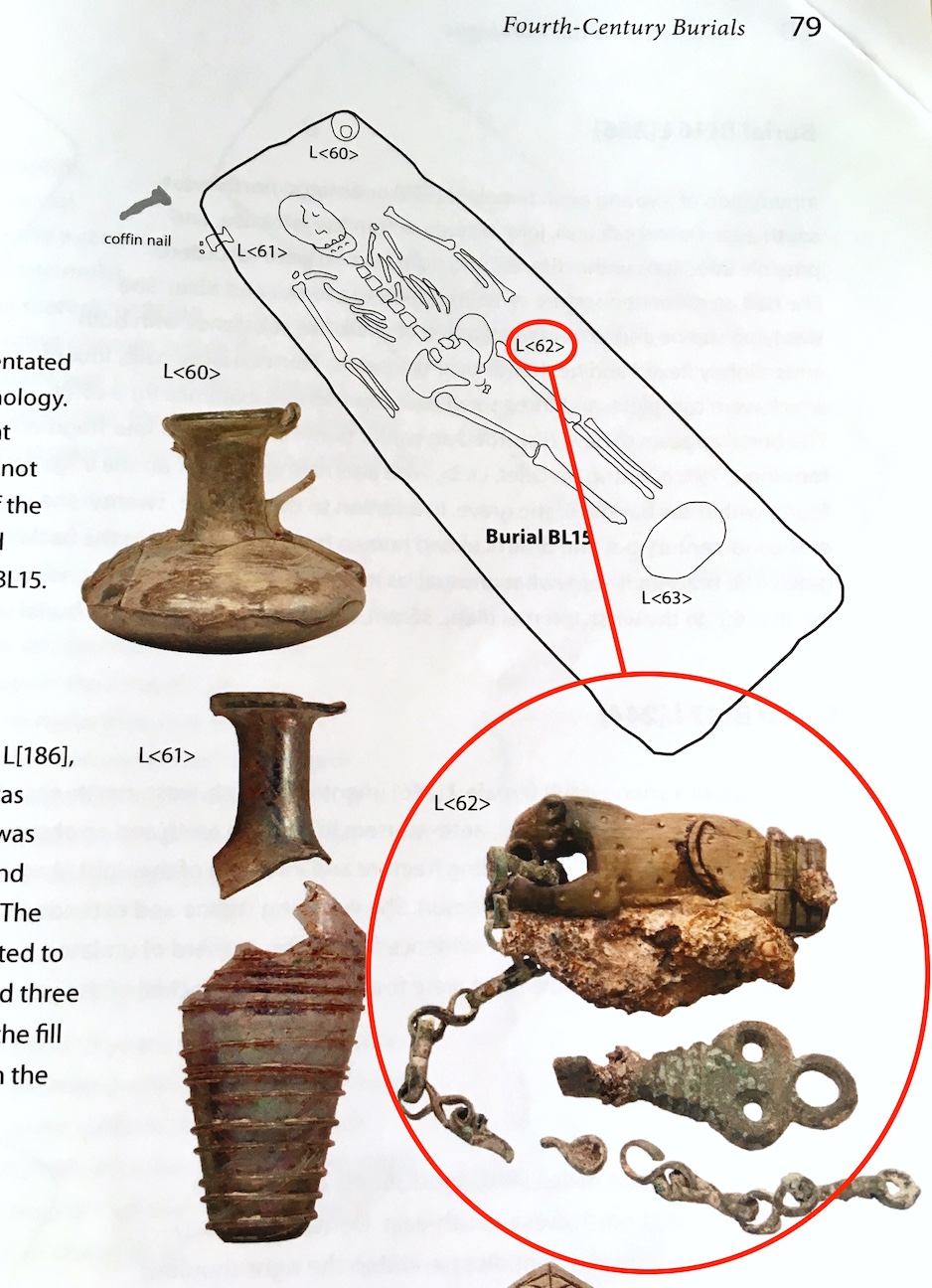
Also from Southwark comes a small copper-alloy key which you can see in one of the cases. It was found near the left hip of a girl’s skeleton. She is called the Lant Street Teen because of the location of her grave and because her age at death was estimated to be fourteen. She was also buried with a wooden box, two small glass bottles and a folding knife. Because of the richness of her grave goods, samples of her bones were tested. Her DNA tells us she was of European ancestry and had blue eyes. But the isotopes in her teeth indicate that she lived in the southern Mediterranean – possibly North Africa – until she was nine, when she made the long journey to Londinium. Her skeleton is not in the Roman Dead exhibition because it is used in workshops for schoolchildren at the Museum of London’s Barbican site! 


In Roman times most keys looked more like big combs on a handle than modern keys. They fit into a pattern of holes to lift up a crossbeam on the inside of the door. Unlike the big iron key on the left, the Lant Street Teen’s copper-alloy key also has little teeth. But what did it open? Surely not a door; it’s far too delicate. Perhaps it opened the box that was found at the girl’s feet? But although the box had copper-alloy decoration, no lock was found. Was the key a magic charm of some sort, like the one found in the stones piled on the Hooper Street Woman’s grave? What was the key for?

IVORY KNIFE
Also belonging to the Lant Street Teen and found next to the copper-alloy key at her left hip was a folding knife with an iron blade and an ivory handle carved into the shape of a leopard. I have noticed that small folding knives like these are often found in the graves of women. In life, they would have been useful for personal grooming, eating and cloth- making. Several other folding knives found in Romano-British graves have fierce animals on them. Why? Why would a girl have a hunting hound or big cat on her knife handle? Perhaps these show the knife can ‘bite’. Or perhaps the animals on the handles symbolically protect their owner and keep away evil. Therefore a knife like this might have dual purpose of being a tool but also protective, making it a practical version of a lucky rabbit’s foot. But we don’t really have the faintest clue. 


The blue-eyed fourteen-year-old girl who owned these items fascinated me so much that I am writing a book about her called The Time Travel Diaries. In this book an eccentric bazillionaire is also obsessed with her. His boffins have accidentally invented a time machine. Unfortunately, he can’t go back so he recruits a twelve-year-old London schoolboy to go back to third century Londinium (using London’s Mithraeum as a portal) in order to find her. In this book, I tried to imagine what Roman London would really have been like. 

I will be reading chapters from The Time Travel Diaries at a FREE family event on Saturday 18 August 2018. And I will also be telling you lots more amazing things I have learned about these Crazy Dead Romans, including the answers to some of the questions I raised in this blog post. For more information and to get your name on the list for my free event, go HERE.

P.S. Thanks to MOLA, London’s Mithraeum and Juliette Harrisson for huge support (and some of the photos!) 

Thursday, December 14, 2017

Ten Things You (Probably) Didn’t Know About London’s Mithraeum

by author Caroline Lawrence


Sophie Jackson, Catharine Edwards, Fiona Haarer & Michael Marshall
A few days ago I went to see London’s Mithraeum, recently reopened in the basement of Bloomberg’s new building. I’m fairly jaded by museums and wasn’t expecting anything special, but it was great. Coming up out of the ‘experience’ I ran into Sophie Jackson and Michael Marshall of MOLA – two of the archaeologists responsible for the display – along with Catharine Edwards, Professor of Classics and Ancient History from Birkbeck College and lecturer Fiona Haarer of the Roman Society. Although I am one of MOLA’s archaeology ambassadors, I had booked the normal way and our meeting was totally serendipitous. Chatting with them, I learned a couple of facts which I share below, along with a few other things you might not know. 

I do urge you to go and I hope this short list enhances your experience!


1. Exit 8. It’s easiest to reach London’s Mithraeum via Bank station exit 8. If you’re coming from Waterloo just get the Waterloo & City line. One stop is all it takes. Exit via the travelator and when it ends make a sharp left to reach Exit 8 which now has London Mithraeum added at the bottom of a list of landmarks. Go up the stairs to street level and continue straight ahead for less than 200 meters, passing the Starbucks on your left. You’ll see entrance to the Mithraeum on your right. It’s on the ground floor of Bloomberg’s brand new European headquarters. It doesn’t look like a Mithraeum from here; it looks like a modern art gallery because it is a modern art gallery called SPACE. N.B. As of 2019, you can take the brand new Walbrook Exit and emerge literally next door to the entrance!


2. Dead Time. Entry to London’s Mithraeum is free but you have to book a visit. They won’t just let you roll up. But sometimes if you roll up at their ‘dead time’ of 3pm they might let you in. N.B. Never show up on Monday, when the exhibition is closed. 

3. Three Parts. Like Gaul, the London Mithraeum is divided into three parts. The first part is in the art gallery reception where a guide will give you a Samsung tablet and point you at a modular wall displaying around six hundred roman artefacts all found within a few metres of where you are standing. Tap the outline of an object on your tablet and up comes a superb hi-res image of the artefact. Swipe right and find a line or two about what it is in a nice big, easy-to-read font. Why do you need a tablet when you can just look? Because some of the pieces are quite high up and/or small, and the imagery is superb. 


4. Special Glass. The piece of glass in front of the modular display of Roman objects is state-of-the-art. According to Sophie Jackson, Director and Archaeologist at MOLA, (Museum of London Archaeology), it is the biggest piece of glass you can get of that thickness and with the non-reflective properties. Hidden hinges on the left allow the slab of glass to swing open so that the modular displays can be regularly updated. 

5. Lucky Amulet. The tiniest object in the modular display wall is an amulet of amber shaped like a gladiator’s helmet. It is minuscule, about the size of your little fingernail. According to Michael Marshall, Senior Finds Specialist at MOLA, it was put in a day before we were there, replacing a less sexy pair of tweezers. Michael also told us that this tiny object was spotted by an archaeologist the old-fashioned way, with the naked eye. (Near the amulet is the famous LONDINIO tablet, also recently added by popular demand.) 


6. Go Down to Go Back. Someone at MOLA or Bloomberg had the very clever idea of showing how you have to descend to go ‘back in time’. As you go down the black marble stairs you see what the ground level would have been for important moments in London’s history such as the WWII bombing level and the Great Fire of 1666. There is a similar graphic on the back of the elevator. The Temple of Mithras dates from about 240 AD, almost 200 years after Londinium was first established. 

7. Famous Actress Joanna Lumley narrates some of the commentary on the mezzanine level, which is the second part of the experience where ‘clues to what form the cult took are explored in light and sound.’ Listen to the commentary as you watch a ghostly light show on the walls. 


8. Please Touch. You are allowed to touch the three resin casts: the head of Mithras, a tondo with inscription and a 3-D plan of the temple. As a cheerful guide named May explained to me: ‘The exhibition is meant to be touchy-feely!’ The head of the mysterious god Mithras with its distinctive Persian cap was found in 1954 on what was intended to be the last day of excavation of just one of hundreds of bomb-exposed sites in London. Planned building on the site was halted so that the Mithraeum could be excavated and eventually removed to another site. Bloomberg and MOLA have brought it back to exactly the place it was originally found. 


Get Well card by Roman glassmaker David Hill
9. Just Theories. Don’t swallow the written explanations or spoken commentaries whole. Our understanding of this mysterious cult is changing all the time. We don’t really know what they did at these ceremonies. We don’t even know if Mithras was actually killing the bull or just wounding it. In a recent article, scholar Christopher Faraone claims the word ‘tauroctony’ (i.e. ‘bull-slaying scene’) is a ‘nice-sounding Greek noun that appears nowhere in Mithraic inscriptions or literary testimonia and in fact nowhere in ancient Greek.’ JRS 103, pp 1-21 


10. The Experience. The third and final part of London’s Mithraeum is an ‘experience’ on the site of the ruins themselves. I don’t want to spoil it for you but it involves sound, light and mist. And although it was one of the coldest days of the year this underground space was comfortably warm. 

case.londonmithraeum.com
There is a superb free guide to the history of London as revealed in the Archaeology at Bloomberg co-produced by MOLA. You can download it HERE. (Spoiler alert: There are some images in the final pages of the brochure which might spoil the third part of the experience.) 

You can also get an interactive guide to the wall of artefacts on your smartphone or tablet by going to case.londonmithraeum.com

Bravo to Bloomberg, MOLA and Foster + Partners Architects! You did a great job. 

Book your FREE tickets to the Mithraeum HERE. 

Monday, September 18, 2017

Roman Londoners from the Bloomberg Tablets

by Caroline Lawrence

It is a cool grey Saturday morning in mid-September I am on my way to a London square near St Paul’s cathedral. A writer in search of inspiration, I am hoping to meet some ancient residents of Roman London or Londinium, as it was called. 


fragment of Samian ware with archer now at MOLA
For many centuries it was believed that St Paul’s cathedral was built on the site of an ancient temple dedicated to the Roman goddess Diana. After the great fire in 1666 when the architect Christopher Wren was digging the foundations for his new St Paul’s, he kept a sharp lookout for evidence of Roman occupation. Although he found no trace of a Temple of Diana, he did find other Roman artefacts including fragments of popular Samian ware, a type of imported, glossy orange pottery beloved by rich Romans in Britain. 

Over three hundred years after the new St Paul’s rose from ashes, the multi-national company Bloomberg were digging the foundations for their new European headquarters in the City of London. Like Wren they also found Roman artefacts; not just a few, but over fifteen thousand. These were preserved in the waterlogged soil of the Walbrook, one of several streams that feeds into the Thames. The Roman goodies included leather shoes, pottery, brooches, hairpins, rings and – most exciting of all – over four hundred writing tablets. 


Unlike the famous Vindolanda tablets, most of the so-called ‘Bloomberg tablets’ are not postcard-thin wafers of limewood designed to be inscribed with ink, but stylus tablets made of silver fir reclaimed from imported wine barrels. Also known as wax tablets, these were slim tiles of wood with a shallow depression for a layer of wax. This wax was scratched away with a sharp stylus to reveal the wood underneath. The London tablets were mainly covered with soot-blackened wax, which contrasted with the pale wood underneath. 


As a Classicist, Londoner and writer of historical fiction for kids, I was thrilled when MOLA, the Museum of London Archaeology department, invited me to be one of their ‘ambassadors of archaeology’. I jumped at the chance and was rewarded with a copy of the first of several volumes about the Bloomberg finds and also a private tour of the MOLA repository in Hackney. At Mortimer Wheeler House I saw some of the tablets and artefacts up close. The ancient combs, shoes and brooches were fun, but I’ve seen plenty of those before in museums. 


What I hadn’t seen were items like the wonderful iron stylus from Rome (left) with an inscription on its hexagonal sides declaring: I have come from the City. I bring you a welcome gift with a sharp point so that you may remember me. I hope I bring you good fortune when the way is long and the money sack is empty. As archaeologist Michael Marshall (above) remarked, this is the ancient equivalent of My Parents Went to Rome and all I got was this lousy T-shirt. 

And then there were the famous tablets. Most would have about the size of a small paperback book (140 cm x 110 cm), but with with the thickness of a smartphone. A few are the size of an iPad and a few are tags. Some have a central depression for the impression of signet rings. Roman wills had to be witnessed by no fewer than seven men and they were always recorded on sturdy wax tablets. 


When you look at the tablets you are amazed that anyone can make sense of the faint chicken scratchings left by the stylus as it pushed through the wax nearly two thousand years ago. But a combination of ultra-modern technology and old-fashioned genius makes this possible. 

Genius photographer Andy Chopping records the traces of scratches left by the stylus and gives them to genius epigraphist Roger Tomlin (above). A kind of code-breaker of ancient Latin cursive, Tomlin has been able to decipher parts of 80 of these tablets. (See how they do it HERE.)

From the archaeological context and a few dates on some of the tablets, we know these documents go right back to the very first years of London’s existence as a Roman town and cover a period of about twenty years, from roughly AD 60 to about AD 80. They give us an extraordinary glimpse into the life of Roman Londoners, naming merchants, craftsmen, soldiers and politicians who lived in the new outpost of the Roman Empire. 

Fittingly for London, almost all the legible tablets have something to do with business and commerce. Each tablet is given a label with a code including the letters WT which stands for ‘Writing Tablet’. 

One thrilling tablet, WT44, was written when Nero was emperor and is dated to 8 Jan AD 57. In it, a freedman named Tibullus notes that he owes another freedman named Gratus 105 denarii for some merchandise which was sold and delivered. 

This tablet sent a chill down my spine when I remembered that Boudica burnt Colchester, St Albans and London only three years later during her brief but violent rebellion. It is claimed that she killed over 70,000 people. Did Tibullus and Gratus survive? 

Tablet WT45 shows how quickly London rose from the ashes and St Albans, too. It is business as usual as Marcus Rennius Venustus agrees to bring twenty loads of provisions from Verulamium to London. It is dated 21 October AD 62, within two years of Boudica’s rebellion.


Another extraordinary label, WT6,  gives us the first historical mention of London. Dated between AD 65 – 70, it is addressed to a certain Mogontius. We don’t know who he was but the name is a Celtic one, linked to the god Mogons who was worshipped in Britain and Gaul and might have been extra-popular with soldiers. 

The tablets are written according to certain conventions. Although the messages themselves are often scrawled in a hard-to-decipher type of writing called cursive, the addresses are usually written in easy to read capital letters. They are either in the dative case or have the Latin word dabis – the verb to give in the second person singular future tense – ‘you will give’ . This was considered more polite than the imperative da! Give! And might be translated ‘Please give...’

So we have tablets addressed thus:


Please give this to Bassus

To Atticus, son of [name lost]

To Sabinus, son of Pirinus

Please give this to Junius the cooper, opposite Catullus’ place

One tablet is addressed to Tertius the Brewer, who might be Domitius Tertius, a brewer mentioned in a tablet from Carlisle. Maybe he sourced his barrels from Junius the Cooper.  

Other Romans named include Julius, Florus, Jucundus son of Flavius and the merchant Optatus. 

My favourite name is Namatobogius; I hope to meet him and find out who he was. 


When I finally arrive at Paternoster Square I am greeted by MOLA development and community project officer Magnus Copps (his real name) who introduces me to four members of The Vicus re-enactment group: Matt the baker, Simon the saddler, Chris the merchant and a lady scribe who wants to remain anonymous. When I ask them which Bloomberg Roman Londoners they are, they say they aren’t specific Londoners mentioned in the Bloomberg tablets, just generic Roman Britons. 

After a flash of disappointment, I take the initiative and assign them possible roles. 


Simon is wearing a fetching Celtic style tunic so I provisionally give him the name Namatobogius. When he does other events with The Vicus – for example at Fishbourne Roman villa or Caerleon legionary fortress – he plays the part of an auxiliary with the Hamian archers, co-incidentally the cohort that appears in my second Roman Quest book. He tells me you can use hair from a horse’s tail as a bowstring, and how the Romans used tannin-rich oak, apple or chestnut to dye leather.


With his bright blue eyes, long yellow hair and torque, Chris from Cambridge is obviously Belgic. But he’s wearing a Roman style toga. This fits his persona of an injured auxiliary from Germania who took early retirement and set up as a merchant. At first I dub him Optatus, a merchant mentioned in the tablets. But when he mentions that he is a micro-brewer, I give him a new persona: Tertius the Brewer. Appropriately, he is holding a beaker. His handmade socks and new shoes are totally authentic. He also confirms what I have always suspected, that it is impossible to run in a toga. 


Matt Hoskins, a cub scout leader from Poplar, a district of Southeast London, is a genial baker in his mid-twenties. With his pale skin, dark hair and tattooed arms he could be Celtic, so I might dub him Mogontius. He is a font of information about sourdough mixture, different types of flour and bugs in honey. He shows me a libum, a type of honey cake made with cheese and decorated with bay leaves. He also demonstrates Locatelli’s theory of how Roman bakers wrapped twine around their round loaves before baking so the customers could easily carry them away when hot. And possibly to keep them out of reach of vermin. 

But what about women?


Vindolanda gave us the famous birthday invitation sent by Sulpicia Lepidina to her friend Claudia Severa, but of all 92 persons named in the 80 legible Bloomberg tablets, not one is female. So I can make the elegant lady scribe anybody I want her to be. But it would be nice to have an authentic name, so I hop over to the online site of RIB, Roman Inscriptions in Britain, and immediately find two possible candidates.


She could be Tullia Numidia, commemorated in the epitaph of a now lost tombstone from London. Or how about Tretia Maria, named in a curse tablet (right) found near Moorgate? The author of the tablet (a lead one in this case, not from Bloomberg) is afraid of Tretia blurting out a secret. He or she writes: I curse Tretia Maria and her life and mind and memory and liver and lungs mixed up together, and her words, thoughts, and memory; thus may she be unable to speak what things are concealed...

Liver and lungs mixed up together? That’s a bit nasty. But wait! Writers have to be nasty. We have to give our characters interesting opponents and force them to undergo tests and trials. Otherwise the reader will be bored. So Tretia Maria it is. And even as I write it I wonder: Could Tretia be a misspelling of Tertia? In which case, she could be related to Tertius the Brewer: his beautiful daughter perhaps or younger sister. Perhaps Mogontius the baker and Namatobogius the cobbler are both vying for her affections. But what is the secret she knows and who wants to stop her blurting it out?

I feel a story coming on… 

To learn more about the tablets, and the ancient stories they reveal, check out Voices from Roman London. And you can follow MOLA on Twitter: @MOLArchaeology