Showing posts with label poetry. Show all posts

Tuesday, March 21, 2017

Diana, a poem

Diana

Coins
Of golden sunlight,
Pools of green,
Dapple her skin like
A fawn's
As she runs
Through the glade.

Points
Of silver arrows
Flash in the quiver,
Rattle in their case like
The shards
Athenians scratched 
To vote.

Cries
Of startled birds 
Fly up into the blue;
Her arc
Is in her hand,
An arrow notched
And ready.

Pebbles
Scatter, wet and gleaming,
As her golden-sandalled foot
splashes in the brook,
A warning
To the prey
She seeks.

Tears
Sparkle on her cheeks
Like angry diamonds,
Splash onto sunburned arms 
And dusty knees;
Weary she returns
To her garden.

Stars
Begin to prick
The violet dusk;
Bathed and clean
She sits in the fragrance
Of evening jasmine, henna, myrrh,
Under a crescent moon.

And he comes
To her there
In the secret place,
Tiny brazen hooves and silver horn,
pushing his velvet nose
Into the hollow of her neck,
Bowed in prayer.

Caroline Lawrence 1998

Nothing is lost! This poem I wrote in 1998 bore a kind of fruit nearly 20 years later when I did a re-telling of an ancient Roman tale for Barrington Stoke. Virgil's tragic Camilla story is found scattered out of order in books 7 and 11 of The Aeneid. I tried to put it in order and fill in the blanks. Queen of the Silver Arrow is written in simple prose for reluctant or dyslexic teen readers. But although the vocabulary is easy enough for a 7-year-old to read, some of the themes and images are better suited to children 11+

Sunday, July 21, 2013

The Anxiety of Fidelity by Marina Macklin

The Anxiety of Fidelity in Roman Love Poetry
From the Desk of Corinna: Reflecting On Her Affair With Ovid


I have thought to set it all down in writing, to immortalize a different account of what happened back then, an account that I could dictate, not one dictated to me and of me. It seemed a sort of golden time, when life teetered on the edge of something heartbreakingly incredible, when teenage roses might burst forth into astounding, earth-shattering beauty that would last only for a few ephemeral days before fading away into the swirling leaves of autumn. But that autumn came, and love was not true, or perhaps love was not love. In any case, that man who wrote such pretty poems to my beauty and charm left on an autumn wind, and I fell forward into the rest of my life, immortalized in verse but tethered to the uncomfortable remnants of a very earthly existence.


He wrote what he wrote, he said what he said, he spoke of Cupid stealing away a foot from his lines, that god of love's exacting of mischief; he expressed that anxiety of fidelity that surely stalks behind the happy steps of all lovers. But I never did. I never had the chance to write my own account, and I hope to remedy that herein. My old daily journals have proved true to time, and I can still vividly remember the emotions that I described in such great detail in those days.

After he published the first poem, after he sent his maidservant Nape to my window with tablets professing love, I wrote this: "Will this man ever cease writing poetry to me? His elegies are flattering, his attention is welcome, but I have begun to fear that never will I be able to free myself from the attention that follows each published poem. I have read every one, unhealthy for my ego though it might be."

He had then decided that was perfectly appropriate to address a poem to my husband. Looking back, that particular book of poems only elucidates further the inconstant nature of Ovid. He talked to me for weeks only about my husband's loose hand in relation to my conduct in our marriage (and outside of it), and then he decided to switch his view and accuse my husband of being far too jealous. He wrote of how my husband prevented me from "loving my lover."   I know now that he was simply a maker of excuses; a man that had to find reasons for things that I could not fully explain. Even now, I ask myself, would it have been so difficult for him to understand that, perhaps, I simply could not maintain a charade of this magnitude, even if my husband already knew, even if he, my lover, thought that I had no shame? But therein lay the problem, I can see it now, clear as day: 1 did have shame; it had simply lost itself in his eyes, in his slow but burning smile, in his youthful arms. I might not have been able to write poetry dedicated to these things as he once wrote poetry dedicated to me, but I still felt these things, that passion, just as he did! Yet my instinct was to murmur, "No" every so often. For he was just a baby, really. My husband might have been ancient and dry and lifeless in comparison, but I was still married to him, not to Ovid, that man I loved, and I knew that this was a fact I could not change.

I could never fully ignore, thought I might have been able to cast it from my mind for short and blissful periods of time, the measure of hypocrisy that took root in his poetry: his inconstancy of position, his fear of my further infidelity juxtaposed with his inability to see how my affair with him was infidelity in itself. As I read my old journal, I can see a change in daily entries that had once concerned themselves with the household, the gossip, and the interesting whispers that floated around Rome like leaves on a windy day. That little book, intended to keep an account of my day to day goings-on, became a reflection of the core of my life at that point: that illicit relationship that somehow became the very opposite of illicit, that public renown, that public shame that was somehow not shameful, but still managed secretly to shame me to my very core. And it revolved around that man, about whom my younger self simply could not make up her mind.

My very reaction to his eleventh poem could not illustrate my mixed feelings more fully. After its publishing, I wrote, "He has written another poem, of course. It is his eleventh. It seems he has realized how his poems have brought attention upon me. How is it such a shock to him that the young men of Rome find me intriguing, and not solely for my personal charms but also for the notoriety that his poems of love have given me? In this latest poem, he spent his verses regretting every pretty phrase and lovely metaphor with which he feted my beauty and allure. He has entirely made up his mind that this new renown will lead me to infidelity!  Yet he remarks too that I still hold him in my power, that only I can stir the poetry in him. I cannot say for sure how I feel about this." Our relationship was constantly haunted by the low hum of a threat on the horizon: ironic, perhaps, considering our very relationship itself was a threat to the traditional values of love. We were never married to each other; I had a husband; the affair still managed to be very much a public one; and yet he still worried about the attentions I paid to other men. Oh yes, I was never the most faithful of women, that I will readily admit. But, you see, I will readily admit it. I would never subscribe to some pretence of virtue; I would never pretend that I had always been faithful. He rather crucified me for that, of course; he wrote those poems, he made sure that Rome knew all about my doings. But he already knew I was an unfaithful woman; after all, I had cheated on my husband with him, hadn't I? But he, I never knew about him. I never really knew if he held himself to the standard that he lambasted me with in that poem, that standard that engulfed him with jealousy when it threatened to deprive him of me, yet was of no concern when it gave me to him and released me from my husband. Oh, but there were rumors. I never asked him forthrightly, and I rue that now, for if I could only know whether or not he remained faithful, oh it would be such a relief. He wrote poems about other women later, of course, but that was after he had gone from my life, half willingly and half defiantly, caught in some fit of jealousy and, though he would not care to admit it, confusion. For ultimately he was confused: I betrayed the fidelity inherent in love simply by loving him, yet he could never accept it as a betrayal; he could never see the anxiety that my infidelity had surreptitiously brought into our relationship, the anxiety that would ultimately bring about our love's demise.

This is the second time that the Golden Sponge-stick Writing Competition international category winner has been Marina from Highland School, Virginia, USA. Last year as an eleventh grader, she wrote an epistolary tale based on the letters of Pliny the Younger, entitled Letters to Procula. Now in her last year of high school, doing Honors Latin, she used book 1 of Ovid's Amores as her primary source. Bene fecisti, Marina! For those who are interested, here is a translation of the eleventh poem referred to in Marina's story. 

Thursday, May 21, 2009

The Mystery of the Latin Pillow

Or: The Curious Case of the Classical Cushion
by Caroline Lawrence, author of The Roman Mysteries


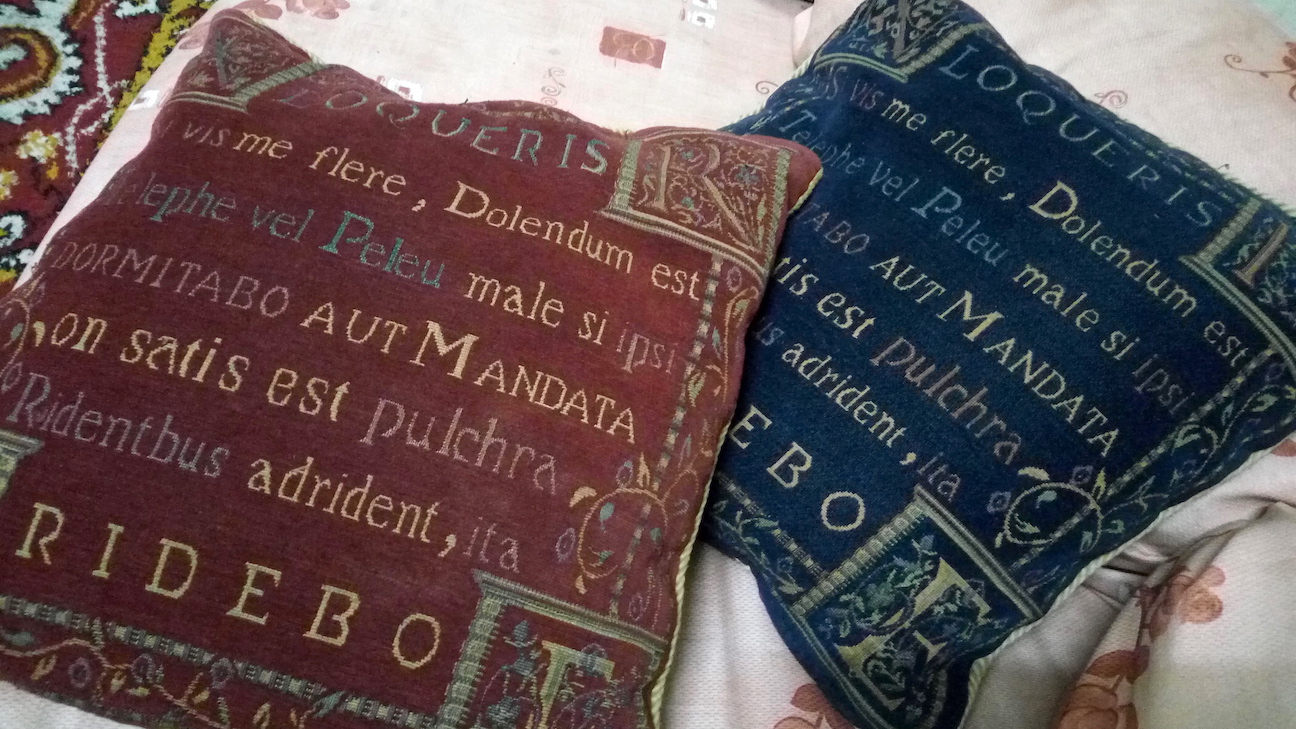
It all started when a keen fan from Tasmania asked me to translate a cushion in her house.

This happens a lot.

Not necessarily being asked to parse a pillow, but I am often asked to help with Latin homework, compose mottoes and translate inscriptions.

Top Fan Julia had a tapestry cushion with Latin on it.
She diligently copied down the Latin and sent it to me:

LOQUERIS
Si vis me flere, Dolendum est

Telephe vel Peleu male si ipsi

dormitabo aut Mandata

on satis est pulchra

Ridentibus adrident, ita

RIDEBO

The Latin looked extremely dodgy so before launching in on a translation, I did what any self-respecting scholar should always do first: I googled it. Sure enough, a search of si-vis-me-flere took me straight to several pages of chat about these pillows. It seems to be a few verses from Horace’s Ars Poetica, but badly garbled.

Quintus Horatius Flaccus AKA Horace was a poet who lived in the time of Julius Caesar and the first emperor Augustus. He is most famous for his Odes and Epodes and for coining the phrase Carpe diem! or 'Seize the day!' His Ars Poetica, 'The Art of Poetry', was actually a letter to a friend, written about 20 BC. A hundred or so years later, the orator Quintilian was the first one to call it the Ars Poetica. The Oxford Classical Dictionary describes it as ‘a most puzzling work … [saying] little that is worthy of Horace.’

So here we have an obscure passage from an obscure Latin treatise. The passage from which the pillow phrases are taken comes about a hundred lines into the letter. If you look at the cushion you can see phrases have been chopped and changed, words have lost initial letters or dropped out altogether.

Here is the non-garbled version:

Non satis est pulchra esse poemata: dulcia sunto
Et quocumque volent animum auditoris agunto.
Ut ridentibus adrident, ita flentibus adflent

humani vultus. Si vis me flere, dolendum est

primum ipsi tibi: tunc tua me infortunia laedent,

Telephe vel Peleu; male si mandata loqueris,

aut dormitabo aut ridebo: tristia maestum
vultum verba decent; iratum, plena minarum
ludentum lasciva, severum seria dictu.


And here is a rough translation:

It’s not enough for poems to be beautiful: they must be persuasive
and able to lead the soul of the hearer wherever they want.
As we grin among those who are smiling,
so we tend to well up around those who weep.
If you want me to cry, you yourself must first feel anguish
Then your misfortunes will move me, O Peleus or Telephus;
if you speak inappropriately, I will doze off or laugh out loud:
sad words require a mournful expression,
angry ones need a face full of menace,
Naughty words suit a playful mood,
serious words go with sober topics.


(By the way, Horace names Telephus and Peleus as examples of mythic characters tragic tales to tell. Telephus was a son of Hercules, famous for a fresco from Pompeii that shows him suckling from a deer. He had a miserable life which included suckling from said deer, being a beggar, almost sleeping with his mother, suffering for many years with a would not heal, etc. Peleus was a prince from Aegina – the island near Athens – and had to become an exile after accidentally killing his brother. Although he later became father of the great warrior Achilles, several tragedies were written about him.)


According to several online discussions, the guilty fabric is manufactured in China. But in the guise of cushions, upholstery, wall-hangings and curtains, it has found its way all over the world: Australia, Germany, Norway, Chile, Oxford, South Yorkshire and Tasmania.

I was at Alderley Edge School for Girls (Greater Manchester area) last week to talk about my series of books set in ancient Rome, when the librarian Ruth pointed at the heavy curtains in the hall. ‘Look!’ she said. ‘Latin curtains!’ I stepped closer and peered at the letters. Sure enough, it read: ‘Loqueris 
Si vis me flere…etc.’

If someone asks you to translate their cushion, and you recognise some of the words I’ve been talking about here, tell them it's garbled but that it says something like: ‘If you want to be a poet, laugh with those who laugh and cry with those who cry.’

How on earth a Chinese manufacturer got hold of the random and rather obscure piece of Latin poetry remains a mystery.

P.S. Someone has recently translated another piece of Latin gobbledygook – the famous lorem ipsum text filler – into English.


[The Roman Mysteries are perfect for children aged 9+. Carrying on from the Roman Mysteries, the Roman Quests series set in Roman Britain launched in May 2016 with Escape from Rome.]

Friday, March 25, 2005

Hippie Mysteries!

Remember hippies? They dressed in beads and fringes and they painted flowers on their cars and said 'Far out!' and 'Peace, man!' a lot. Well, before there were hippies there were beatniks. Beatniks wore black turtleneck sweaters, and drank espresso and discussed philosophy and read poetry and said 'Cool, Daddy-O!' In the 1950's and 1960's San Francisco was one of the most famous homes of beatniks and hippies.

One of their favourite meeting places was the famous City Lights Bookstore in a part of San Francisco known as North Beach. City Lights Bookstore is still there today – in 2005 – and it's hardly changed. You can still buy beatnik and hippie poetry and even see some beatniks and hippies. Most bookshops have categories like Best Sellers, Mystery & Crime, Children's etc. City Lights Bookstore does have a children's section, down in a musty basement right between Lesbian Literature and Muckraking. And guess what? They had a copy of The Pirates of Pompeii!

Here is a picture of me (in sunglasses and a turtleneck) holding that famous volume of hippie/beatnik literature in front of a door which is labelled I AM THE DOOR. I went with my brother Dan last week and we wandered around for a happy hour. At one point Dan saw a copy of a book called STEAL THIS BOOK by a hippie called Abbie Hoffman (a man). Dan tried to steal it, but the staff got very upset and he had to put it back... (Just joking! *hee*)

Just outside City Lights Bookstore is the famous Transamerica Pyramid. And that interesting green building to the right of it is owned by movie director Francis Ford Coppola. There is an Italian restaurant called Café Zoetrope there. Coppola also owns a vineyard in the Napa Valley.

One day I would like to own a vineyard. Or maybe a bookshop. One day I might even write some Hippie Mysteries.

I love San Francisco (never call it 'Frisco') and I would move there like a shot if it weren't so darned far from Italy and Greece and the British Museum. Also, it has all those pesky hills!

Still, maybe one day...

[The 17+ books in the Roman Mysteries series are perfect for children aged 9+, especially those studying Romans as a topic in Key Stage 2. I have also written some Western Mysteries (set in the Wild West) and the Roman Quests series, a follow-on from the Roman Mysteries set in Roman Britain.]