Showing posts with label apotropaic. Show all posts

Thursday, July 22, 2021

Caroline Lawrence Membercast Objects

In July 2021 I was interviewed by fellow children's author Iszi Lawrence (left) for the British Museum Membercast. We talked about artefacts in the British Museum that have inspired my writing. For anyone who wants to know more, here are some of the objects we discussed. Click the photos for links to the objects. 

1. Rock crystal die. Find it in the Greek and Roman Life room (room 69) display case 9. This beautiful little object was a vital clue to the identity of a dog-killer in my first book, The Thieves of Ostia.


2. Wax-tablet and writing things. Greek and Roman Life room (room 69). I try to make some artefacts a matter of life and death, like a wax-tablet for Lupus, a character from my Roman Mysteries series of books. Lupus is mute and illiterate but as he learns to read and write his wax tablet becomes a vital means of communication. My replica wax tablet smells like honey because of the beeswax on it. 


3. Why would you put a scary actor’s mask on a baby feeder? I believe the answer is that it is apotropaic (turns away evil). A face like this, possibly called a mormolukeion, keeps malicious spirits from turning the milk sour. This becomes an object of life or death importance in my book Escape from Rome. Find it in the room next to the Greek and Roman life room, in room 70 and display case 14.


4. Hydria. This beautiful Greek jar for carrying water is one of literally thousands of Greek, Roman and Etruscan vases in the British Museum. Women and slave-girls would take a pot like this to the fountain and bring it back on their heads, full of water. Other Greek vases range from tiny perfume bottles to big mixing bowls for wine. The decoration on them gives us glimpses into daily life, customs and beliefs. For a scene where kids hide in a fountain, check out my book Adventure in Athens


5. Oil-lamps are like snapshots of the ancient world… Many of them also have apotropaic images on them, and the oil-lamps themselves – lights in the darkness – keep away evil. One of my favourite oil-lamps is in the Greek and Roman Life room (room 69) and shows what racing chariots really looked like. I incorporated that knowledge into Roman Mystery 12, The Charioteer from Delphi. 


6. This superb statuette of the ancient Greek philosopher Socrates informed my most recent historical thriller, The Time Travel Diaries, Adventure in Athens. Note that he is only wearing a cloak, probably light linen for those hot Athenian summers. Find him downstairs in Room 22 and display case 6. 


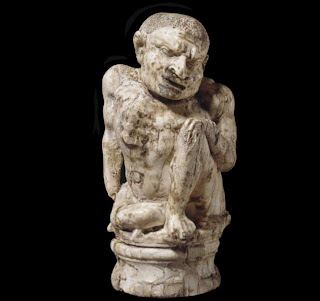
7. Another figurine, a little ivory hunchback from Alexandria, is inspiring my current work in progress, a retelling of Aesop’s Fables. (According to some ancient sources, Aesop was a hideously ugly hunchback.) Note that he is wearing nothing at all. You can find him near the Socrates figurine just mentioned in display case 6 in room 22. 

Thanks to Iszi Lawrence for letting me gush about some of my favourite objects and thanks to the British Museum for inspiring my writing. Find out more about my books at carolinelawrence.com. Find out more about Iszi's books at iszi.com.

P.S. All the photos on this post are copyright of the British Museum. 

Monday, March 15, 2021

Up Yours, Brutus!

by Caroline Lawrence (author of the Roman Mysteries)

One of the first things that greeted visitors to the Life and Death in Pompeii and Herculaneum exhibition at the British Museum in the summer of 2013 was a jolly fresco of a phoenix above two peacocks (below). On the audio guide, curator Paul Roberts called this fresco a pub sign. It was found on a wall of a popina or fast food joint in Pompeii. The slogan reads Phoenix felix et tu: The Phoenix is happy (or lucky), and you!

What caught my attention was the phrase et tu which immediately called to mind Julius Caesar's last words according to Shakespeare: et tu, Brute.  Of course, as any Classicist knows, Caesar didn't really say et tu. He spoke in Greek: Kai su, teknon, which means 'and you, my child'. This is often interpreted as the poignant words of a noble, betrayed Roman to the young assassin who might have been his illegitimate child: 'Even you, my son?'


But the phoenix pub sign hints that Caesar might not have gone down quite that submissively on the Ides of March in 44 BCE.

One thing the Pompeii exhibition brought home to me was how obsessed the ancient Romans were with keeping away evil. A little research showed me that the phrase 'and you' – whether in Greek or Latin – is apotropaic.

Apotropaic is Greek for something that 'turns away'. It usually refers to anything that averts evil or bad luck. Apotropaic images include the raised palm of the left hand, erect phalluses, the unflinching gaze of a full frontal face and the eye amulets that are still so popular in the Mediterranean. Also apotropaic is the peacock, which has a tail full of 'eyes'. All these things 'turn away evil'.

The phrase et tu ('and you') has a similar meaning. It reflects back. Our modern equivalent might be 'the same to you!'. In Roman times, if a person approached you with good intentions, saying 'et tu' would be a blessing. But if they came at you with evil intent, the phrase becomes a curse. So whether Julius Caesar said et tu or kai su to the young man stabbing him, it meant the same thing: 'Back at you, punk!' or better yet: 'Up yours, Brutus!'


Check out my 30 plus history-mystery books for kids at www.carolinelawrence.com!


Thursday, June 27, 2019

ADORN: Protective Roman Jewellery

Many people who lived in ancient times believed that when you looked at something your eyes would emit little particles of fire, (a bit like Superman with his laser vision.) That meant that an angry, jealous or envious person could actually hurt the person they were looking at. The anger or envy in their heart, transmitted by the beams, could make someone sick and even cause their death. This was called the ‘evil eye’ and children were considered particularly vulnerable. People also believed in a world full of gods, demigods and spirits, not all of them friendly. For this reason, people often wore magic amulets to avert the evil eye or distract demons. Borders, patches and knots in clothing often served this purpose. but it is most clearly seen in jewellery. 

At a new exhibition of jewellery dating from the Bronze Age to the 21st century, I was lucky enough to get a sneak peek at some of the objects and spotted five different types of protective Roman jewellery. 


MEDUSA MEDALLION
The first object I spotted is this marvellous little medallion showing the gorgon Medusa. Any face shown looking back will reflect back the ‘evil eye’ but Medusa is doubly powerful, her gaze can turn you to stone! In addition, the amulet is made of jet which was considered a special substance in Roman times because it warms quickly in your hand and if you rub it, then it can move things like dust and hair, seemingly by magic (but really by static electricity.) Jet was very popular with women, so I imagine the British wife of a retired Roman soldier wearing this around her neck for protection. If you look carefully you will see this Medusa also has snakes at her throat as well as in her hair, probably because demons and evil spirits dislike snakes. 


SERPENT BANGLES
Speaking of snakes, these charming little bracelets are stylised serpents. They are made of copper-alloy and come from the later Roman period in Colchester. I think they are a bit sad because they are quite small and may have been worn by a little girl after she died. Perhaps she wore them when she was alive to scare away evil spirits. Snakes were associated with death and rebirth in the Roman world and so these might also protect her in the afterlife. We have found other serpent bracelets from the Roman world. Girls and women seemed to like snakes more than men, but that may just be because men didn’t wear bracelets. 


BULLA EARRINGS
In Roman times baby boys were often given a gold bulla (the word means ‘ball’) to hang around their neck. This was a protective amulet and when the boy reached manhood he would offer it to a god in thanks for protecting him. I have never seen a girl wearing a bulla medallion, but these earrings would have provided twice the protection of a single bulla. They are exactly the same style as some found in Pompeii and might have come all the way from Italy. 


MOON BRACELET
If boys often wore amulets that resembled the sun (gold balls), girls often wore amulets in silver that looked like a crescent moon. The goddess of the moon was Diana and the moon is often associated with females. The lunate or moon-shaped pendant can be seen on many of the so-called Fayum portraits, paintings of Romans living in Egypt in the 1st and 3rd centuries AD. The protective qualities of the silver moon on this bracelet are enhanced by the beads which are made of jet, amber and glass, all ‘magical’ substances. See the coin with the hole? That was another good-luck token. This was literally a ‘charm’ bracelet in that it has protective properties. 


SATYR GEMSTONES
You might have trouble finding these gemstones in the exhibition because they are TEENY tiny, about the size of your little fingernail! They are called intaglios which means they have something engraved into them. These stones would probably have been put in a ring and then used as the owner’s seal or signet. In Roman times a person’s ring was their ‘signature’! In the case of both these semi-precious blue-black gemstones we think the figures are satyrs. Satyrs were mythical creatures – half goat and half man – sacred to the god of wine, Dionysus. Also known as Bacchus, Dionysus was another god who could protect you, and after death he often led worthy souls down to the underworld. So, like all the other objects in my list they served an additional protective function in addition to their decorative use.

The exhibition is called ADORN but they could also have called it ADORN & PROTECT! It is on from 27 July 2019 until 16 February 2020 at Colchester Museums. The show is included in the price of entry to the Castle. For more information, go HERE.

Thanks to curators Glynn Davis and Pippa Pickles for showing me around! The superb photos were taken by Douglas Atfield and are all copyright Colchester Museums. I have used them with permission.


Wednesday, August 21, 2013

Last Chance for Pompeii Exhibition!

9.10 on a Sunday morning!
You've been meaning to go to the British Museum Pompeii Exhibition all summer but it finishes at the end of September. At time of posting this, pre-booked tickets are almost sold out – just a few left for September weekends – so you might have to show up early to get one of 500 tickets released first thing each morning (not necessarily for immediate entry) OR find a friend who is a Member (i.e. a Friend) with guest privileges to take you OR become a Member yourself. If you become a Member, you can go whenever you like, breeze past the queue and go straight in. Then you can check your emails over coffee or tea in the brand new Members' Room.

The exhibition has had rave reviews but one problem is that it is almost always too crowded to enjoy. My best tip is to get yourself a Membership, show up on Saturday or Sunday just before opening at 9am, join the orderly queue outside the gates, go straight in to the exhibition (no need to queue at that point), ignore the filmstrip (you can come back to that later) and go straight into the exhibition which you can then enjoy in blissful emptiness (above right). But don't blithely take my word for it: always check the latest on opening times.

I have already blogged about TWELVE FUN THINGS TO SEE but here are TEN MORE THINGS to look out for.


"PHOENIX FELIX ET TU"
1. ET TU, PHOENIX? One of the first things you see past the inscriptions and graffiti is this jolly fresco of a Phoenix above two peacocks. Peacocks are real, but the Phoenix is a mythical bird of fiery resurrection. Curator Paul Roberts calls this a "pub sign". It was found on a wall of a fast food joint in Pompeii. The slogan says "The Phoenix is happy (or 'lucky'), and you!" What interests me is the expression "Et tu" which is used elsewhere in Roman contexts as an apotropaic slogan. Apotropaic is Greek for "turns away evil" and it refers to anything that averts bad luck. Apotropaic images include the raised palm of the left hand, erect phalluses, eyes and the unflinching gaze of a full frontal face. All these things "turn back evil". The words "et tu" (and you) seem to have a similar meaning. Our modern equivalent might be "back at you!" In Roman times, if a person approached you with good intentions, saying "et tu" would be a blessing. But if they came at you with evil intent, then the phrase is a curse. This puts Julius Caesar's last words, Et tu, Brute*, in a whole new light!

2. COMIC RELIEF? Next to the famous fresco of Dionysus and Vesuvius in the atrium room is a small marble relief showing the earthquake of AD 62 or 63. If you look closely you will see it is quite comical. For example, the two men depicting equestrian statues look silly and are staring straight out (an apotropaic device) and their horses are actual long-eared donkeys.  Humour is another apotropaic device so I think this sculpture may be saying something like, "We laugh in the face of earthquakes!"


first time seen by public
3. PANTHER TABLE - Curator Paul Roberts said if he could take home one item when the exhibition finishes, it would be this one. That's probably because it languished in a storeroom for many years and he was the first to show it to the public. Like the goat, snake and dolphin, the panther is associated with Dionysus, the patron god of the region. This wonderful table probably would have been painted.

4. BALL 'O' PIGMENT - In a bowl just on the left as you enter the triclinium (dining room) you will see a bowl with two greyish balls. This is how fresco paint came. You would chip off some pigment, grind it in a mortarium, then add egg and water and perhaps a few other ingredients. Finally, the paint was applied to the still-damp plaster. The plaster sucked up the colour and when it dried the painting became part of the wall. That's why these paintings have survived so well. These are the less exciting "white" and "grey" pigments.

5. The NAVEL OF THE WORLD or omphalos is shown on a fresco in the far end of the triclinium room on the right. This fresco screams Apollo. Cupids (the lolcats of the Roman world) frisk around with his bow, his quiver, his lyre, his tripod and possibly a runaway patera. The tripod is especially linked with Apollo because the Delphic oracle sat on one to prophesy. And Delphi was the site of the navel of the world. If you want to know what the navel of the world looked like, there it is underneath the tripod, looking like a fat bollard.


2000 year old loaf of bread
6. Still in the triclinium room is a glass case full of Roman-type "samovars" and portable hearths. Look out for a BRONZE KRATER WITH ARGONAUTS. A krater was for mixing large batches of water and wine. I only noticed the argonauts on my fifth visit, mainly because this room is usually so crowded!

7. ANCIENT PIZZA - OK, it's not pizza because they had no tomatoes in Roman times, but this round loaf of bread looks like puffy pizza. But what's that strange dent around its perimeter? London-based Italian chef Giorgio Locatelli recreated the loaf and came up with a possible cause: a piece of string was tied around the dough, baked in and then used to carry the loaf home.

8. In the culina (kitchen), look out for a PESTLE SHAPED LIKE A THUMB. It is made of white marble and is found below the hare mould for terrine and next to the beautiful sieve with the maker's signature punched in holes. The mortarium containing the thumb pestle has a fun panther face for draining liquid and on the bottom a crude apotropaic Medusa face for turning away evil when it's hung up on the kitchen wall. (You can't see this in the current display mode).


"CACATOR CAVE MALUM"
9. Also in the culina you will see a giggle-inducing FRESCO OF MAN DOING A POO (right). This is often cited as an example of Roman belief that demons or other nasty things lived in the sewers. The naked youth is being protected by two lucky snakes and the goddess Fortuna. The curators have placed this fresco in the culina room, because that is where most private Roman latrines were found: in the kitchen, usually right next to the hearth. Paul Roberts says this was because Romans classed wet and smelly things together. (For more about this, see my post on Demon in the Toilet!)

10. Near the end of the exhibition – in the same case as a soldier's sword – is a collection of treasures found on a little girl's charm bracelet. Ironically, considering the cataclysmic bad luck she experienced, most of the objects had an apotropaic sense... but what's with the shrimp? I have heard of apotropaic farting, but never an APOTROPAIC SHRIMP! Answers and suggestions below, please.

*Clever clogs among you might know that what Julius Caesar really said was the Greek version, kai su, teknon, but it makes no difference: the Greek phrase has exactly the same sense as the Latin, maybe even more so! Also teknon can mean "child" or "son", but also more derogative "kid" or even "punk". So Julius Caesar's last words to his final murderer Brutus had a meaning of "You'll get yours, too, punk!"

For more apotropaic images including two "kai su" mosaics, visit my PG-rated Apotropaic Pinterest page.

Caroline Lawrence writes history mystery books for kids aged 8 to 80. No. Really! All the pictures in this post are © Soprintendenza Speciale per i Beni Archeologici di Napoli e Pompei / Trustees of the British Museum

Saturday, August 14, 2010

Demon in the Toilet!

It is a basic human instinct to fear things that dwell in the dark. This goes right back to our hunter-gatherer days and is hard-wired into the part of the brain that helps us survive in the wild: the limbic brain. As children, we often fear the idea of a creature peering at us through a nighttime window. Some children imagine they can see a staring face on their bedroom wall. It might turn out to be no more than a trick of the shadows or patterns in the wallpaper, but it sets the heart racing all the same. This innate fear shows that we are programmed to notice the two eyes of a predator fixed upon us, so that we can freeze, flee or fight!

I think this inbuilt fear of staring eyes might be the basis of ancient Roman belief in the evil eye. The Romans believed that if a demon, ghost, evil spirit or witch looked at you in a certain way, then you would sicken or have an accident or other bad luck.

There were several bizarre ways of protecting yourself against the evil eye. One of them was the male private parts, yes: willies! You could either wear one in the form of an amulet or put it on the side of your house or near the threshold. Some of these penis amulets even had wings and/or bells on! (see opening pages of The Colossus of Rhodes) These images have often been considered ‘rude”, but in fact they are apotropaic. That means they turn away evil. In the British Museum Roman Life room (room 69) you will find some tiny silver willies on chains and rings, designed for children to wear. This is because children were particularly vulnerable to the evil eye. On sites of ancient cities you will sometimes find them inside the threshold of a front door (where we put welcome mats) or carved on the wall outside.

Another way of turning away the evil eye is to deflect it, by getting something even scarier to LOOK BACK at it. That’s why theatrical masks and pictures of Medusa are common on Roman walls. They keep away evil spirits, ghosts, and anyone who might cast the evil eye. Even the powerful goddess Athena wore Medusa’s head on her chest - in the form of an aegis. Here is a photo I took of Medusa at the ancient site of Didyma in Turkey, once part of the Graeco-Roman world.

The ancient Greeks put eyes on the underside of some of their drinking cups so when a drinker raised the kylix to his lips it looked as if he had big staring eyes. Maybe the Greeks thought people were especially vulnerable to the evil eye when tipsy.


There are three Latin words for demons, ghosts and evil spirits. The first, the word ‘daemon’ is borrowed from Greek daimon and is not very common until Christianity takes hold. The other two words are much more common in the time of Virgil and Ovid.

One common Latin word for ghosts or spirits is ‘lemures’. That might make you think of lemurs, those little nocturnal primates with big eyes. In the 18th century, a Swedish botanist called Linnaeus invented a way of classifying plants and animals. He used Latin words for the animals. The Latin word he chose for the creature that moves around silently at night and has scary, staring eyes was lemur, based on the Latin word for ‘ghosts’. I don't think it's coincidence that Linnaeus associated the idea of staring eyes with a ghost. It all goes back to the evil eye.

Another word for spirit or ghost in Latin is ‘larva’. Larva’ can also means ‘mask’. The word larva is still used in Venice at Carnivale for the white mask worn by certain people. Once again, the biological word is based on the original Latin meaning. Look at a larva or grub close up and you will see it seems to have two eyes and a mouth. If you look at frescoes of Roman theatrical masks, you see how much they look like ghosts, with their gaping eye sockets and silently screaming mouths. Putting some of these on your wall will scare away anything that wants to give you the evil eye. 

This deep-rooted fear of the evil eye is still common in Turkey, Greece and other parts of the Mediterranean today. You can buy beads that look like eyes to keep away bad luck. For some reason, blue eyes were considered more likely to give the evil eye, so the apotropaic beads are blue, too. If you are Christian you can combine the eye with a Madonna or a cross, or both. If you are Muslim you can combine it with the Hand of Fatima. Here are two amulets I bought recently. One is from Egypt and the other is from Turkey. Turkish airlines even puts the symbol against the evil eye on the tail fin of some airplanes!

I was taking my nephew around London last month and I noticed that even here in the heart of a great civilised city we have such images. Have you ever noticed how many faces are built into buildings? Have a look around your own town. You will see faces looking outward, some of them quite scary, some of them above or below windows. I spotted a scary face on the famous St Paul’s cathedral (left) and also dozens of faces above windows on a street near St James Park. Even after humans move into a well-lit town or city, the deep-rooted fears don’t go away. We still get uneasy when people stare at us on the tube or other public place. It’s that basic fear of the predator, or of the evil eye.

Another deep-rooted fear of human beings is that of pits and holes. This is a sensible fear. Scary things live underground. Bears and wolves dwell in caves, snakes and rats like tunnels, scorpions and millipedes lurk in cracks and crevices.

Some towns and cities have whole worlds underground: the sewers! Every so often rumours arise about a creature who lives in the sewer and might rise up out of the loo and bite you. In New York there is a recurring myth about how some baby alligators flushed down the toilet survived and grew to monstrous size. In India they fear cobras and the Victorians of Hampstead believed giant man-eating swine lived down below! These are called ‘urban myths’ because someone knows someone who knows someone who saw one of these toilet dwellers but when you get down to it, the stories have no basis.

Even the Romans had the ‘urban myth’ of a creature who lived in the sewer. Rome’s ancient sewer was the Cloaca Maxima, a feat of ancient engineering. It was big enough to contain boats and it was so well-built that it is still in use today. Claudius Aelianus AKA Aelian, a Greek-speaking author in the Roman Empire, tells of a giant octopus that lived in a sewer like the Cloaca Maxima. According to Aelian (On Animals 13.6), this big cephalopod came up through a toilet in search of garum, or fish-sauce. I loved this idea so much that I have written a book about it. (I have asked Dr Helen Forte to help me illustrate it and she drew these great pictures.)

In many ways, the Romans were very sophisticated. They had public latrines called foricae, and a new study has shown that almost every private house in Pompeii had a toilet, even if it was just a board with a hole above a bucket. But for all their sophistication, Romans were nervous about using the loos. They are the only people - as far as we know - who put pictures of one of their gods inside the toilets. Which divinity? Fortuna! The goddess of good luck. Fortuna is usually shown holding the rudder of a ship (she directs you) and a cornucopia (she provides for you). Sometimes she wears a grain measurer as a hat on her head. You sometimes see frescoes or mosaics of snakes inside toilets, too. Snakes were considered good luck in Ancient Rome. This is why you often find them in lararia, the household shrines.


The Sewer Demon
A Dutch archaologist named Gemma Jansen is contributing to a scholarly work on Roman Toilets, both the big public multi-seater foricae and the small single loos in private homes. She thinks depictions of Fortuna and of snakes, sometimes together, were to keep away demons and other bad things from you when you were at your most vulnerable: sitting on the toilet. I phoned Gemma a few months ago and asked her to tell me how to explain to children that demons might live down in the sewers beneath the toilet. ‘You don’t have to explain it to children,’ she said at once. ‘Children totally get that something scary could live down there. It’s the adults you have to convince!

P.S. For more pictures related to Roman Toilet Habits go HERE.

The 17 books in the Roman Mysteries series are perfect for children 9+ studying Romans as a topic in Key Stage 2. The first book of the Roman Mystery Scrolls series – The Sewer Demon  – is aimed at kids aged 7+. Another spin-off for readers 9+ is the new Roman Quests series set in Roman Britain, which launched in May 2016 with Escape from Rome