Showing posts with label beeswax. Show all posts

Thursday, July 22, 2021

Caroline Lawrence Membercast Objects

In July 2021 I was interviewed by fellow children's author Iszi Lawrence (left) for the British Museum Membercast. We talked about artefacts in the British Museum that have inspired my writing. For anyone who wants to know more, here are some of the objects we discussed. Click the photos for links to the objects. 

1. Rock crystal die. Find it in the Greek and Roman Life room (room 69) display case 9. This beautiful little object was a vital clue to the identity of a dog-killer in my first book, The Thieves of Ostia.


2. Wax-tablet and writing things. Greek and Roman Life room (room 69). I try to make some artefacts a matter of life and death, like a wax-tablet for Lupus, a character from my Roman Mysteries series of books. Lupus is mute and illiterate but as he learns to read and write his wax tablet becomes a vital means of communication. My replica wax tablet smells like honey because of the beeswax on it. 


3. Why would you put a scary actor’s mask on a baby feeder? I believe the answer is that it is apotropaic (turns away evil). A face like this, possibly called a mormolukeion, keeps malicious spirits from turning the milk sour. This becomes an object of life or death importance in my book Escape from Rome. Find it in the room next to the Greek and Roman life room, in room 70 and display case 14.


4. Hydria. This beautiful Greek jar for carrying water is one of literally thousands of Greek, Roman and Etruscan vases in the British Museum. Women and slave-girls would take a pot like this to the fountain and bring it back on their heads, full of water. Other Greek vases range from tiny perfume bottles to big mixing bowls for wine. The decoration on them gives us glimpses into daily life, customs and beliefs. For a scene where kids hide in a fountain, check out my book Adventure in Athens. 


5. Oil-lamps are like snapshots of the ancient world… Many of them also have apotropaic images on them, and the oil-lamps themselves – lights in the darkness – keep away evil. One of my favourite oil-lamps is in the Greek and Roman Life room (room 69) and shows what racing chariots really looked like. I incorporated that knowledge into Roman Mystery 12, The Charioteer from Delphi. 


6. This superb statuette of the ancient Greek philosopher Socrates informed my most recent historical thriller, The Time Travel Diaries, Adventure in Athens. Note that he is only wearing a cloak, probably light linen for those hot Athenian summers. Find him downstairs in Room 22 and display case 6. 


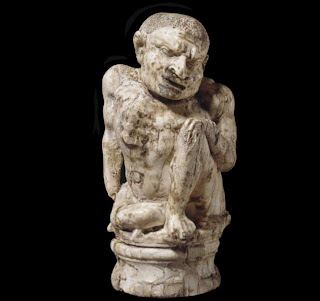
7. Another figurine, a little ivory hunchback from Alexandria, is inspiring my current work in progress, a retelling of Aesop’s Fables. (According to some ancient sources, Aesop was a hideously ugly hunchback.) Note that he is wearing nothing at all. You can find him near the Socrates figurine just mentioned in display case 6 in room 22. 

Thanks to Iszi Lawrence for letting me gush about some of my favourite objects and thanks to the British Museum for inspiring my writing. Find out more about my books at carolinelawrence.com. Find out more about Iszi's books at iszi.com.

P.S. All the photos on this post are copyright of the British Museum. 

Friday, January 24, 2020

Tabula Rasa

The lower leaf is a 'tabula rasa' or blank tablet
The Latin Programme has just announced a competition for kids to write a story or poem under 500 words. You have until 24 April 2020 and the pieces can tackle any theme and take any form as long as they use the Latin phrase ‘tabula rasa’ as a starting point. First prize is £100 in book tokens with two £25 runners up. And I am one of the two judges! 

But what is a TABVLA RASA? 

In Roman times, a ‘tabula rasa’ was a clean writing tablet. 

The word ‘rasa’ is a participle from the verb ‘rado’, I shave or smooth. We get the word razor from it. 

The word ‘tabula’ means a board or plank. We get the word tablet from it. 

Romans often made writing tablets from small, thin wooden planks coated with beeswax. They would then inscribe letters in the wax, using a the sharp end of a stylus made of metal, bone or wood. By the way, we get the word stylus from Latin ‘stilus’, which means stick, stake or pointed instrument. 

When Romans wanted to erase the words they had written on a tablet, they would use the flat end of the stylus to smooth the wax. Some frescoes show a triangular-shaped spatula that could be warmed and then pulled across the wax to smooth it and make it blank. 

Spatula (far left) on a fresco from Pompeii via @LiberalDespot

So the most literal meaning of ‘tabula rasa’ is a smoothed or ‘shaved’ wax tablet. 

Lupus with wax tablet holder (2007)
In my Roman Mysteries, one of my characters can’t speak so he uses a wax tablet to communicate vital messages. 

Maybe your hero needs a tablet to communicate like Lupus.

The phrase ‘tabula rasa’ has a metaphorical meaning as used by philosophers such as Aristotle and John Locke: a blank mind. Locke believed babies were born with a totally blank mind and that the things that happened after their birth were etched into their brains forever. 

So ‘tabula rasa’ can also mean blank mind. 

Maybe your hero has amnesia.

stylus and scraper via Peter Lorimer
‘Tabula rasa’ can be applied to the type of slate on which Victorian schoolchildren wrote with chalk, like a mini blackboard. For this reason ‘tabula rasa’ can also mean a clean slate like when all your debts (the money you owe) or sins (things you’ve done wrone) are cancelled and you can ‘start fresh’. 

Maybe your hero has a chance to start fresh. 

Finally, a fun idea for a mystery or spy story based on the phrase ‘tabula rasa’ is an ancient method of delivering a secret message where you write a message on the wood tablet, then put the wax on top to hide it. That way the writing tablet looks blank but actually contains a hidden message. 

re-enactor writing on a replica tablet of beeswax coloured with soot
Maybe your hero must get a message to a rescuer. Or intercept a message from a spy. 

So there are lots of meanings of ‘tabula rasa’. You might even think of a new one. 

Just make sure you put that phrase somewhere in your entry! 

HERE is the link to the competition. And HERE is a link to some ideas for how to start your story... Good luck! I can’t wait to read your entries.