Showing posts with label toilets. Show all posts

Saturday, April 06, 2013

12 Tasks for the British Museum

The British Museum at night
I am a bit of a nerd. I like lists. I like challenges. I like setting myself tasks.


In my Roman Mysteries Travel Guide I set 12 tasks for kids to achieve at some of the sites where my Roman Mysteries are set. You don't have to do them, but they could make your trip even more fun.

I've just been to the British Museum's fab new exhibition called Life and Death in Herculaneum and Pompeii. [N.B. This show has now finished!] For the benefit of teachers, parents and kids, I thought I would highlight twelve of my favourite objects, ones you could try to spot when you visit the exhibition!

famous plaster cast of a Roman dog
I. The plaster cast of the watchdog. So sad... yet so happy, because he is now one of the most famous dogs in the history of the world. Plaster casts like this were made when archaeologists poured liquid plaster of paris into empty cavities made by decayed bodies, then chipped away the hardened ash to get the shape of the person or animal who had been there. I used to think he was left by accident in the confusion, but now I think his master or mistress left him on purpose to guard the house. They expected to return in a few hours and didn't want anyone to loot their house while they were gone. Roman Mysteries link: my first Roman Mystery – The Thieves of Ostia – was inspired by the memory of a dog barking in the night and I asked the question: What would happen if someone started killing the watchdogs in Ostia, the ancient port of Rome?

herm of Caecilius
II. Caecilius's willy! This is the thing the Cambridge Latin Course never shows us and it came as quite a shock for me. This statue is called a herm and was set up by a freedman (ex-slave) of Caecilius. It shows a "warts and all" portrait bust of the banker Caecilius on top and then half way down are his private parts. The willy makes you giggle and thus turns away evil and bad luck! It's apotropaic. Roman Mysteries link: In the first scroll of The Colossus of Rhodes, Flavia's nursemaid Alma gives Lupus and his friends little willy amulets to keep away bad luck. Some of them have wings and bells on them for extra good luck. You will also see a teeny-tiny penis amulet in the last case of the exhibition. 

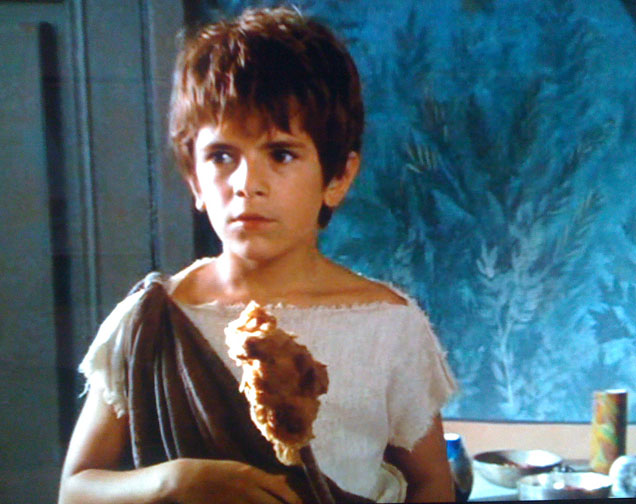
Lupus paints a fresco in book #6
III. Fresco of a garden with plants and birds - you can't miss this beautiful three-wall painting. A fresco was a painting done on fresh plaster. When the plaster is still damp, it sucks up the paint applied and the pigment becomes part of the wall. You can see some plants and birds they had in the first century CE. The hanging actors' masks at the top were probably used to keep away evil. You can see the casts of the family of four who lived here at the end of the exhibition. They were found cowering under the stairs. Roman Mysteries link: In Roman Mystery #6 The Twelve Tasks of Flavia Gemina, Lupus helps a fresco painter finish the labours of Hercules.

It's used for WHAT?!?
IV. Two portable toilets or chamberpots - one in clay with flanges for you to sit on, one in bronze with a lid so it won't slop when the slave goes to empty it in the gutter or (hopefully) down the cesspit. My husband Richard always says: "The first lesson of history is No toilet paper. What did they do when they went to the loo?" Romans often had toilets in their kitchens next to the hearth. And of course the communal multi-seater public toilets are famous. They have holes on top – for the obvious thing – and holes at the front  for a sponge-on-a-stick or spongia, the Roman version of toilet paper. (For a page of Pinterest images about Roman Toilet habits, go HERE.) Roman Mysteries link: In The Dolphins of Laurentum, Lupus doesn't realise what the sponge-stick is for and he uses it to beat a drum.

marble boy and dolphin fountain
V. Statue of a little boy in marble - this is a rare depiction of a real little boy. Notice his hair was painted reddish-gold. He was part of a fountain in someone's garden and held a dolphin from which water spouted. Stories of dolphins befriending humans were extremely popular in Roman times and dolphins were even a symbol for early Christians. Apparently there is a tragic tale associated with the archaeologists who discovered this piece but I have no more details. Roman Mysteries link: Also in Roman Mystery #5, The Dolphins of Laurentum, there are several tales of boys and dolphins, including a real one told by Pliny the Younger, who was 17 when the volcano erupted. He is one of our main eye-witnesses to the events of that terrible day. 

another puteal from Herculaneum
VI. Carbonised windlass and marble well-head - today we just go to our tap and turn it on. Back in Roman times they had several methods of getting water. In some houses, rain water fell through a rectangular hole in the roof (compluvium) into a rainwater pool (impluvium) and then drained down into a storage tank or cistern. Many Roman houses in Pompeii and Herculaneum have a well-head (puteal) so that you can draw water from the cistern. But Pliny the Elder warns that cistern water is often slimy and full of horrid things. Most Romans probably got drinking water from private or public fountains, where the water came straight from the aqueduct. The windlass was the wheel you wound the rope around. The carbonised windlass in case 46 is from Herculaneum. Roman Mysteries link: In Roman Mystery #2 The Secrets of Vesuvius, the well on Flavia's uncle's farm inexplicably dries up the day before the volcano erupted. This is something that really happened. 

oscilla in situ at Herculaneum
VII. Oscillum - nobody knows exactly what these marble discs were used for. They hung between columns of a peristyle and oscillated! (Yes, that's where the word comes from; it means to swing or twirl.) The discs may have been for decoration or to scare away birds or to keep away evil. My learned friend Prof. Girolamo Ferdinando De Simone says "90% of oscilla are connected with Dionysus, god of the region." Roman Mysteries link: One of my Roman Mysteries short stories "The Perseus Prophecy" (In The Legionary from Londinium and other Mini Mysteries) has a rich matron killed by a fallen oscillum. But was it an accident or murder? Flavia Gemina has to use her detectrix skills to solve the mystery! 

Bacchus & Vesuvius
VIII.  Fresco of Vesuvius with Bacchus - The god of wine makes his presence felt everywhere on the Bay of Naples. This marvellous fresco of Vesuvius before it erupted clearly shows it covered with vineyards. The guy inhabiting a cluster of grapes and wearing a vine-leaf garland is Bacchus, the god of wine, or perhaps his Greek equivalent, Dionysus. He is not giving his pet panther some wine; he is pouring a libation. This fresco was part of a lararium or shrine and you can see an altar near the front. Note the snake, too. You will see a lot of snakes in this exhibit, some with red crests. They were considered good luck. One Roman who did not like snakes was the poet Virgil. Just read book two of The Aeneid if you don't believe me.
Roman Mysteries link: In The Twelve Tasks of Flavia Gemina, our heroine detectrix gets a visitation by Dionysus the god of wine. Always a bit dangerous! 

IX. Skeleton mosaic - This black and white mosaic of a female skeleton (once a beautiful slave-girl?) holding wine jugs looks quite creepy and indeed it is. But it's a memento mori, a reminder that one day we will all be dead so we should eat, drink and be merry while we can. Roman Mysteries link: In The Sirens of Surrentum, my most romantic Roman Mystery, set one year after the eruption of Mount Vesuvius, a rich patron named Pollius Felix serves wine in silver cups decorated with skeletons to remind everyone that vita is brevis. You will learn about Stoics and Epicureans in this book. And also how to commit suicide with a sponge-on-a-stick. You can still visit the ruins of the remains of the fabulous seaside villa of Pollius Felix on the Capo di Sorrento. 

"Don't eat me!"
X. Glirarium - a clay jar to fatten dormice. (NB dormice with one "o" NOT "doormice") Everybody thinks Romans ate stuffed dormice all the time. In fact, they probably only ate them rarely as a special treat, if at all. But this jar shows they did eat them. This glirarium (in case #15, next to a wonderful carbonised loaf of round bread), looks like a portable toilet at first but if you look inside you see the spiral track for captive mice to run up to get food. The poor critters were fed and kept in the dark until they became nice and plump. Then you would kill them, roll them in honey and poppy seeds and bake them! By the way... nobody knows for SURE if that's what this pot is. Take everything with a grain of salt. Including dormice. Roman Mysteries link: Also in The Sirens of Surrentum, Flavia's father does not want her to visit decadent Baiae because it is "a glirarium of licentiousness". 

pouring plaster into man-shaped hole
XI. Resin woman - most of the casts you see in this exhibition were made with liquid plaster of paris, like the first cast of the dog at the beginning of this exhibition. But this one from Oplontis (a place between Herculaneum and Pompeii) was made of resin. The picture I've put on the right is from a 1954 film called Viaggio in Italia or Voyage to Italy. It shows the Bay of Naples as it would have looked nearly 60 years ago. There are even some (probably staged) shots of archaeologists making the plaster casts. If you look closely at the resin woman, you can see folds of the fabric she was wearing outside and some of her bones inside. You can also see some of the jewellery she had with her as she fled the eruption.

XII. Two books by me! Along with fun books like Dorkius Maximus and The Rotten Romans, you will find two of my Roman Mysteries in the children's bookshop at the end of the exhibition. Despite the "Famous Five-ish" cover, The Secrets of Vesuvius and The Pirates of Pompeii are full of accurate facts and they will transport you back to AD 79 so you can experience what children went through before – and after – the eruption of Vesuvius! You can also watch a BBC TV series based on the Roman Mysteries though it is not as accurate, and please visit my Facebook page where I post fun news about Ancient Romans regularly. Let me know YOUR favourite item in the exhibition by leaving me a comment below. And if you want to learn more about Roman kids or critters, read the summaries of two talks I gave in May: Animals in Herculaneum and Pompeii and Children in Herculaneum and Pompeii 

Want more? See TEN MORE THINGS, including curator Paul Roberts' fave item.

And visit my Pinterest pages: Vesuvius, Roman Children and Roman Toilet Habits...

P.S. This show has now finished.

Caroline Lawrence is a graduate of UC Berkeley, Newnham College Cambridge, SOAS and UCL, but has the mentality of an 11-year-old thus making her eminently qualified to introduce kids aged 7+ to the world of Ancient Rome. Best of all, she teaches through stories: The Roman Mysteries, The Roman Mystery Scrolls and the new Roman Quests series, set in Roman Britain!

Saturday, August 14, 2010

Demon in the Toilet!

It is a basic human instinct to fear things that dwell in the dark. This goes right back to our hunter-gatherer days and is hard-wired into the part of the brain that helps us survive in the wild: the limbic brain. As children, we often fear the idea of a creature peering at us through a nighttime window. Some children imagine they can see a staring face on their bedroom wall. It might turn out to be no more than a trick of the shadows or patterns in the wallpaper, but it sets the heart racing all the same. This innate fear shows that we are programmed to notice the two eyes of a predator fixed upon us, so that we can freeze, flee or fight!

I think this inbuilt fear of staring eyes might be the basis of ancient Roman belief in the evil eye. The Romans believed that if a demon, ghost, evil spirit or witch looked at you in a certain way, then you would sicken or have an accident or other bad luck.

There were several bizarre ways of protecting yourself against the evil eye. One of them was the male private parts, yes: willies! You could either wear one in the form of an amulet or put it on the side of your house or near the threshold. Some of these penis amulets even had wings and/or bells on! (see opening pages of The Colossus of Rhodes) These images have often been considered ‘rude”, but in fact they are apotropaic. That means they turn away evil. In the British Museum Roman Life room (room 69) you will find some tiny silver willies on chains and rings, designed for children to wear. This is because children were particularly vulnerable to the evil eye. On sites of ancient cities you will sometimes find them inside the threshold of a front door (where we put welcome mats) or carved on the wall outside.

Another way of turning away the evil eye is to deflect it, by getting something even scarier to LOOK BACK at it. That’s why theatrical masks and pictures of Medusa are common on Roman walls. They keep away evil spirits, ghosts, and anyone who might cast the evil eye. Even the powerful goddess Athena wore Medusa’s head on her chest - in the form of an aegis. Here is a photo I took of Medusa at the ancient site of Didyma in Turkey, once part of the Graeco-Roman world.

The ancient Greeks put eyes on the underside of some of their drinking cups so when a drinker raised the kylix to his lips it looked as if he had big staring eyes. Maybe the Greeks thought people were especially vulnerable to the evil eye when tipsy.


There are three Latin words for demons, ghosts and evil spirits. The first, the word ‘daemon’ is borrowed from Greek daimon and is not very common until Christianity takes hold. The other two words are much more common in the time of Virgil and Ovid.

One common Latin word for ghosts or spirits is ‘lemures’. That might make you think of lemurs, those little nocturnal primates with big eyes. In the 18th century, a Swedish botanist called Linnaeus invented a way of classifying plants and animals. He used Latin words for the animals. The Latin word he chose for the creature that moves around silently at night and has scary, staring eyes was lemur, based on the Latin word for ‘ghosts’. I don't think it's coincidence that Linnaeus associated the idea of staring eyes with a ghost. It all goes back to the evil eye.

Another word for spirit or ghost in Latin is ‘larva’. ‘Larva’ can also means ‘mask’. The word ‘larva’ is still used in Venice at Carnivale for the white mask worn by certain people. Once again, the biological word is based on the original Latin meaning. Look at a larva or grub close up and you will see it seems to have two eyes and a mouth. If you look at frescoes of Roman theatrical masks, you see how much they look like ghosts, with their gaping eye sockets and silently screaming mouths. Putting some of these on your wall will scare away anything that wants to give you the evil eye. 

This deep-rooted fear of the evil eye is still common in Turkey, Greece and other parts of the Mediterranean today. You can buy beads that look like eyes to keep away bad luck. For some reason, blue eyes were considered more likely to give the evil eye, so the apotropaic beads are blue, too. If you are Christian you can combine the eye with a Madonna or a cross, or both. If you are Muslim you can combine it with the Hand of Fatima. Here are two amulets I bought recently. One is from Egypt and the other is from Turkey. Turkish airlines even puts the symbol against the evil eye on the tail fin of some airplanes!

I was taking my nephew around London last month and I noticed that even here in the heart of a great civilised city we have such images. Have you ever noticed how many faces are built into buildings? Have a look around your own town. You will see faces looking outward, some of them quite scary, some of them above or below windows. I spotted a scary face on the famous St Paul’s cathedral (left) and also dozens of faces above windows on a street near St James Park. Even after humans move into a well-lit town or city, the deep-rooted fears don’t go away. We still get uneasy when people stare at us on the tube or other public place. It’s that basic fear of the predator, or of the evil eye.

Another deep-rooted fear of human beings is that of pits and holes. This is a sensible fear. Scary things live underground. Bears and wolves dwell in caves, snakes and rats like tunnels, scorpions and millipedes lurk in cracks and crevices.

Some towns and cities have whole worlds underground: the sewers! Every so often rumours arise about a creature who lives in the sewer and might rise up out of the loo and bite you. In New York there is a recurring myth about how some baby alligators flushed down the toilet survived and grew to monstrous size. In India they fear cobras and the Victorians of Hampstead believed giant man-eating swine lived down below! These are called ‘urban myths’ because someone knows someone who knows someone who saw one of these toilet dwellers but when you get down to it, the stories have no basis.

Even the Romans had the ‘urban myth’ of a creature who lived in the sewer. Rome’s ancient sewer was the Cloaca Maxima, a feat of ancient engineering. It was big enough to contain boats and it was so well-built that it is still in use today. Claudius Aelianus AKA Aelian, a Greek-speaking author in the Roman Empire, tells of a giant octopus that lived in a sewer like the Cloaca Maxima. According to Aelian (On Animals 13.6), this big cephalopod came up through a toilet in search of garum, or fish-sauce. I loved this idea so much that I have written a book about it. (I have asked Dr Helen Forte to help me illustrate it and she drew these great pictures.)

In many ways, the Romans were very sophisticated. They had public latrines called foricae, and a new study has shown that almost every private house in Pompeii had a toilet, even if it was just a board with a hole above a bucket. But for all their sophistication, Romans were nervous about using the loos. They are the only people - as far as we know - who put pictures of one of their gods inside the toilets. Which divinity? Fortuna! The goddess of good luck. Fortuna is usually shown holding the rudder of a ship (she directs you) and a cornucopia (she provides for you). Sometimes she wears a grain measurer as a hat on her head. You sometimes see frescoes or mosaics of snakes inside toilets, too. Snakes were considered good luck in Ancient Rome. This is why you often find them in lararia, the household shrines.


The Sewer Demon
A Dutch archaologist named Gemma Jansen is contributing to a scholarly work on Roman Toilets, both the big public multi-seater foricae and the small single loos in private homes. She thinks depictions of Fortuna and of snakes, sometimes together, were to keep away demons and other bad things from you when you were at your most vulnerable: sitting on the toilet. I phoned Gemma a few months ago and asked her to tell me how to explain to children that demons might live down in the sewers beneath the toilet. ‘You don’t have to explain it to children,’ she said at once. ‘Children totally get that something scary could live down there. It’s the adults you have to convince!’

P.S. For more pictures related to Roman Toilet Habits go HERE.

The 17 books in the Roman Mysteries series are perfect for children 9+ studying Romans as a topic in Key Stage 2. The first book of the Roman Mystery Scrolls series – The Sewer Demon  – is aimed at kids aged 7+. Another spin-off for readers 9+ is the new Roman Quests series set in Roman Britain, which launched in May 2016 with Escape from Rome. 

Monday, May 26, 2008

Fun Things about Turkey

Saturday 24 May 2008

It’s our last day in Turkey - and my birthday! - and we are enjoying a day off after a grueling schedule of ancient sites. We have been upgraded to the five-star Korumar Hotel overlooking the bay of Kusadasi. Once Kusadasi was a collection of little white houses on a brown hillside overlooking a blue harbour. Now it’s a major centre of tourism, with luxury hotels stretching out along the coast on either side. In the tourist season, between May and October, it is visited by up to seven massive cruise liners every day. They come in at dawn, disgorge tourists on coaches to Ephesus then depart in the late afternoon. A few months ago one got stuck in the harbour and it took the efforts of several hard-working tug-boats to dislodge it. Just as well it wasn’t high season.

Originally I had intended hiring a taxi to retrace Flavia’s route from Halicarnassus to Ephesus, but I am just too tired. Instead I go into town early to take some photos. I get a nice one of a collared dove at an old caravanserai, now a hotel. But it’s too early and only a few shops are open. There are even fewer tourists about, making me easy prey. ‘Hello, Lady,’ say the shopkeepers. ‘Where you from?’ ‘You alone?’ ‘You want jewelry? Turkish delight? Minaret?’

I smile and try to politely rebuff them but they have answers for everything. They employ a very sophisticated blend of ironic honesty and humour, and they capitalize on the British hatred of being impolite.

Shopkeeper 1: ‘Come here, Lady. I need your money.’

Shopkeeper 2: ‘Look, Lady. I sell genuine fake watches.’

Shopkeeper 3: ‘You want carpet? Very nice carpets here.’
Me: ‘I don’t have room.’
Shopkeeper 3: ‘I give you free suitcase.’
Me: ‘I mean I don’t have room in my apartment.’
Shopkeeper 3: ‘I give you new apartment. Free with carpet.’

Shopkeeper 4: ‘Hello, Lady. You want to buy something?’
Me (smiling): ‘Just looking.’
Shopkeeper 4 (smiling): ‘Just selling.’

Shopkeeper 5: ‘Hello, Lady. You alone? You married? You want nice husband?’
Me: ‘No, no, no.’
Shopkeeper 5: ‘Yes, yes, yes.’

Shopkeeper 6: ‘Hello, Lady. You from ship? Hello! Lady! LADY! Why are you being rude to ignore me?’

At least they are not as bad as the Egyptian shopkeepers, who physically grab hold of you and practically wrench the wallet from your hands.

I return to the hotel for their wonderful buffet breakfast and have yogurt with honeycomb so fresh that you can eat every bit of it.

Later Richard and I go back into the old part and he does some water colour sketches as an excuse to sit and have a Turkish coffee (before noon) or an Efes Bira (after noon). Kusadasi is still pretty empty. The six massive cruise boats must have sent all their passengers to Ephesus today. We buy Richard a couple of shirts made from Denizli cotton and I get a small shoulder bag with camels on it.

We walk up to the fort on Pigeon Island and find most of the people from our tour have had the same idea. In the fort there is a crafts market and the skeleton of a whale that once beached itself here.

At a café Richard does a watercolour and I watch a beautiful young Turkish couple eat lunch. They seem very much in love. I ask if I can take a photo and they tell me they are engaged.

I also observe an interesting difference between the Turks and the British. The local cat gang is watching a Turkish family eat. The family is not happy. They hiss at the cats, trying to shoo them away. The handsome fiancé from the next table gets up and chivalrously throws some of his bottled water at the cats. The gang of cats flee. How romantic! If the group having lunch were British they’d be feeding and petting the flea-bitten creatures.

That evening I we have our final dinner on the terrace of the Korumar as the sun sets. The tour group leader has organized a birthday baklava for me and it’s the perfect end to a great trip.

Here are some fun things I learned about Turkey:
1. The toilets have a little spigot at the back so you can wash your bottom after you’ve been...
2. But you have to put used toilet paper in the bin next to the loo. You are not allowed to flush paper down the toilet.
3. The famous Apple Tea (Elma Chai) is just apple juice with hot water added, served in pretty glasses.
4. You get covered with warm puffy bubbles in the hamam (Turkish Baths).
5. In olden times a man in the female part of the hamam would be executed.
6. Today, chances are a burly Turk will give a woman her puffy bubble massage in the hammam!
7. They splash you with lemon cologne on the buses.
8. Children only go to school for half a day, either morning or afternoon.
9. The Turks love a sour cherry drink called 'vishne'; it is delicious
10. Turkish spelling of English words is very efficient. Group is ‘grup’ and toast is ‘tost.’ Who needs those extra vowels anyway? My favourite is ‘oto’ for auto.