Friday, July 30, 2010

Friday with Sherlock

When Arthur Conan-Doyle wrote the first Sherlock Holmes detective story in 1886, he was creating a character who would not only give pleasure to millions of readers but also provide hundreds of writers with inspiration for decades to come. From Professor Henry Higgins to Dr Gregory House, from CSI Miami to The Curious Incident of the Dog in the Nighttime, popular fiction owns a huge debt to Sir Arthur and his creation. I myself adapted two Sherlock Holmes mystery stories for a couple of the mini-mysteries in my latest volume of Roman Mysteries short stories, The Legionary from Londinium. I made the middle-aged British detective a pre-teen Roman detectrix, transferred it from Victorian London to the ancient port of Rome, and voila!

In addition to riffs on the theme of Holmes, there are dozens of more or less direct adaptations on stage and screen. Some of the great actors who have played Sherlock Holmes include Basil Rathbone, Peter Cushing, Jeremy Brett (left), Peter O'Toole, Christopher Plummer, Rupert Everett and, in last year's hit film Sherlock Holmes, Robert Downey Jr.

Last Sunday saw yet another incarnation of Sherlock Holmes and his famous sidekick Dr Watson. The new BBC TV series Sherlock imagines what would happen if you rewrote Holmes and Watson into 21st century London. Some things have to change: Holmes deduces facts about Watson’s relative by examining a mobile phone rather than a pocket watch. Some things don’t change. For example, Watson now is a veteran of conflict in Afghanistan, as was John Watson in 1887's Study in Scarlet. The series is extemely clever and huge fun, epecially if you’re familiar with the original stories. There is even a faux Sherlock website online: The Science of Deduction. Benedict Cumberbatch as Holmes and Martin Freeman as Watson are both great, and I take off my deerstalker to the writers, Steven Moffat and Mark Gatiss. I am already a huge fan of Sherlock.

I am also a fan of London Walks, a company which puts on a walking tour called 'In the Footsteps of Sherlock Holmes' every Friday at 2.00pm. In honour of the Beeb’s new series, I decided to make last Friday a ‘Sherlock Holmes Day’. My plan was to visit to the Sherlock Holmes Museum, make a pilgrimage to the filming location for the exteriors of 221b in the new series, and finish up with the walking tour.

Many years ago, when I first arrived in England to study at Cambridge, I wandered up and down Baker Street, looking for 221b and hoping for a museum or at least a blue plaque. At that time there was nothing, not even a number 221 let alone ‘b’. But now you can find the Sherlock Holmes Museum at 221b, located slightly out of sequence next door to 237 Baker Street, but with a convincing appearance and even a blue plaque, something usually reserved for real historical figures. Tickets are a reasonable £6 for adults and £4 for children. You can book tickets online and print them out. I did so and got there as early as London transport allowed, about 9.50. (The museum is open from 9.30 to 6.00 every day except Christmas)

A ‘policeman’ is waiting outside to welcome visitors and to plonk a deerstalker hat on you for a photo op. Inside I find a bright conservatory gift-shop filled with expensive but fun souvenirs. The house itself is suitably dark and filled with Victorian clutter. The first flight of stairs takes me up to Sherlock Holmes’ famous parlour. It is satisfyingly full of suitable artefacts and paraphernalia. I discover Mrs Hudson sitting at the breakfast table near a pot of anchovy paste, making origami birds out of information sheets. Charlotte is the youngest prettiest Mrs Hudson I’ve ever seen. She says lunchtime is usually the best time to come, but it’s just after 10.00 and I have the house pretty much to myself.

Dr Watson arrives, somewhat flustered, and asks tourists if they want to sit in Sherlock's chair and try on his deerstalker for size. A pair of Japanese tourists are thrilled to do so. Upstairs are more rooms, some of them look as if Holmes or Watson had just stepped out for a moment. Others contain impressive wax figures of characters from the stories. Tourists have lots of fun posing with these. I find the head of the Hound of the Baskervilles in one room and a hand emerging from an attic in another. A happy hour is spent wandering around and taking photos. There are at least half a dozen rooms and all of them filled with goodies.

When I leave - just after 11.00 - I notice a line of tourist waiting to get in. But the policeman is entertaining them and they seem cheerful. I cross the street and go back into Baker Street tube for the next leg of my Sherlock Holmes day. There are some great Sherlock Holmes illustrations on the walls of the Jubilee Line. It was one of these - The Lion’s Mane - that inspired my short story ‘Death By Medusa’. But today I'm standing on the outdoor platform for the eastbound Metropolitan line. I'm hoping to find one of the shooting sites for the new BBC series. The tube train comes and I travel two stops to Euston Square. Then I exit: right out of the ticket barriers, right out of the tube entrance, right onto North Gower Street. Up ahead I see the awning for Speedy’s Sandwich Bar.

When I watched episode one of Sherlock, A Study in Pink, I thought they'd filmed it at the Sherlock Holmes Museum with an apparently false awning marked 'Speedy's Sandwich Bar' placed over the museum's distinctive green sign. But closer inspection showed me the railings weren't quite right. It looks very much like the Sherlock Holmes' dwelling on Baker Street, but it isn’t. On the off-chance that there was a real Speedy's I did quick search via Google, Google maps and Google street view. And I found it on 187 North Gower Street. “Elementary, my dear Watson!” (What did Holmes do before Google?)

Speedy's serve a great cappuccino for only £1.50 and you can have lunch there, too. They do fish and chips, jacket potatoes and chicken escalope with spaghetti. And sandwiches, of course. The staff are charming and remember when the film crew set up to film the scene where Holmes emerges from a taxi to join Watson at the door of 221b. Most of Sherlock is filmed in Cardiff, but if you want to make a pilgrimage to an iconic London site, this is the place to come.
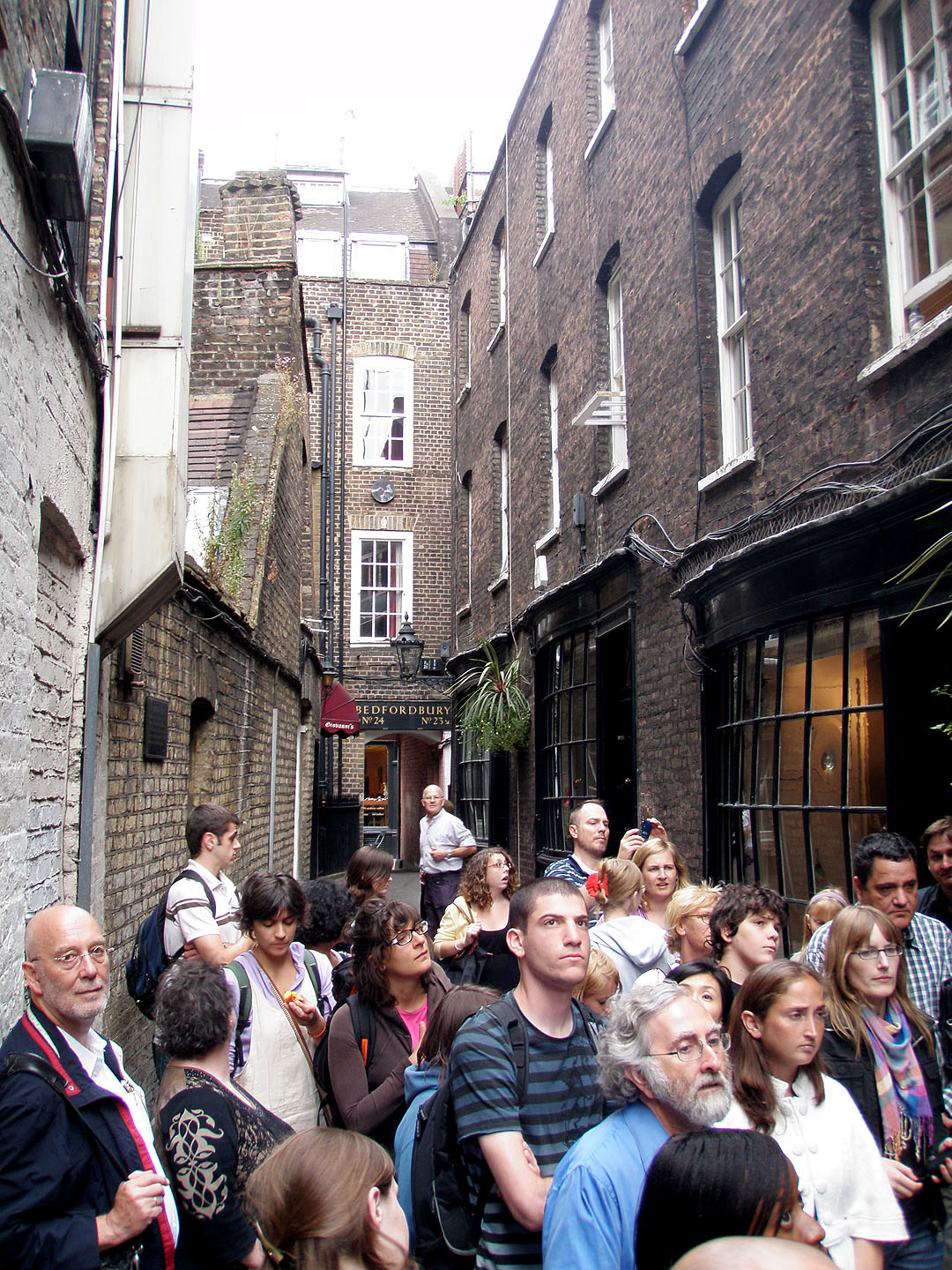
Outside the impressive St Pancras church not far from Sherlock's digs, I catch a number 58 'omnibus' down to Aldwych, then walk along the river to Embankment tube station to meet the walking tour. London Walks are great. You just show up and pay the guide: £8 for adults, £6 for students or concessions. The tours last two hours. Today, Richard IV is our guide, so called because there are four guides called Richard employed by London Walks. I’ve been on two London Film Walks with him and he’s very knowledgable. On my last walk - 'The West End on Film' - there were only half a dozen of us. Today there are more than forty: of all nationalities and ranging from kids to greybeards: surely a testimony to the enduring popularity of Sherlock Holmes.

Richard starts us out at Victoria Embankment Gardens then walks us up Buckingham Street, where Conan-Doyle had a pied-a-terre. Then along the back of the Alelphi, up the Strand past Simpsons, left on Southampton Street to see the Lyceum Theatre and the original offices of the famous Strand Magazine. We move on to Covent Garden, through a warren of hidden alleys with working gas lamps and the smell of urine (not much has changed there) towards St Martin-in-the-Fields church and Trafalgar Square.

Along the way Richard shares facts and anecdotes about how Conan-Doyle went from being a struggling doctor to become the fabulously famous and successful "J.K. Rowling of a hundred years past". My favourite quote of Richard's is when he tells us that "Sherlock Holmes stories are not meant to be analysed; they were written to entertain."

Finally, we end up a the picturesque Sherlock Holmes pub near Craven Street. Here you can see another replica of Sherlock Holmes' study on the first floor. Their menu offers delightful dishes like Hounds of the Baskervilles (i.e. toad-in-the-hole) and Mrs Hudson's Steak and Mushroom Ale Pie. For dessert you can try a traditional pudding like Spotted Dick with Custard or Treacle Sponge. Or you can just sit outside and sip a half of bitter or a soft drink beneath a frosted portrait of Holmes, Watson and their genius creator, Sir Arthur Conan Doyle. Long may his detective hero endure!

Friday with Sherlock Itinerary:
Morning: Sherlock Holmes Museum 221 Baker Street NW1 6XE
Coffee: Speedy’s Sandwich Bar 187 North Gower Street NW1 2NJ
Lunch: Sherlock Holmes Restaurant 10 Northumberland St WC2N 5DB
Afternoon: In the Footsteps of Sherlock Holmes walk, Embankment Tube
Evening: The Secret of Sherlock Holmes, Duchess Theatre, WC2B 5LA
or a night in with a Sherlock DVD of your choice:
Richard IV recommends Jeremy Brett Sherlock Holmes TV series
And of course BBC's fab Sherlock!

"Elementary, my dear Watson!"

Wednesday, July 14, 2010

Inspiring Kidslit

Just back from Premier Christian Radio where I was invited to talk about children's books on their Inspirational Breakfast show. Here are seven of my favourite inspirational children's books, (though I discovered all but one as an adult.) Also, three of my favourite quotes about spirituality and writing.

‘Writing is not an occupation; it is a way of life, in a sense not altogether unlike that of a religious devotion. It is a means of discerning what one feels and believes about life…’ Walter van Tilburg Clark, author

‘Why did God create mankind? Because God likes stories.’ Jonathan Sacks, chief rabbi

'Jesus was not a theologian, he was God who told stories.' Madeleine L'Engle, author


MY FAMILY & OTHER ANIMALS by Gerald Durrell (1956)
Gerald Durrell was ten when his family moved to Corfu in 1935. Thanks to a photographic memory, he remembers every detail of each glorious day spent on the colour-saturated, sun-soaked island. His older brother Lawrence is the one who claims literary greatness, but for my money Gerald beats him hands down. Full of the sights, sounds, tastes, smells and animals of a Greek island, this book alternates between being uproariously funny and deliciously descriptive. An early scene with the Durrell family's hilarious entry into Corfu town still leaves me helpless with laughter. A pure delight.

ISLAND OF THE BLUE DOLPHINS Scott O'Dell (1960)
This is the story of Karana, a twelve year old Native American whom tragedy abandons on an island off the coast of California. Alone except for a pack of wild dogs, Karana shows astonishing bravery and resourcefulness. Scott O'Dell shows us a world of great beauty: otters eating abalone in their kelp beds, a skirt made of shimmering cormorant feathers, a white dog howling in a grotto, a tidal wave: blood red in the setting sun. And dolphins, of course. When O'Dell died his family scattered his ashes over the glittering blue Pacific and as they turned for home, a dozen leaping dolphins escorted the boat back to shore. A fitting end for the masterful storyteller of this children's classic.

A WRINKLE IN TIME by Madeleine L’Engle (1962)
Fantasy sci-fi for kids which deals with themes of evil, self-sacrifice and the power of love. L’Engle was a theologian with a great passion for physics and science. My fourth grade teacher read us this book in the lazy after lunch period and that is my happiest memory from primary school. The Christian message runs under the surface but is all the more powerful for being veiled.

I AM DAVID by Ann Holm (1963)
A boy escapes from a nameless camp in a nameless country. With nothing but a map and a compass he crosses Europe to find the mother he has never known. He is wary, distrustful, older than his years. And yet in many ways he is an infant. His journey across Europe is a kind of rebirth; he discovers new colours, like the colour of the sea under a summer sun; new tastes, like the taste of an orange; he learns to trust: people, a dog, God. This is a timeless story of the triumph of persistence and courage over a truly evil opponent. There is one scene of self-sacrifice which is unforgettable. And the ending is deeply moving.

TRUE GRIT by Charles Portis (1968)
'People do not give it credence that a fourteen-year-old girl could leave home and go off in the wintertime to avenge her father's blood…' So starts one of the best Western novels ever written. Mattie is looking for a man with 'true grit' who will help her hunt down her father's killer. She settles on Rooster Cogburn, a hard-drinking, walrus-moustached cowboy. But really Mattie is the one with 'true grit'. Roald Dahl said it was the best novel to come his way in a long time and Donna Tartt writes 'I cannot think of a novel - any novel - which is so delightful to so many disparate age groups and literary tastes.' Probably my favourite book of the moment.

KENSUKE’S KINGDOM by Michael Morpurgo (1999)
I once met Michael Morpurgo and he was so polite. He is also gracious and compassionate. Those qualities shine out in this moving story of a boy's survival on a desert island. It's got all the best ingredients: a faithful dog, a strange but magical world, growth through hardship. Sol Stein's definition of how a writer should be polite to his readers is this: Never take the reader where they want to go. If that is true, then Morpurgo is the best kind of author, one who is polite in his life and in his writing.

PEACE LIKE A RIVER by Leif Enger (2001)
Echoes of To Kill a Mockingbird and True Grit in this best-selling book. The novel is narrated by eleven-year-old Reuben, an asthma-sufferer who lives with his single father, his older brother Davy and his precocious younger sister Swede. (She is only eight but writes epic poetry.) After Davy commits a crime and breaks out of jail the family goes on the run into the Badlands of North Dakota. You could call this a modern western. With miracles.

Friday, June 25, 2010

Embalmed in Honey

As an author of 17 novels and a dozen short stories, the most frequent question I get asked is "Where do you get your ideas?" Well, from books like Vicki Leon's is one place!

I bought the wittily titled Working IX to V a few years ago and have been dipping into it with great pleasure. It's all about strange jobs and careers from Ancient Greek and Roman times. She mentions well-known jobs like Gladiators, Pirates, Vigiles, Bakers, Garum-makers, etc. But she also talks about less well-known careers, that of the Armpit Plucker, Amber scout, Cryptologist and Funeral Clown. In one of her accounts, that of the Stercorarius (manure salesman), she mentions the ancient Roman urban myth of a giant octopus in the sewers. This one line gave me the idea for the entire plot of a new book I am working on called The Sewer Demon.

Vicki Leon's latest book, hot off the press, is called How To Mellify a Corpse. Glancing through it, I see she covers topics such as Gems and Gem fakery (idea there for a counterfeiting gem-maker); Stealth Bombs and Stench Warfare (more ideas for deadly poisons); Model flying dove designer Archytas (would be good for a slapstick plot). There is also a chapter about how Alexander the Great decided to be embalmed in honey (i.e. mellified) rather than be cremated like a good Greek boy. That's where the title of the book comes from. Vicki is also posting more free ideas on her great blog called Historical Detective.

Vicki Leon is erudite and witty. Here are some of her throw-away lines: "The Greeks had an edifice complex", "Entrail reading ... splashy in multiple senses of the word", "In days of yore, honey got a lot of buzz", etc.


Above all she is a genius at linking the ancient and modern.
Witness the following chapter headings:
Religious Syncretism: The Grinch who stole Saturnalia
Refrigeration: The Big Chill B.C.
Acoustics: The first surround sound
Ghosts and worse: Necromancing the Stone
Arena Addiction: Franchising Blood and Sand
Archimedes part 1: Early googling

The Sewer Demon
Vicki's books are a veritable gold-mine of ideas for writers like me.

Teachers can use her fun topics as starting points for projects. 

And if you, a family member or friend is a lover of Classics then this is the perfect book for dipping in and out of in, maybe in the latrine!

How To Mellify a Corpse is fascinating fun and I give it X out of X. Enjoy!

[The first of the new Roman Mysteries Scrolls series for kids 7+ is The Sewer Demon. Future titles include The Poisoned Honey Cake and The Thunder Omen. The 17+ books in the existing Roman Mysteries series are perfect for children aged 9+, especially those studying Romans as a topic in Key Stage 2. There are DVDs of some of the books as well as an interactive game.]

Sunday, May 09, 2010

Introducing Threptus

I am hoping to write a Roman Mysteries spin-off series starring a beggar boy called Threptus. He appears in The Man from Pomegranate Street and a short story called "Threptus and the Sacred Chickens" from my final volume of mini-mysteries: The Legionary from Londinium. Here is an a brilliant imagining of Threptus by Minimus illustrator Helen Forte. If you want to help me think of a series title, please vote in the poll on the left!

INTRODUCING THREPTUS

Threptus is an eight-year-old Ostian beggar-boy who idolizes Lupus. After the death of the emperor Titus in AD 81, Lupus and his friends Flavia, Jonathan and Nubia have to leave Ostia in a hurry! Before they go, Lupus gives starstruck Threptus his wax tablet and stylus. On the tablet, Lupus has written: CARRY ON MY GOOD WORK. Proud Threptus is determined to become a detective, like his hero, and make the port of Rome a better place to live. He leaves his life of begging to become apprentice to a soothsayer named Floridius. But how can an ordinary eight-year-old beggar-boy make a difference? By using his wits to solve mysteries and overcome baddies, of course! The Roman Mysteries were for children aged 8 and up. These books will be suitable for children even younger, but existing fans will love them, too!

;)

Saturday, May 01, 2010

Advice from "Old Timers"

How do you research the Western genre when you live in London?

Last month my husband and I attended the Santa Clarita Cowboy Poetry and Music Festival. One of the best things about it was meeting lots of other Western movie fans. All of them were friendly and all of them gave us advice about things to do and see and places to visit.

We met Jerry and Sharon over the plaque of Graham Green on Newhall's Western Walk of fame. (Graham Greene played Kicking Bird in Dances with Wolves). They gave us some recommendations. They told us to go to Durango, Colorado and ride in the open car of the Silverton Railroad. (above) "The nearby Indian ruins are stunning", said Jerry. "Like Mesa Verde." They also said we should visit Williams, Arizona. There is a train tour of two days and two nights with all meals included. "And watch out for the natural spike in Sedona, Arizona," said Jerry. "You have never seen red rocks like them."

Sharon's favorite Western film is Murphy's Romance, a rom-com with Sally Field and James Garner. Jerry likes The Shootist, John Wayne's last film. It was filmed partly on the Warner Brothers Western lot (no longer there) and partly in Carson City, Nevada, near the governor's mansion.

Waiting for the shuttle to take us to Melody Ranch Movie Studio's for an open-air showing of High Noon, I got talking to Sampitch Kid, named after a river that runs through Utah. We talked about firing cap and ball revolvers and he told me I should check out the Single Action Shooting Society: http://www.sassnet.com "The closest you'll get to the Old West short of a Time Machine." Dang, that looks like fun! You even get to choose your persona and a period name. Hmmm. Maybe I could be my great grandmother Corinne Prince: schoolmarm, quilter and buffalo-hunter.

Standing in line for grub at the movie night, I got talking to Western journalist Mark Bedor. I told him about my new Western detective series set in Virginia City, Nevada in the 1860's. "So why are you here at the Melody Ranch?" he asked me. "To get a sense of the smell and sound and feel of a western town," I said. "The light, for example. When you walk into a saloon your eyes need to adjust because it's so dim in there." When I mentioned the light, Mark got excited. "Yes," he said. "I recently did Cavalry School and we were riding on the plains of Montana. I've never seen light like that big sky." "Cavalry School?" I said. Mark nodded happily. "I spent a week riding with Custer for Cavalry School. You can't understand it until you've done it." He gave me the link for an article he wrote and told me the website: www.uscavalryschool.com


"But I don't know how to ride a horse," I said.

"You want to ride?" said Mark. "Go to White Stallion Ranch in Tucson, Arizona. They will match you with the right horse and at the end of a week you'll be cantering and galloping." (Horses of the White Stallion)

"I know your books are set in Virginia City, Nevada," he added. "But you should also visit the Virginia City in Montana. And Red Rock, Utah." Mark also recommended some reading: John Gray on Custer, a book called Apauk, Caller of Buffalo by John Willard Schultz and Trails Ploughed Under by Charlie Russell. Mark even took a photo of me in my new buckskins with Richard. (photo by Mark Bedor)

Later in the week I went to an elementary school to talk about my other history mystery series, The Roman Mysteries. The class teacher's father picked me up in Santa Clarita and while we were driving to Chino he told me about Oatman, Arizona, a town named after a young woman kidnapped by Indians. "You can see the real thing there," said Dave King. "Once I went into a saloon to use the facilities and there were old timers there propping up the bar like in those Westerns. You can also see donkeys roaming the streets." Apparently there is an egg-frying contest on July 4th every year. (www.oatmangoldroad.org)

Thanks, "Old Timers", we'll definitely ride the railroad, sign up for a week at White Stallion and visit Oatman!

Monday, April 26, 2010

Cowboy Movies

I've just spent three days at the Santa Clarita Cowboy Poetry and Music Festival, doing research and making connections for my new series, The Western Mysteries. While I was there I asked all the cowboys, re-enactors and fans what their favourite Western movie was. If you want to find out, mosey over to my Western Mysteries Blog. Then tell me yours!

(Check out my own Western books for kids at carolinelawrence.com)

Top 3 Westerns?

Which three Western movies do you think might be the most popular among real cowboys and cowboy re-enactors? Go on. Have a guess. Then read on.

I've just spent three days at the Melody Ranch Movie Studio (where HBO's Deadwood was filmed) with my husband Richard, researching my new series of kids' history mystery books, The Western Mysteries. This is the 17th year they've held the Santa Clarita Cowboy Poetry and Music Festival and by all accounts it was bigger and better than ever. I chatted to lots of performers, re-enactors and fans and asked most of them what their favorite Western movie was.

I've already mentioned cowboy poets Yvonne Hollenbeck and Pat Richardson in my blog about Cowboy Poetry. Yvonne's favorite Western is Lonesome Dove and Pat's is High Noon. "Gary Cooper was a real cowboy," said Pat. "And they filmed a lot of that film right here on Melody Ranch."

On the last day of the festival, Sunday, Richard and I boarded the trolley at the La Quinta Inn to find a beautiful cowgirl: Miss Catherine Lane. She plays Belle Montana, heroine from dime novels of the 1880's. Her fave Western is The Good, the Bad & the Ugly. YES! That's mine, too.

On the trolley was also a passel of desperados from Tombstone. They are Law Dogs 'N Ladies, a tribute to the movie Tombstone. You'd think they all place Tombstone top but no. Susan plays Calamity Jane. Her fave Western is Quigley Down Under. Tim Fowler is Ike Clanton and his fave Western is Tombstone. Their son Kirk likes Lonesome Dove.

Other fans on the trolley voted: One for Lonesome Dove and one for High Noon.

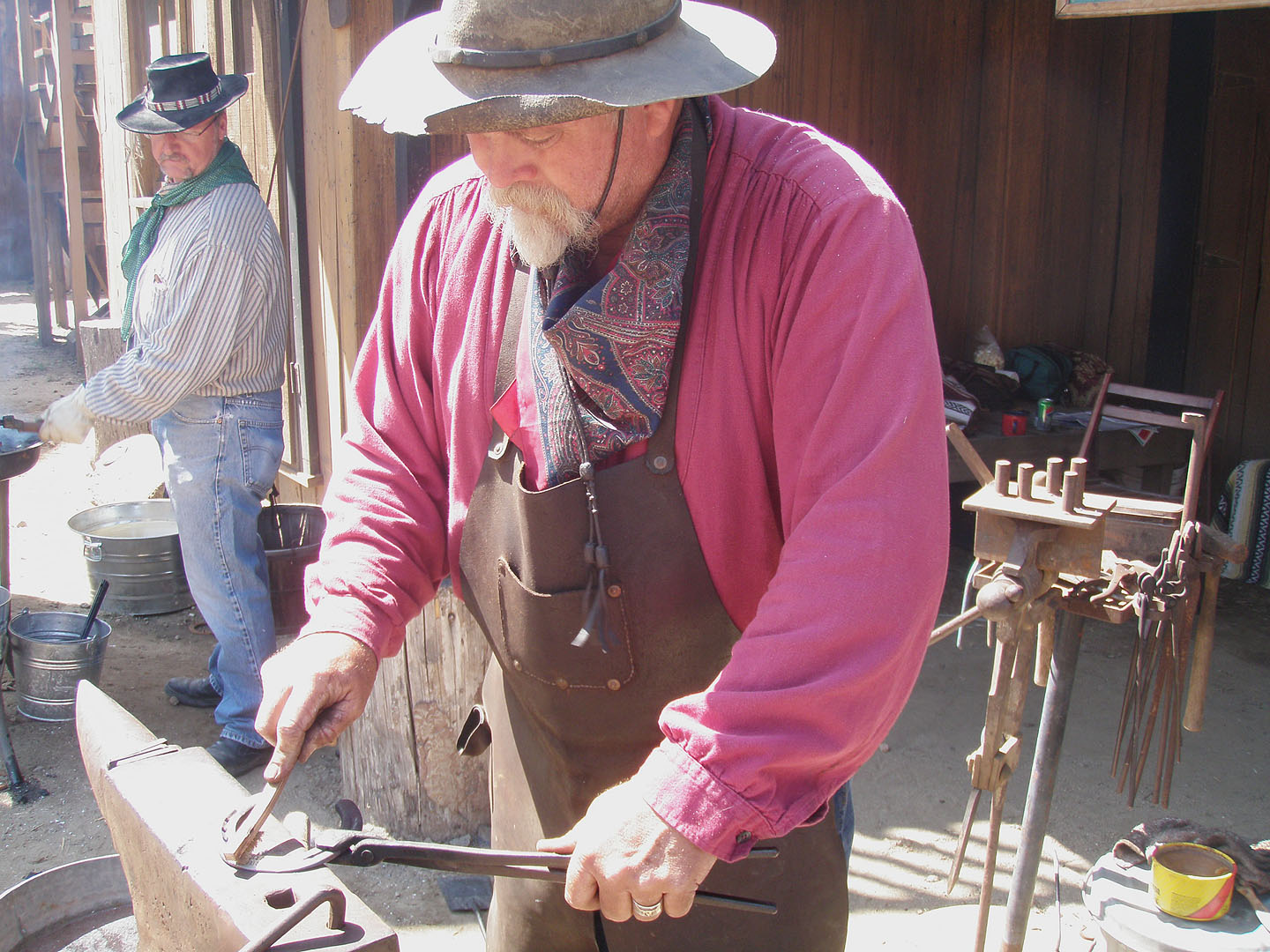
When we got to Main Street I wandered over to a blacksmith who was personalizing horseshoes. I figured I'd better get one inscribed with the name of the hero from my new series, but blacksmith Wishbone Smith said "P.K. Pinkerton" was too long. While he was hammering out "P.K." on a pony-sized horse shoe, I asked him what his fave Western was. "Lonesome Dove," he replied without hesitation, and proceded to quote Robert Duvall's character Gus. His son's fave Western was Tombstone. I was beginning to detect a pattern here.

David Rainwater the fiddler couldn't choose between Tombstone or High Noon. Lasso expert Dave Thornbury's top flick is Tom Horn and black-clad, bullwhip wielding Doc Durden from Virginia City's is... you guessed it: Tombstone.

There was some great music at the festival: a Civil War Brass Band, Indian flutes, some great rock/blues and of course tons of Western music. Richard and I loved it all. I met Rich Hillworth waiting to hear Celtic Cowboys outside the California Stage on Main Street. He lives near Lancaster and used to drive mule trains across the desert. His fave Western is Lonesome Dove. David Matuszak was selling the "Bible of Western films", A Cowboy's Trail Guide to Westerns, but he loses points by saying Richard's fave Western, Little Big Man it wasn't a Western! David's fave Western is Red River. A fabulously dressed couple named Todd and Holly loved The Big Country and Tombstone, respectively.

Everybody was telling us to get the peach cobbler and bottomless coffee made by the Chuckwagon guys so we got a bowl to share and bought the tin mugs you can refill all day. The cobbler was yummy but the coffee had grounds at the bottom. Now I know why those cowboys in the Westerns always toss the last bit into the sagebrush. We sat at a table with Carol and Dave, who told us about Cowboy Church! It was held that morning at 8.00 and they had some good ol' gospel cowboy worship. Too bad we missed it. They also meet the first Friday of every month at their pastor's ranch in Agua Dulce near the amazing Vasquez Rocks. Carol's fave Western is Tombstone and his is (the newer) 3.10 to Yuma.

By now I was pretty sure of the winner. On our way down Main Street the last time I did a double take. Was that Robert Duvall? Nope. It was Gus Curry. His fave Western? Lonesome Dove of course. He posed for me with the tastefully attired Mary Culver, who loves High Noon. Despite her vote, I think Lonesome Dove was definitely the top Western, followed very closely by Tombstone. High Noon came in a respectable third, according to my very unofficial and random poll.

So here is the answer to the question I posed:

Top Western?
1. Lonesome Dove
2. Tombstone
3. High Noon

The Santa Clarita Cowboy Poetry and Music Festival was fabulous and we will be coming back next year, hopefully with lots of copies of the first book in my new series, The Case of the Deadly Desperados!

P.S. I forgot to put up a picture of a delicious couple of other Tombstone re-enactors, bad boy Nathan and hurdy girl Colleen. Nathan wears dark blue glasses with a tiny mirror in one corner so he can see who's sneaking up behind him! (I didn't mention to Nathan that buffalo soldier Victor Williams told me blue sunglasses were worn by those suffering from V.D.) No prizes for guessing Nathan and Colleen's fave Western... But Lonesome Dove still moseys in at the top place.

(Find out about my Western detective stories for kids at carolinelawrence.com)

Saturday, April 24, 2010

Cowboy Poetry

What is Cowboy Poetry?

Yvonne Hollenbeck

I'm in the lobby of La Quinta Inn in Newhall, California, waiting for a shuttle to take me to Melody Ranch open weekend - research for my new Western Mysteries - and I am suddenly surrounded by cowboy poets. Fair enough: the official name of the Melody Ranch and Movie Studio Open Weekend is the Santa Clarita Cowboy Poetry and Music Festival.

So I ask a lady sitting nearby, "What is Cowboy Poetry?"

She is Yvonne Hollenbeck, entertainer, author and 'Cowgirl Poet of the Year'. (http://www.cowboypoetry.com)

"Well," she says, "cowboy poetry talks about cowdogs, horses, the western way of life, in poetry."

'So it's like Country Western music without the without the music?" I ask.

"And without the country," says Andy Nelson, who is sitting behind her. He is a cowboy poet who has the 'Clear Out West' radio show and has written a book called Riding With Jim.

"We like to think our poetry can stand on its own", says Yvonne. "Some times the best song is a bad poem set to music. I'm quoting Sting," she adds.

On my left is Pat Richardson. He writes poetry, does his own illustrations and is a popular performer on the cowboy poetry circuit, along with Yvonne and Andy. He gives me a signed copy of his book Unhobbled.

I flip through the book and my eye falls on a poem called 'Pony Eggs'. Apparently when Pat was a little boy, longing for his own horse, his dad told him coconuts were pony eggs. "You'll notice they got hair and fur on them, and when they hatch out there'll be a pony in each one!" The poem tells how Pat got his 'revenge' many years later.

Another poem called Five Card Draw has this verse:

One night Ben had a full house,
Bet his saddle, spurs an' rope;
Zeke giggled at his foolishness
and raised three bars of soap.


That poem goes on for stanzas until a humorous and bloody ending.

According to Wikipedia, Cowboy Poetry was told around the campfire, with humor, rhyme and tall tales. I think of Mark Twain, and the tall tales that got him into such trouble in Virginia City.

What is surprising to me as I attend the Cowboy Festival is how popular Cowboy Poetry still is. Probably because in America ranching is still a major industry.

Later that day Richard and I are sitting in a sold out tent of maybe 700 people. Every third head in this place wears a cowboy hat. And most are real cowboy hats. We are all watching a white-mustached guy called Dave Stamey who is obviously a huge star on the cowboy poetry circuit. And deservedly. He is like a singing Sam Elliott: a brilliant musician whom everybody loves. Just outside the seating area, I see two young women gazing at him adoringly and mouthing the words of his songs, including "I'm not old, I just been used rough..." Wow. Imagine having groupies when you're in your 50's and not even Mick Jagger!

I'm sitting next to a woman from New Mexico. She tells me her husband wanted to come but it was his busy season and he had to visit some ranches.

"What does he do?" I ask.

Above the sound of the music it sounds like she says: "He shoots horses."

"WHAT?"

"He's a farrier," she says. "He shoes horses."

"Ah," I say. But already I am thinking: There's got to be a cowboy poem in that.

.

High Noon at the Cowboy Festival

I've been looking forward to the Santa Clarita Cowboy festival for over a year. It's at the Melody Ranch where lots of famous Westerns were filmed, but it's only open one weekend a year.

We booked tickets online - our weekend pass was easy to get but the tours of the studio part of the ranch were sold out within the first hour. They only have places for 30 people. (Fix this, organizers!) We DID get tickets for the Movie Night. This is an outdoor showing of a classic Western at the end of main street, following dinner. Hmmm. What would that be like?

I booked us in to the La Quinta Inn, because they have a shuttle to and from the festival. Most people drive to a big car park behind the tracks on 13th Street in Newhall. It turns out that there is no shuttle from the hotel for the Friday Movie Night, but my iPhone tells me we can walk it in just under an hour. When I ask directions at the front desk the La Quinta Director of sales, Michelle Crawford, offers to drive us into Newhall. That's what I call service! It's just after 3.00pm and the weather is warm but not hot. California has been experiencing a cold snap. Michelle drives us to Newhall, which is a really boring name for this charming cowboy-flavored town. The William S. Hart ranch and park are here, plus a Cowboy Walk of Fame. The town should be called something more evocative like Coyote Flats or Buffalo Run. (There are some buffalo on the grounds of William S. Hart's estate).

Main Street is charming, with a very Mexican feel. Richard and I have a drink at the Trocadero, a new establishment among some older taquerias. Then we look for names we recognize on the Western Walk of Fame. Lots of names are unfamiliar but we know Powers Boothe from Deadwood, Bruce Boxleitner from Gods & Generals and Graham Greene from Dances with Wolves. While we are standing over this last plaque we get talking to a nice couple: he in cowboy hat, she in cowboy boots. We enthuse about Westerns for a while, then promise to look out for each other at the festival.

Richard and I wander down to peek into the William S. Hart park, just closing, then trek back to the shuttle pick-up spot for 6.30pm.

It is pretty easy to tell the other punters: most are wearing cowboy hats. I get chatting with Sampitch Kid, who has come all the way from Utah. Two Santa Clarita buses take about a hundred of us down some ranchy residential streets: Placerita Canyon, etc. Then through the gates of Melody Ranch, Spanish style of course, and here we are on the main street of a cowboy town. It looks great, with a bank, a jail, and plenty of saloons.

The sun is low in the sky. We line up to get our seat numbers, then bag a chair at our round, checkered tables and look around until movie time at 7.00. Merchants are already setting up. Pictures of horses, vintage wear, cowboy hats and a saddelry. Gary posed on one of his saddles. They are beautiful and they cost about $9000 a pop. Lots of work, leather and silver go into those.

Richard spots a buckskin dress and I can't resist trying it on. All right, I buyt it! I can do school events wearing it. They call us to dinner. This means getting in a long line but that is fine because you can get chatting to people. We met a fascinating journalist named Mark Bedor who was telling us all about his week learning to spend a week Custer's Cavalry. He also told us the best place to learn to ride a horse: White Stallion Dude Ranch, in Tucson, Arizona.

Food is a choice of chicken or beef, with nice yams, sauteed peppers and salad. Much nicer than any cowboy ever had on the range. The movie is High Noon, and it is introduced by Michael Blake, the son of Larry J Blake, in an uncredited role as the owner of the saloon where Gary Cooper punches a guy. He told us whenever he got bullied at school he would ride his bike home humming the theme to High Noon. It was one of the first films to use a theme throughout, and the famous ballad 'Do Not Forsake Me O My Darling' was in the charts even before the film came out.

(Here is a bit of trivia. Tex Ritter sang the song in the film but Frankie Lane had the hit.)

Everyone is quiet, almost reverent, as the film starts and although I saw about 30 frosted layer cakes for dessert, nobody makes a move to go and get a piece. We all want to watch the film. It is fun watching as people cheer and boo and everybody laughs at the end when a voice from one of the tables remarks 'You're supposed to clap and cheer at the end of a B Movie.'

We are all cold by now and hurry back down to the shuttle buses. Helpful volunteers wave the way with flashlights. Richard and I are the last ones to get on the first bus. 'Can anybody here give us a ride back to La Quinta Inn?' I say in a loud voice to the whole bus. I needn't have worried. Cowboys are all gentlemen.

Wednesday, April 07, 2010

Dubai Lit Fest '10

If you should find yourself having tea at the Burj Al Arab this weekend, take a moment to glance at the person at the next table - there's a better chance than usual that it'll be somebody famous. Same thing goes for anyone taking an abra ride on the creek, getting a henna tattoo at a desert camp, or shopping for gold chains at Deira souq: bring an autograph book, just in case. Chris Wright, Dubai National Friday 12 March 2010

I am reading those words over breakfast at the luxurious Intercontinental Hotel in Dubai, and put my paper down. I can indeed look around and see any number of famous authors: Martin Amis, Kate Adie and Alexander McCall Smith, to name but three. And some stellar children's authors, too: Darren Shan, Michelle Paver and Coln Iggulden.

I'm not as well-known as some of the authors at the Dubai LIterary Festival, but one of the organizers had heard me speak in Cambridge and so I got an invitation. That's how I come to be in Dubai the shopping in the Gold Souk with Garth Nix, Joe Abercrombie and Jackie Wilson (above, right), or getting a henna design applied to my hand at the 'Bedouin Desert Experience.' (above, left) According to my newspaper article, last year "the distinguished Chinese writer Jung Chang rode off into the desert on a camel" and she had to be rescued by a man on horseback. And the tour guides "lost three or four authors in the Spice Souq. They were too busy asking questions and didn't follow instructions." But Dubai is a friendly, multi-cultural place with virtually no crime, so getting left behind is not too worrisome.

The Emirates Literary Festival doesn't pay authors an honorarium, but they do something much better. They fly you and a partner business class on Emirates airlines and they put you up in a four star hotel. When we arrived at Dubai's new airport we met children's illustrator Polly Dunbar. As our courier drove us in a golf-cart to passport control Polly said the airport made her feel like Dorothy in the Emerald City. We are whisked through immigration and driven to our hotel, the Intercontinental in an area of Dubai called Festival Village.

Five years ago, says our driver, this was all sand. Now there are canals, a marina, hotels and shopping malls. In the intense and humid heat of summer, the air-conditioned malls are the place to hang out with friends and family. The morning after our arrival I wander around with my husband Richard. Apart from the shop signs in Arabic - TOYS R US, Marks & Spencer, etc - and the exotic attire of the shoppers, I could be at Bluewater or some American supermall. Even the music is ambient eurochill.

Dubai is proud to have lots of record-breaking landmarks. The marina at Festival Village is going to be expanded to become "the longest man made channel in the world" which will result in the resultant piece of isolated land becoming "the largest man-made island in the world". So our guide says. I'm not sure if that is true or not, but at the moment Dubai does have the tallest building in the world, the Burj Khalifa (below). The engineers of this Tolkeinesque spire have even allowed room to add extra floors if another bulding has tries to steal it's claim to glory. Or perhaps I should say its "claim to the Guinness Book of Records".


I am learning all this and seeing quite a bit of Dubai because the organizers have laid on complimentary excursions. They have also given us plenty of free time. In the four days I am here, I only have to do two talks. Even with optional extras like local radio interviews and panel sessions there is still time to soak up the warmth, explore a new country and get to know some of the other authors.

Because of free wi-fi and coffee, I hang out in the Green Room - the authors' sanctuary. On my first morning I meet Paul Blezzard, a charming and dynamic author/networker who rules the Green Room roost from his power corner. We tweet each other from across the room and he points me to his own BLOG and his elegant impressions of the first Dubai Lit Fest last year. Blezzard got to hang out with Kate Adie and Louis de Bernieres, who waxed eloquent about Dubai and likened it to "Ozymandias".

One of the highlights of my trip to Dubai is meeting some literary Dubai twitterers at a Cafe near the InterCon. They are charming, friendly, intelligent, aware, and they hail from all different parts of the world: Pakistan, the Philippines, Palestine, Greece and Russia to name just a few. Alexander McNabb invites me to join his panel about Social Networking and its place in literature, culture and the dissemination of ideas. Chris Cleave joins us and also Paul Blezzard, who namedrops happily. On the screen behind us is a Tweetfall: a real time feed of what all the Twitterers in the audience think of us. There are two conversations going on at one point and laughter from the audience isn't always at what we are saying, but at amusing comments about Paul putting his feet on the chair. (photo above right by Wajiha Said)

Kate Adie is here again this year. She tells us that last year at this time the building sites were crawling with workers. Now the sites and cranes are ominously deserted. And that's saying something considering "a third of the world's cranes are in Dubai." That's according to our guide on one of the final excursions of the Festival, the double-decker bus tour of Dubai. There are only about ten of us on the tour, which took us to see the tallest building, the biggest hotel and the only seven star hotel in the world (the Burj Al Arab, right). It is only on this final day that the appeal of Dubai fades. As we pass the biggest shopping mall in the world, our guide tells us it has an indoor ski slope with "real snow that costs 8,000 barrels of oil per day to maintain".

This shocking fact does not go down well with any of us. Nor does the news that a British couple have been imprisoned for kissing in public. I suddenly realize that Dubai desperately needs to cultivate culture and multiculturality. For that reason alone, the Emirates Lit Fest is a Very Good Thing. Anyone who gets a chance to participate should go for it.

Friday, April 02, 2010

Winged Sandals!

.
In my interview with Lucy Coats on her first MYTHIC INTERVIEW FRIDAY, she asked me which power I would like to have - and what I would do with it.

I said I would love the winged sandals of Mercury/Hermes, so that I could fly!

As if on cue, the cool Dr Laura Flusche posted this picture of Beatrice Ong's scrumptious Ms Mercury shoe, on her Eternally Cool Blog.

Isn't it fab?

Tuesday, March 23, 2010

Beckham as Achilles

In the talk I give at schools, How to Write a Great Story, I always start by telling them about Achilles and his heel and why it is necessary to give your hero an 'Achilles Heel'. Last week the great David Beckham tore his Achilles tendon. Britain's poet laureate, Carol Ann Duffy, wrote this brilliant poem about him, entitled 'Achilles'.

Achilles

Myth's river - where his mother
dipped him, fished him, a slippery
golden boy flowed on, his name on
its lips.

Without him, it was prophesied,
they would not take Troy.

Women hid him, concealed him in
girls' sarongs; days of sweetmeats,
spices, silver songs...

But when Odysseus came, with an
athlete's build, a sword and a shield,
he followed him to the battlefield,
the crowd's roar.

And it was sport, not war,
his charmed foot on the ball...

But then his heel, his heel, his heel...


.

Saturday, March 20, 2010

Shooting Soap

Every historical author needs at least one good expert source. One of mine is 'Hawkeye', a British gun-dealer and expert on Civil War period firearms.

I recently sent him a few pages of my first Western Mystery, to make sure I had details of the guns right.

In the first Western Mystery, The Case of the Counterfeit Injuns, my hero gets shot with a Smith & Wesson seven-shooter. It's only a .22 but my hero is only a kid. So how much damage would it do? Would a slug from a .22 knock down a 12 year old if fired at close range? Would it pierce buckskin? Or just bounce off? Can you even call a .22 a slug? Shouldn't you call it a 'pea'? It's tiny! (above)

I sent the relevant pages to Hawkeye and he sent back this fascinating reply:

I did a little test for you myself. Taking 10 rounds of modern .22 short, I pulled out the bullets, tipped out the modern nitro powder & replaced it with 4 grains of fine black powder, then put the bullets back on top. Fired from the old Eureka - barrel length 2 1/2 inches, it penetrated 1 1/4 inches of pine at 6 yards range. At the same distance it penetrated a soft leather belt pinned to a new bar of soap and exited the rear of the soap through a large hole. In my opinion the Smith & Wesson No. 1 with its 3 inch barrel would perform almost identically.


(above: Hawkeye's 2 1/2 inch barrel Eureka)

Ouch! So the answer to my question is yes, you can call a .22 ball a 'slug' because it can pierce buckskin and make a nasty hole at close range!

.

Sunday, March 07, 2010

Get the bang right

I am having another fun session shooting cap & ball Colts today at a shooting club in South London. My mentor - let's call him Hawkeye - is sharing some secrets of how the movies get it all wrong.

1. There are five other shooters in our blind and I'm nearly deafened by the reports from their cap & ball revolvers (they are mostly .44s) even though I am wearing 'ear-defenders'. I remark on this to Hawkeye and mention The Proposition, a great Australian film which starts with a shootout where the gunshots sound like popguns. 'In films,' he says, 'they never get the bang right.' I jump as another deafening shot goes off behind me. 'And the more powder', says Hawkeye, 'the louder the bang. Also, more powder meant the ball would be more accurate. It's trajectory would be flatter.'

2. In the real wild West, they never held the gun sideways or with both hands. 'I think Hawaii Five-O is the first time you see cops holding a gun with two hands,' says Hawkeye. 'And the Pulp Fiction type holding it on its side is ridiculous. And what Jimmy Cagney does in the old films is criminal. He jerks the gun downwards as he fires.'

3. 'In my book,' I say, 'I have a ball from a .22 knock down my 12-year-old hero.' Hawkeye snorts. 'Even a shot from a .44 wouldn't throw you against the wall', he says. 'It would take a .50 calibre ball, from one of the big Sharpe's for example, to knock you down.'

4. Hawkeye says for a while there was a ridiculous fad for ricochets on American TV Westerns. (You know the kind of thing: B'dang! B'dang!) Hawkeye says lead balls go thunk. They don't bounce off things.

5. In For a Fistful of Dollars, a machine gun stands in for a gattling gun. Wrong! (I also noticed lots of ricochets in that film, too.)

6. In The Good, the Bad & the Ugly there is a delightful scene where Eli Wallach's Tuco (right) makes up a gun using the best parts from others. Wrong! (In his autobiography, The Good, The Bad, and Me, Wallach admits he was just riffing and having fun).

7. One bullet wouldn't necessarily have killed you.
Shooter: Bang!
Shootee: Argh! (slumps to ground, instantly dead.)
In actuality, one of the Younger Gang was shot 28 times... and lived long enough to witness the age of aviation. According to Hawkeye.

8. Cool leather holsters with matching cartridge belts? Not so common. Men often carried guns in their pockets or on a piece of string or in a sack. Many so called gunmen didn't even know how to fire a gun properly. Says Hawkeye.

9. In the film Winchester 73, Jimmy Stewart's character shoots a bullet through a washer tossed high in the air. Hawkeye scoffs at this, too. He says that might happen if the washer was stationary, but never while flying through the air.

10. Did they ever get it right? 'Yes,' says Hawkeye. 'In John Wayne's last film, The Shootist, he tells the boy that although the grouping of the bullets is important, a target never shoots back. The important thing is not to flinch.'

Note to self: In the Western Mysteries I should avoid ricochets, people slammed against walls or knocked over by slugs, single shot instant death, amazing accuracy, and most important of all, I must get the bang right!

.