Showing posts with label Comstock. Show all posts

Monday, October 31, 2011

Twain's Bloody Massacre

Insensitive, moi?
Was a real life incident in July 1863 part inspiration for one of Mark Twain's most famous newspaper hoax articles?

[Warning: I am about to quote some fairly graphic descriptions of death by Bowie knife]

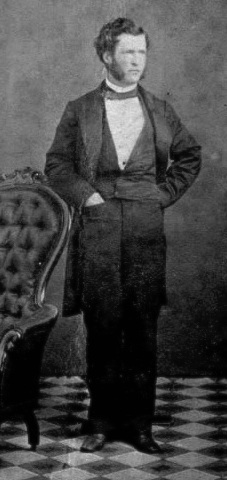
Before Mark Twain was a genial, white-haired, much-beloved raconteur, he was a hard-drinking, hot-tempered, pipe-puffing reporter with "mutton chop" sideburns and no mustache. (left) He lived in Virginia City (famous for being the setting of the TV series Bonanza) and he wrote for the Territorial Enterprise Newspaper. The Comstock, as that region was called, was wild and woolly, full of "thieves, murderers, desperadoes, ladies, children, lawyers, Christians, Indians, Spaniards, gamblers, sharpers, coyotes, poets, preachers, and jackass rabbits." Despite this rich vein of journalistic gold, Sam Clemens – who had not yet adopted the pseudonym Mark Twain – was not afraid of slandering local residents or even of making up hoax stories to fill blank pages of the paper.

His first hoax, early in October of 1862, was an article about a Petrified Man found in the Nevada desert east of Virgina City. Twain describes a prospector with a wooden leg who was found turned to stone at a place called Gravelly Ford. He describes the man's position, and if any of his readers had bothered to adopt the pose – or even mentally visualise it – they would have realised immediately that Twain was joshing them. (He even signed that article "Josh") One of his main aims in writing this hoax piece was to vex an enemy of his, a man named George Sewall with whom he was feuding. And he succeeded. People generally do not expect the printed word to be an outright lie.

A year later, Twain wrote another hoax, a truly grisly piece about a man living in Empire City who supposedly kills and mutilates his family, cuts his own throat from ear to ear, then rides three miles before dropping dead on the steps of a Carson City saloon. Once again, careful readers would have read the clues and figured out that this story wasn't true. After all, how can a man ride three miles with his throat cut from ear to ear? (see map above right)

But readers of the morning paper pushed away their breakfasts in horror upon reading Twain's grisly report of the unhinged father's murder and mutilation of his family.

Territorial Enterprise readers put off their breakfast by Twain's gory article

Territorial Enterprise, October 28, 1863

A BLOODY MASSACRE NEAR CARSON
From Abram Curry, who arrived here yesterday afternoon from Carson, we have learned the following particulars concerning a bloody massacre which was committed in Ormsby county night before last. It seems that during the past six months a man named P. Hopkins, or Philip Hopkins, has been residing with his family in the old log house just at the edge of the great pine forest which lies between Empire City and Dutch Nick's... About ten o'clock on Monday evening Hopkins dashed into Carson on horseback, with his throat cut from ear to ear, and bearing in his hand a reeking scalp from which the warm, smoking blood was still dripping, and fell in a dying condition in front of the Magnolia saloon... [even more graphically bloody details follow, which you can read HERE.]

The Journals of Alfred Doten

I've been reading (and re-reading) the Journals of Alfred Doten as part of researching my Western Mysteries stories set in and around Virginia City in the early 1860s. Like Mark Twain, Alf Doten was a failed prospector turned journalist. Throughout his life he kept meticulous and detailed journals, recounting the weather, cost of things and concrete details of life in the California gold fields and later on the Comstock, in Nevada.

This morning over breakfast I pushed away my own yogurt and strawberries in dismay as I read Doten's sad and distressing entry for 16 July 1863.

July 16 - About 8 oclock this evening a man by the name of Patrick Comerford committed suicide at the Mineral Hill tunnel, some 2 miles below here [Como, Nevada]. He was living near the mouth of tunnel with some half dozen others - he went into the tunnel and with a bowie knife he cut his throat - first ripped it up from upper part of breast bone to his chin & then cut across nearly from ear to ear, severing the jugular, windpipe &c - did the job securely - his partners heard him groan and went in and found him - he died in a few minutes - one of them immediately came up to town &c told the story - several people went down there - Briar went - he acted as Coroner and the jury gave verdict in accordance with the facts - he was an Irishman and about 35 or 40 yrs old - no reason could be assigned for the rash act - he seemed to be all right enough but somewhat troubled in his mind, and at times somewhat abstracted 
Journal of Alfred Doten p 719

As a writer who constantly draws inspiration from things I read and hear about, I am pretty sure that poor Patrick Comerfield's bloody suicide in July 1863 was partly the inspiration for Twain's "Bloody Massacre" hoax, written three months later. The gruesome details of Comerford's suicide must have spread like wildfire even if not reported by local papers.

Thus it is not too surprising that many Comstockers believed Twain's similar but greatly embellished account of a bloody suicide by Bowie knife. In fact, the article caused such horror and outrage that, Twain had to print this retraction the very next day:

Territorial Enterprise, October 29, 1863
I TAKE IT ALL BACK
The story published in the Enterprise reciting the slaughter of a family near Empire was all a fiction. It was understood to be such by all acquainted with the locality in which the alleged affair occurred. In the first place, Empire City and Dutch Nick's are one, and in the next there is no "great pine forest" nearer than the Sierra Nevada mountains, etc. 

[For more retrospection about this hoax read Mark Twain's Sketches New and Old.]

You would think Twain might have learnt his lesson, but no. Six months later, in May of 1864, he wrote a different sort of hoax, this one about the Ladies of Carson City. As a result of this third hoax the hot-blooded young reporter was challenged to a duel by pistol and had to flee Nevada. But that's another story.

[The second book in my Western Mysteries series, out June 2012, was originally going to be called The Case of the Petrified Man, but had to be re-named The Case of the Good-Looking Corpse as the first title was not considered exciting enough for kids. Like many writers of the past, I am still getting inspiration from events of the bloody Comstock as recorded by Sam Clemens, Alf Doten and many others.]

Thursday, September 22, 2011

ABC of the Western Mysteries

A basic GLOSSARY for British children reading the Western Mysteries who might not know what a Desperado or a Stagecoach is... or where Nevada and Utah are.

America in 1862

A is for America - the country across the Atlantic Ocean where people speak English with funny accents. It is also known as the United States, but in 1862, the states only went halfway across America with a few on the west coast. A great chunk of land in the west was called "Territory". Towns in the Territories were often lawless and wild.

Is P.K. a Desperado?
B is for Ball & Blackpowder - this is what old-fashioned bullets were made of. You also needed lint and a tiny little metal cap that you put on the back of each hole in the cylinder of your Revolver to make a spark which set off the powder and get the ball flying towards its target. Later on they put the cap and ball and powder in one metal case called a cartridge. This is what we now call a Bullet.

A Chinese Youth
C is for Chinese (not Cowboys) - in the early 1860s, when The Western Mysteries are set, there were far more Chinese out west than Cowboys. Cattle drives did not begin in earnest until 1866.

D is for Desperado - a desperate person who is usually on the run after committing murder, robbery or other serious crime.

E is for Emigrants - most of the people who flooded to America in the 1800s were emigrants from Euorpean countries like England, Scotland, Ireland, Germany, France, Russia, etc. And, of course, the thousands from China.

F is for Frontier - the place in the American West where settled land gave way to wilderness populated by wild animals and Native American tribes.

A Gunslinger
G is for Gunslingers - almost everybody carried a firearm in the 1860s out west, even women & kids.

H is for Horses - The West in the early 1860s was a world mostly driven and powered by animals with hooves: horses, mules & oxen.

An Indian Tomahawk
I is for Indians or Native Americans - the tribes of people already living in North America when the emigrants arrived were as varied as the people from European countries, sometimes more so.

J is for Jackrabbit, also coyote, grizzly bear, prairie dog, buffalo and all the other unique wildlife found in the West.

A Kerosene Lamp
K is for kerosene or coal-oil, which is what folk used to light their lamps. They used candles, too. In 1862 gas had not quite reached Virginia City.

L is for Lincoln - who was president between 1861 and 1865 when America was fighting a terrible Civil War over slavery and freedom.

26-year-old Mark Twain
M is for Mark Twain - his real name was Sam Clemens and he was one of America's greatest authors and humorists. He joined the Civil War for about two weeks then headed west to Nevada Territory with his brother Orion, who had been appointed secretary to the governor. After trying his hand at prospecting, Mark Twain became a reporter in Virginia City where he remained for two and a half years. Many years later he wrote Tom Sawyer & Huckleberry Finn, among others.

N is for Nevada - then a "Territory" and now the triangular state to the right of California, (see maps). It is full of deserts, mountains and minerals.

O is for Ore - rock and/or dirt containing precious metals or minerals. The Gold Rush in 1849 brought a huge wave of people to California, then ten years later the Silver Boom brought thousands Nevada, to the Comstock Lode beneath Mount Davidson.

P is for Pinkerton - the first detective agency in the world. The founder, a Scotsman named Allan Pinkerton, coined the phrase "Private Eye". Their head office was in Chicago, Illinois (one of the high-up states in the middle).

A Quartz Stamp Mill
Q is for quartz stamp mill - a machine with heavy iron pistons that crushed quartz so that silver and gold could be extracted.

R is for religious revival - America was going through a great Christian revival in the 1860s and almost everybody was deeply devout.

S is for stagecoach - a large, closed carriage pulled by four to six horses; it was used to carry passengers, goods and mail on a regular route. Sometimes you could ride on top.

T is for tobacco - like religion, almost everybody had tobacco. They either smoked it, sniffed it or chewed it. Those who chewed usually spit their tobacco-tinted saliva into vessels called spittoons. Ew.

A Stagecoach

U is for Utah - now the state to the right of Nevada on a map, then it was a "Territory", a part of America which did not yet have the full rights of the other states.

Nevada Territory 1862
V is for Virginia City - the mile-high city on a steep mountain above a buried "ledge" of silver called the Comstock Lode.

W is for Washoe - the region around Virginia City, named after a lake to the west (see map) and also a tribe of Indians who lived there.

X is for "X marks the Spot" - Prospectors were people who prospected or "looked out for" areas where gold or silver could be found. Then they "staked their claim" i.e. announced it as theirs. They guarded their claims with bowie knives, revolvers, rifles... and their lives.

Y is for Yankee or Yank - slang for somebody from the northern states or on the Union side of the Civil War. A person on the other (Confederate) side was often called a Reb or Rebel.

Washoe Zephyr
Z is for Zephyr - by definition a warm and gentle breeze. In Virginia City, a Washoe Zephyr was what people jokingly called the gale force wind that sometimes swept over the mountains and threatened to uproot trees and houses.

If you would like to read a book with all these words and a heck of a lot of adventure, get The Case of the Deadly Desperados by Caroline Lawrence. It is available in hardback, Kindle and unabridged audiobook format. Suitable for children aged 9+. Perfect for American history at Key Stages 2 & 3.

Thanks to Richard Russell Lawrence, who did the maps & drawings, all based on primary sources... 

Monday, December 14, 2009

Stagecoach #2

In the 1860's there were at least half a dozen stage coaches in and out of Virginia City every day.

In a book called Resources of the Pacific Slope, J. Ross Browne gives details of the routes of a dozen stages in the 1860's. For example, Route #1 went to Sacramento California via the Donner Pass and North Lake Tahoe. It cost $20 to Sacramento but $25 back because that was the most popular direction of travel in the 60's. Another stage went down to Dayton and from there to Como across the Carson Valley. Some stagecoaches went up to an area called Humboldt and from there to Salt Lake City and the east.

As our time in Virginia City is now over, we decide to follow Stagecoach Route #2 to California. J. Ross Brown tells us exactly which towns it passed through: Gold Hill, Silver City, Empire, Carson City, Genoa, Van Sickles Station, then up the Kingsway Grade to Dagget Pass at the summit and down into California via Strawberry, Placerville and Shingle Springs, all the way to Sacramento.


It's a beautiful September morning as we get in our convertible 'stagecoach' and set out from Virginia City to follow this route. We leave at 10.00am, and five minutes later we go over the hump called 'The Divide' which marks the boundary between Virginia City and Gold Hill. The Civil War re-enactors staged a mock battle here in a quarry beside the train tracks. Of course the Civil War never got this far west, and the V&T train wasn't here in 1862, when my first book will be set. However, the Gold Hill Hotel was. It's the oldest hotel in Nevada. Sam Clemens, Dan De Quille and Alf Doten all ate there.

Down the hot, winding road through a pair of dramatic rocks (above) called Devil's Gate. This was a popular place for bandits to lie in wait to rob the stage. An old illustration exaggerates the size of the rocks by putting tiny people between them. Exaggeration was rife in the 1860's... We breathe a sigh of relief as we pass through Devil's Gate into Silver City without incident.

As we pass an abandoned mine just out of Silver City we wave to our friend 'Irish'. He runs the Comstock Gold Mine and Stamp Mill and we met him when he demonstrated how the ore stamps worked and sounded. He is a colourful character who first came to Virginia City as a 16 year old in 1958. LIke many others, the popular TV show Bonanza was what brought this region to his attention. He went back to California to be a roadie for The Grateful Dead and Willie Nelson, but now he has ended up back here in a fabulous 'boys' fort' type of dwelling on the golden, sage-dotted hills.

After Silver City, the road flattens out into the wide flat Carson River Valley. We join Highway 50 here. If we were to go left we would reach Dayton, which might be Nevada's oldest town. My great-grandmother Corinne Prince grew up there. Her father was a teamster, one of those men who drove eight to twelve-mule carriages with loads of ore going out and timber coming back. Corinne probably went to school in the Dayton School house, which was built in 1863 and is now a museum.

But our 'stagecoach' doesn't go left to Dayton. It goes right, west, to Empire. We can't really see any signs of old Empire; New Empire is a suburb of Carson City. But in Carson City we see the old mint, where my great-grandmother worked for a while, and the governor's mansion. Stages might have changed teams here in Carson, as it's about 20 miles from Virginia City.

A road west takes you towards the Sierra Nevada mountains, which are barren and rounded and steep on this side. Then the flat road curves south to Genoa. Originally known as Mormon Station, Genoa is a pleasant surprise. It's green and shady with excellent information about the pioneers and local characters like Snowshoe Joe, who was a mail carrier. Genoa and Dayton have a little rivalry going on as to which of them is the oldest town. Let's just say they are both old, founded in 1851. Richard and I stop for an espresso on the rocks at the delightful Genoa Coffee & Candy Company. We go to see the famous hanging tree before setting out south with a 'fresh team of horses.'

There are hot springs south of Genoa and today David Walley's Hot Springs is a popular place to get married. Half a mile south, on the right of the road, is Van Sickles Station Ranch, now a private residence. Van Sickles was a commissioner and in the early 60's his hotel was the first port of call once you crossed the mountains. With hot water and good food, it must have been a joy for the weary traveller. In winter you could sledge down the eastern Sierras. Van Sickles was famous for shooting a desperado called Sam Brown who had killed half a dozen men. After Sam fired on Van Sickles, the hotel owner went after him with a shotbun. He was later tried and a jury passed a verdict of 'self-defense'.

The eastern side of the Sierra Nevada mountains come straight down and stop dramatically at the flat plain of the Carson Valley. One minute you're on the flat, the next you're climbing the Kingsbury Grade. This wagon road was built by two men named Kingsbury and MacDonald in 1860, it shortened the distance between Virginia City and Sacramento by 15 miles. The road cost $585,000 to build and the builders charged a toll to pay for the road. A wagon and four horses had to pay $17.50 for a round trip from Shingle Springs to Van Sickles Station. The Pony Express used this road, too, for the short period of its existence between 1860 and 1861.

The four-horse team strains as it pulls our stagecoach and up over sparsely wooded eastern slopes with dizzy views down to the flat Carson Valley. Once over Dagget Pass, tall pines and smooth grey granite boulders take over. The summit is over 7400 feet, then down to Lake Tahoe, blue and peaceful in the warm September sun. When we were in Virginia City, we took a ten minute stagecoach ride with Gary. What you don't realise until you try riding as a passenger in one is how claustrophobic it can be. You can't see what's coming and the scenery whizzes by. If you were sitting facing backwards it might have been quite disconcerting. Not good for people who are easily travel-sick. The idea of taking a bone-rattling stagecoach all this way is almost inconceivable. Especially knowing that they sometimes travelled at night around the precipitous bends. Eeek!


After the pass, Richard and I stop at South Lake Tahoe for lunch. In the 1860's people were often malnourished because fresh fruit and veg were almost impossible to find apart from the autumn. We know from J. Ross Browne and others that staple foods were corn-meal, lard, bacon, eggs, potatoes, cabbage, cheese, sugar and coffee, When Sam Clemens arrived in Virginia City in 1862, a man called Rollin M. Daggett remarked that he 'had been living on alkali water and whang leather...' This is an exaggeration, of course, but gives you an idea of the monotony of food back then.

Strawberry was one of the most famous stopping places on the western Sierra Nevada Mountains. There were no strawberries there, but according to some reports, a man called Berry owned the inn and he had straw for the horses. Another article by J. Ross Browne, first published in Harper's Monthly Magazine, December 1860 documents the first wave of prospectors coming over the Sierra Nevadas to mine gold and silver on the Comstock. Some of his most hilarious anecdotes take place at Strawberry.

The illustration above right shows 'Dinner at Strawberry', an illustration from 'A Peep at Washoe'. A light at length glimmered through the pines, first faint and flickering, then a full blaze, then half a dozen brilliant lights, which proved to be camp fires under the tree, and soon we stood in front of a large and substantial log-house. This was the famous Strawberry', known throughout the length and breadth of the land as the best stopping-place on the route to Washoe...

Soon the road shows glimpses of the American River on the left. Further down in Coloma gold was discovered for the first time in 1848 with the cry: 'Gold. Gold in the American River!' The road down the western Sierra Nevadas is a much gentler grade. It takes us into the hot valley and Placerville, which was once known as Hangtown. Placerville was named after 'placer' mining, the method where you pan for gold in an open stream or creek. Placerville's Main Street still has buildings dating back to the 1850's and you can see Stage Coach Alley. You can also get a hot dog at Hangville Hot Dogs. This was another staging place for horses. After Placerville it is on to Shingle Springs.

We tried to find the old train station at Shingle Springs but only founded traces of the old track in a cutting of earth red with iron. The train arrived here in 1865, but until then you would carry on in your stagecoach to Sacramento, another 30 miles on. At last you could emerge and take a different method of transport: boats plied daily from here to San Francisco. I'll bet plenty of travellers vowed never to sit in a stage coach again!

TIPS FOR STAGECOACH TRAVELERS

The best seat inside a stage is the one next to the driver. Even if you have a tendency to sea-sickness when riding backwards - you'll get over it and will get less jolts and jostling. Don't let "sly elph" trade you his mid-seat>

In cold weather, don't ride with tight-fitting boots, shoes or gloves. When the driver asks you to get off and walk, do so without grumbling, he won't request it unless absolutely necessary. If the team runs away - sit still and take your chances. If you jump, nine out of ten times you will get hurt.


In very cold weather abstain entirely from liquor when on the road, because you will freeze twice as quickly when under its influence.

Don't growl at the food received at the station - stage companies generally provide the best they can get.

Don't keep the stage waiting. Don't smoke a strong pipe inside the coach. Spit on the leeward side... Don't lean or lop over neighbours when sleeping. Take small change to pay expenses. Never shoot on the road as the noise might frighten the horses. Don't discuss politics or religion.

Don't point out where murders have been committed, especially if there are women passengers.

Don't lag at the wash basin. Don't grease your hair, because travel is dusty. Don't imagine for a moment that you are going on a picnic. Expect annoyances, discomfort and some hardships. (Omaha Herald 1877)


P.S. Listen to a fun audio account of a young Englishman's stage journey across America in 1859 on the Wells Fargo History site.