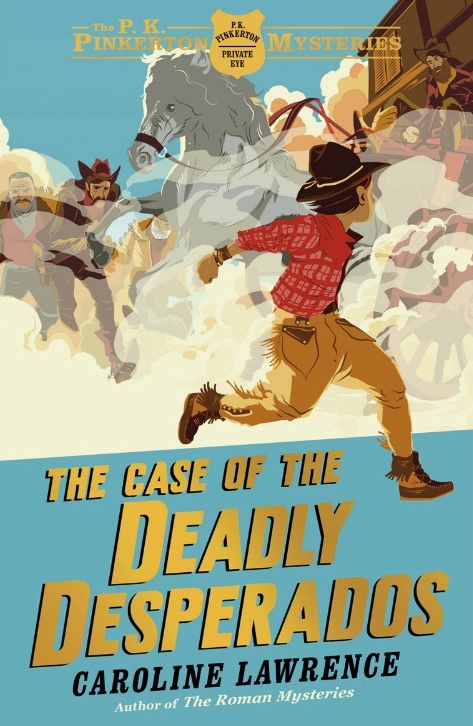
Showing posts with label P.K. Pinkerton. Show all posts

Friday, May 19, 2017

Caroline's Autobiography

18 May 2017

Dear Caroline


We are learning about you and your life story we are writing a biography and i was wondering if you could give me any information about your life as an Author. I know you studied Latin at Cambridge University but our main points are

- Life as a child
- Studying
- Author Life 
- Life now

Thank you, James (aged 9)

Dear James, Here it is! 


- Life as a child


Caroline with brother Dan & sister Jennifer c. 1960
Caroline Lawrence was born in London, England in 1954. Her American parents returned to the United States shortly afterwards and she grew up in Bakersfield, California with her younger brother Dan and her little sister Jennifer. (Her surname was Weiss which means her sister is NOT Jennifer Lawrence but Jennifer Weiss.) Caroline's father taught English, French and drama in a local high school and her mother was a stay-at-home mum and a talented artist.

During the long hot summers, Caroline and her brother and sister would go swimming in one of Bakersfield's several public pools or play in prickly golden fields under a desert sun. Caroline's parents made a conscious decision NOT to have a TV, but some nights as a treat they would all pile in the car – Caroline and her siblings in their pyjamas – and go to a Drive-In movie. (A Drive-In movie is where you stay in your car and watch a film on a big outdoor screen. Here is a LIFE report about Drive-Ins.) This is where Caroline first fell in love with movies. 


- Education 


Hoover Tower at Stanford University, California
When Caroline was twelve, her family moved to Stanford University in northern California so that her father could study Linguistics there. Stanford is now famous as being part of Silicon Valley. At the age of 18, Caroline fell in love with the world of Ancient Greece and Rome after reading a book that changed her life: The Last of the Wine, by Mary Renault. Because of that book she decided to study Classics at Berkeley. (Classics is the study of Greek and Latin and the culture of Ancient Greece and Rome). She enjoyed decoding Greek and Latin so much that she managed to win a Marshall scholarship to study at Cambridge University. In 1977 she was flown to England and began studying Classical Art and Archaeology at Newnham College, Cambridge.

She has been in England ever since, with short trips home to California or to the places where her books are set.   


- Life in England


Caroline & Simon in 1982
After taking a first class degree from Cambridge, Caroline moved down to London to work as a trainee stockbroker. This was NOT a success but she met her first husband at that job. They got married, moved to a village in Essex and had a little boy named Simon. Sadly the marriage did not last. Caroline returned to London when her son was five years old and lived as a single mum for five years. When Simon was ten, Caroline married a graphic designer she met through her church, Holy Trinity Brompton. His name is Richard Lawrence and he is English. Their wedding was at the Chelsea Registry office with a blessing afterwards at St Paul's church in Onslow Square. They will celebrate their 25th anniversary in October 2017. 

- Becoming a Author 

For a few years, Caroline helped out at her son’s school, first as a volunteer, later as a paid teacher. Her subjects were Latin, French and art. After she had been teaching for about ten years, she decided it might be fun to be a writer. She started getting up an hour early every day to write before she went to school to teach. 

Caroline's original goal was to write screenplays for movies, but in August of 1999 on one of her visits home to California her sister Jennifer said, ‘Why don’t you write a book for kids set in Pompeii?’ At that moment Caroline had what she calls a lightbulb moment. (In old-fashioned cartoons whenever a character had a good idea a lightbulb appeared over their head: BING!) 


Nubia, Flavia, Lupus & Jonathan in a chariot
This was Caroline's idea: Nancy Drew in Ancient Rome. That month she wrote the first draft of the Thieves of Ostia, which was accepted by Orion almost immediately but not published until September 2001. The stories follow the adventures of clever Roman girl named Flavia Gemina and the three friends who help her solve mysteries: her next-door-neighbour Jonathan ben Mordecai, a beautiful slave-girl named Nubia and Lupus, a half-wild beggar boy with no tongue. Over the following ten years Caroline wrote sixteen more Roman Mysteries, some of which were televised by the BBC in 2007 and 2008. You can see pictures from the filming of the Roman Mysteries TV series HERE.  

Since finishing the Roman Mysteries Caroline has written 17 more books, including four books set in America’s Wild West, The P.K. Pinkerton Mysteries. She is now working on The Roman Quests, a series set in Roman Britain about three children who must flee Rome. In Britannia they meet grownup Flavia, Jonathan, Nubia and Lupus. 

- Life now
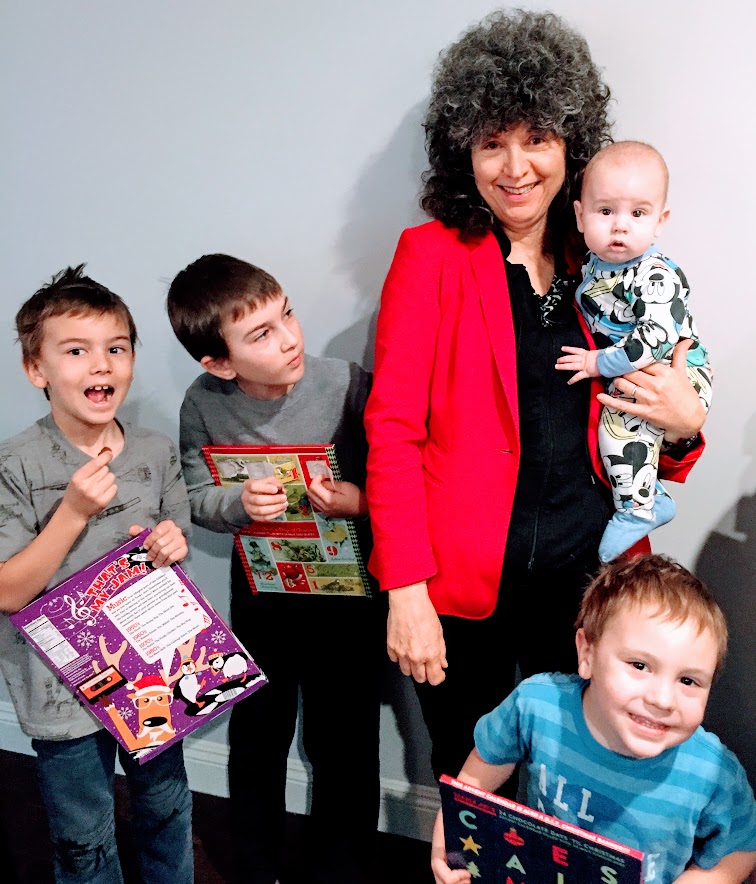

Caroline and grandsons December 2016
Caroline loves being a writer of historical fiction for kids because it combines her love of art history, ancient languages and travel. She lives by the river in London with her husband Richard, who helps her with ideas and illustrations, and who feeds her. Caroline’s son Simon is now grown up, living in Los Angeles California and working in the film industry. He has an Australian wife named Brooke and four sons. Caroline’s favourite thing is still going to the movies, and she still hopes to write the screenplay for a successful film one day. 

P.S. You can also see a long blog about How I Write and lots more info about me and the Roman Mysteries on my FAQS page.

Wednesday, March 12, 2014

Bad Bandit, Good Writer


Recently I re-visited Terry Gilliam’s film Time Bandits, a beautiful example of historical storytelling (with a generous dash of fantasy) for kids. 

Over half term, children in London were invited to attend free screenings of three classic films followed by a talk from a children’s author. This event was co-sponsored by the Rio Cinema in Hackney and Victoria Park Books. They invited me to give a talk following Terry Gilliam’s fun 1981 film about a boy kidnapped by bandit dwarves and taken on a journey through time. At 10am on a rainy Thursday, bookseller Jo De Guia introduced the film by showing some student-made trailers for books by the three authors. (Here’s the one they made for my latest book). Then, two dozen children and their parents settled down to enjoy the main feature.  

Francesca Isherwood, Caroline Lawrence, Conrad Ford
Joining me in the balcony above were Francesca Isherwood and Conrad Ford. Fran, now aged 22, played Flavia Gemina in the CBBC Roman Mysteries series seven years ago. Conrad is the son of a family friend, a filmmaker waiting for his first break. I benefitted from their comments and observations. Fran had never seen it; she and I kept ‘snapping’ comments. Conrad has seen Time Bandits many times and kept pointing out details we might otherwise have missed. I had watched a non HD version on YouTube a few days earlier, and it was a completely different experience seeing it on a big screen where we could absorb the fantastic amount of detail that went into its making.

Time Bandits is the story of Kevin, an English boy obsessed with history. Six dwarf bandits emerge from his wardrobe one night clutching a map that shows time portals in the fabric of the universe. They have stolen the map as they want to leave their boring job in charge of shrubbery and lead the more exciting life of bandits. But they are being pursued by God (AKA the Ultimate Being) and Satan (AKA Evil), both of whom want the map back. The dwarves take Kevin with them in their flight. No more spoilers in case you haven’t seen the film. 

Jo De Guia from Victoria Park Books introduces the film
From our lofty vantage point above the stalls, Fran, Conrad and I could look down on the kids and see that they were enjoying the movie hugely. Afterwards, everybody moved a short distance to the Hackney Library where families produced a picnic lunch. As parents and children munched sandwiches and crisps, I led a discussion of the film and then offered some practical tips on how to write a gripping story. 

Good historical fiction – be it poetry, prose or film – should transport the reader to another place and time. In our discussion, we first identified the seven distinct settings or ‘arenas’ in the film Time Bandits:

1. Kevin’s World, especially his Bedroom
2. Napoleon’s Castiglione
3. Robin Hood’s Sherwood Forest
4. Agamemnon’s Ancient Greece
5. The Titanic
6. The Time of Legends
7. The Fortress of Ultimate Darkness

The Rio Cinema in Hackney, London
As we discussed the film, it occurred to me that when a competent criminal commits a crime, he leaves no evidence, no clues, no eyewitnesses and no DNA. A bad bandit, on the other hand, scatters the scene with clues, witness and DNA. 

Storytellers have to be bad bandits. We have to leave clues, present reliable and unreliable eyewitnesses, scatter our DNA everywhere. If we do, our readers will be captivated. Here are some Time Bandit-inspired techniques that writers could use to create vibrant historical fiction. 

CLUES. Props and artefacts are the clues the storyteller leaves to help us decode a world. Kevin’s home was crammed with 1980 props like microwave ovens, blenders and a television. When the film first came out, these were state-of-the-art. Thirty years later, they are historical artefacts vividly painting a place and time. Props in Napoleon’s world included torches, muskets, Punch and Judy. For Sherwood Forest we saw carriages, rope traps, bows and arrows. In ancient Greece a kind of Corinthian helmet, as well as swords and daggers were more or less accurate, as was a Mycenaean death mask like the one Schliemann claimed to have found. On the Titanic the props crew got the champagne glasses right, along with deck chairs and a tennis racquet. The Time of Legends gave us a cauldron and a giant ship, not to mention a giant who became part of the landscape in this strange world. The Fortress of Ultimate Darkness was a nightmare world where every object was a grossly inflated or exaggerated version of toy or picture from Kevin’s room. Conrad pointed out that even the plastic film that covered Evil's henchmen hearkened back to the protective covers over the couches in Kevin’s sitting room. Conrad also drew my attention to the giant LEGO pieces, chessboard and skeletons in the walls, all magnifications of items in Kevin's bedroom. 


Bad Bandits and their Map
The outstanding prop of Time Bandits is the MAP. More than a clue, it is a kind of talisman but also the object of the quest, what Hitchcock would call the MacGuffin. The bandits have stolen it and the opponent, Evil, wants it in his battle against the Supreme Being. In storytelling, it is always good to make the goal visible. And if the goal is abstract, make sure you have a concrete symbol of the goal. 

‘WHAT WAS HE WEARING?’ Good storytellers have got to be geeky about costumes. Seeing Time Bandits on a big screen was a revelation. Fran pointed out that that one of Napoleon’s generals was wearing pink long underwear… and a corset! Agamemnon and his murderous wife Clytemnestra wear fine linen tunics and jewel-coloured silk mantles with gold thread. John Cleese as a foppish Robin Hood refused to wear tights but his outfit is still Lincoln green. 

SCENE OF THE CRIME. Gilliam is specific about the setting of the story. It’s not just any town Napoleon is invading; it’s Castiglione. It’s not just any forest full of robbers; it’s Sherwood Forest. It’s not just any ocean liner; it’s the Titanic. If it’s mythical, make it as detailed as any world, a technique at which Game of Thrones excels. 

TIME OF THE CRIME. Gilliam and the writers varied the time and place of the heists to make each arena more distinctive. Napoleon’s night time fortress was lit by torch and candle. Mist and rain shrouded Sherwood Forest. Ancient Greece – filmed in Morocco – shimmered with heat. The Titanic was fair weather, midday, until they hit the iceberg. Then everything got wet and white. 

SUSPECTS. When I write historical fiction, I often scatter a few genuine historical people in the background. Put in Napoleon and you know you’re somewhere around the year 1800; mention Castiglione and you know it’s 1796. Drop in Agamemnon and you know you’re in the world of Greek mythology. Set Robin Hood in among men in tights. Plonk Bertie Wooster types on the Titanic. 

MOTIVE. As writers, we need to find motives for all our characters’ actions. When writing a history-mystery story with a crime or crimes at the centre, we have to first establish the motive for that crime. Only then do we address the detective’s motive which is usually straightforward: to solve the crime and capture the perp. But we writers need a motive, too. Why have we written this story? What is our goal? Every criminal knows what he’s after. Do we?

METHOD. We need to learn basic techniques like plot structure. And flourishes like scene deepening. We need to assemble the team, the archetypal characters who will help the hero on his journey. We need to plan, plan, plan. Keep going over the heist. Get it right. Get it down. And then, after you’ve planned it all out on the day you have to be ready to abandon that plan and go with your instincts. And all the time, keep your eye on the prize. What is this story about? What are you after?

OPPORTUNITY. Like any good pickpocket, cat burglar or heist-meister, we need to prioritize time to hone our skills. Crime is a craft. Writing is a craft. We need to make time to do it.
So, to sum up: If you want to be a Good Storyteller, be a Bad Bandit. Leave clues. Leave eyewitnesses. Scatter your DNA. 

What do I mean by that last one? The DNA? I mean find your own unique style of writing, which is already as much a part of you as your voice or your eyes. It’s back to OPPORTUNITY. You just have to find it. And the only way to do that is to write, write, write! 


My latest book is The Case of the Pistol-packing Widows, about a 12-year-old half Sioux detective in Nevada in the winter of 1862. It's out in two different hardback editions, the US and the UK. Terry Gilliam's new film The Zero Theorem opens soon. 

Wednesday, July 31, 2013

Top Eleven Westerns 2003-2013

A recent article in The Atlantic (How the Western was Lost and Why it Matters) suggests that Gore Verbinski's poorly-received The Lone Ranger might be the final nail in the coffin of a dying genre, the Western.

But what is a "Western"? Can it even be encompassed by the term "genre"? Is it not bigger than that?

The American Film Institute defines a Western film as one "set in the American West that embodies the spirit, the struggle and the demise of the new frontier."

The above-mentioned article talks about the "timeless pleasures" Westerns provide: "tough guy heroes, action set pieces on horseback, adventures in magnificent landscapes, good triumphing over evil..."

For me, a Western is any movie, TV show or book which depicts an individual or small group battling to survive in some kind of frontier. Ideally, it will include two or more of the following ingredients:
a) horses
b) revolvers
c) Native Americans
d) deserts
e) outlaws

Is the Western really dying? Using the above as my criteria I have chosen my top eleven Westerns films or TV shows from the past decade, viz: 2003 - 2013. I have listed them from oldest to newest.

montage of my fave Westerns 2003-2013 by Richard Russell Lawrence

1. Firefly (TV 2002-2003)
This short-lived, much-loved Joss Whedon television show was a great example of a Western set in space, the "new frontier" in the tradition of Star Wars. It has all five of my ingredients (though Native Americans are only glimpsed in a crowd scene in episode one.) Probably the wittiest of my eleven choices. Certainly the most fun.

2. Open Range (2003)
This is the only Western on my list that involves cattle or cowboys, which are absolutely NOT necessary for a Western. Open Range was laudable in its attempts to go for realism (e.g. a horse is killed in a shootout) and for the sublime Robert Duvall, but was bleached to bones by the blazing brilliance of the Deadwood sets, costumes and characters.

3. Deadwood (TV 2004-2006) 
The best of the lot. The first few scenes of this magnificent, misguided HBO TV series made me jump to my feet and yell "THAT's what it would have been like!" Deadwood is probably responsible for the past decade's mini-revival (or death throes!) of the Western genre. It is the quintessential Western, pitting loner misfits against the wilderness, greedy men and their own fatal flaws. Why "misguided"? It could have run for years but creator Milch sank it with expletives in an attempt to make it feel authentic. This goes to show what a minefield of political incorrectness the Western genre can be. 

4. The Proposition (2005)
Here's a great example of a Western set in Australia, but it totally works. Brutal, mysterious and with Ray Winstone. What's not to like? The opening gun battle is like nothing I've seen on film before and the story has more twists and turns than The Sixth Sense.

5. Seraphim Falls (2006)
With nods to The Outlaw Josey Wales and Unforgiven, this is an overlooked gem. The action ranges across mountains and deserts and features a surreal cameo by Angelica Huston as a Snake-oil Saleswoman. I don't care if the critics panned it. I loved it.

6. No Country for Old Men (2007)
Cormac McCarthy's book faithfully transported to screen by the Coen Brothers. A "modern" Western with sagebrush dry humour and a world-view as bleak as the West Texas desert.

7. Breaking Bad (TV 2008-2013)
The best TV show of the decade, I'm calling this a Western on account of its stunning desert landscapes and (New) Mexican cartel drug lords scarier than any Comanche Indians. As with many later Westerns, the protagonists are the outlaws. Plenty of desert sunsets, shootouts and showdowns. And did I mention the New Mexico desert?

8. Meek's Cutoff (2010)
I found this film infuriating when I first saw it on account of its "lack of ending". I stomped home to look up the background history of the real pioneers it's based on. That was when I realised the genius of Kelly Reichardt's approach. The life of an American settler was in constant limbo with no knowledge of what the next day or even hour might bring. Reichardt's constrained screen aspect mimics the blinkered viewpoint of seeing the world through the tunnel of a "poke bonnet" and the muffled dialogue of the men frustratingly conveys how much women were sidelined. An encounter with a Native American is fraught with misunderstanding and confusion. Haunting, unforgettable and stripped of all romance, Meek's Cutoff is probably the most realistic "taste" of the West the way it was.

9. True Grit (2010)
No film could do justice to Charles Portis' masterpiece, but the Coen Brothers give it their best shot. My perfect True Grit would have John Wayne as Rooster with the 1969 screenplay, including its better-for-film upbeat ending (written by Portis) but with Hailee Steinfeld as Mattie and the set dressing of the 2010 version.

10. Justified (TV 2010 - still going!)
This barely squeaks by on my criteria, having very few horses, no desert and no Native Americans, but Raylan Givens – a beautiful US Marshall in cowboy boots and hat and with an itchy trigger-finger – is a fabulous Western hero. Although Elmore Leonard's story is supposed to be set in Eastern Kentucky, it's actually filmed in and around Santa Clarita, Hollywood's iconic Western backlot.

11. Rango (2011)
Not really for kids, this decidedly creepy animation is packed with references to other Westerns and popular movies. I have listed nearly two dozen on my Rango Cheat Sheet. By making the characters animals rather than ethnic groups, Gore Verbinski neatly avoids many of the "hot buttons" that weigh down The Lone Ranger... and threaten the entire Western genre.

So my thought is: No, the Western is not dying. We are certainly not in the right Zeitgeist, but if well-written and conceived, a story of men or women on the frontier with six-shooters and horses can still be hugely satisfying.

Finally, there are some great Western books being produced. A few of my recent favourites are St. Agnes Stand by Thomas Eidson, Boone's Lick by the great Larry McMurtry and Robert B. Parker's Appaloosa (much better than the film). I myself am trying to revive the genre among children with my tales of a half-Sioux, half-white 12-year-old Detective in Virginia City, Nevada Territory: The P.K. Pinkerton Mysteries. Just out is The Case of the Pistol-packing Widows.

Tuesday, January 08, 2013

History Chickens!

me and my soft toy chicken
[I first published this on the History Girls in 2011]

One of the drawbacks of being a historical fiction author living in 21st century London is that you have to keep reminding yourself about things that would have existed in first century Rome. Or a Nevada mining town in the 1860s. Or Jerusalem during the siege of Titus. Or where-ever, when-ever.

Some things don't change about town life: beggars, pickpockets, street markets... But there were lots of critters roaming about back then that you rarely see today on the Kings Road, Chelsea. Horses, stray dogs, feral cats, flocks of goats and... chickens!


ancient Roman pawprint
My husband Richard and I are both avid fans of historical fiction, especially movies and TV productions. Whenever we are watching a Western or a Sword and Sandals drama and we see poultry, we punch the air and shout "CHICKENS!" Then we mentally give the film or TV show an extra star, a kind of "chicken-o-meter" of authenticity. (We have recently added a "spittoon-ometer" to gauge the historical accuracy of westerns. What is YOUR accuracy barometer?)

Forum Boarium 1855
One of my favourite things about HBO's Rome was the presence of chickens in the forum. Most set designers wouldn't dream of making Mark Anthony step over a roosting free-ranger as he went to give Caesar's funeral oration, but the producers of this programme were spot on in this respect. Most Romans would have encountered a daily hazard in steaming piles of manure, scavenging dogs, fleabitten feral cats, etc. "Friends, Romans, Countrymen... Lend me your ugh! What did I just step in?" Any Roman passing through the Forum Boarium would definitely have had to watch his or her step. Forum Boarium means "Cattle Market", but they also dealt in goats, sheep, pigs and no doubt chickens. This is one of the 10% surprises I have blogged about elsewhere.

"Only three sesterces..."
Another one of my favourite historical dramas is HBO's Deadwood. This TV series – with its amazing evocation of an 1870s mining town in the Black Hills of South Dakota – revived the Western genre in America and partly inspired my new P.K Pinkerton Mysteries series. But the producers of Deadwood made one grievous error. NO CHICKENS! (apart from some briefly glimpsed dead chicken feet in the title sequence, that is.) 

So you can imagine how thrilled I was when screenwriter Dom Shaw introduced a sacred chicken and its owner to the CBBC TV adaptation of my book The Slave-girl from Jerusalem. Floridius the Soothsayer, brilliantly played by Mark Benton, posts a sign in the forum:

Threptus & Aphrodite
Aulus Probus Floridius: Haruspex, mercator sacrarum gallinarum, orator, peritissimus ad horoscopos operaque varia. 
(Aulus Probus Floridius: Soothsayer, dealer in sacred hens, orator, very skilled in horoscopes and random tasks)

Floridius also says amusing things like: "Would you like me to sacrifice this nervous chicken to ensure the verdict? Only three sesterces?" and "The entrails of the sacred chickens never lie!" Also, he falls into the fountain a lot.

Most authors would be peeved if a screenwriter introduced a major character into an adaptation of their story. But I loved Floridius so much that I gave him a walk-on part in the final Roman Mystery, The Man from Pomegranate Street. Then I let him have a bigger part in the second volume of Roman Mini-Mysteries, as sidekick to an 8-year-old beggar-boy detective named Threptus. And finally I conceived an entire spin-off series starring the two of them.

And all because of those chickens. 

You can read "Threptus and the Sacred Chickens" in The Legionary from Londinium & other Mini-Mysteries. 

The Roman Mysteries are perfect for children 9+ studying Romans as a topic in Key Stage 2. The Roman Mystery Scrolls series (with chickens) is aimed at kids aged 7+ and the Roman Quests series, set in Roman Britain, is a new spinoff series for kids 9+.

For more information about me and my books, visit carolinelawrence.com

Monday, July 23, 2012

7 Tips for Writing Historical Fiction


"The past is a foreign country: they do things differently there"

mural in Virginia City Nevada
This famous opening line from L.P. Hartley’s The Go-Between is my key to writing historical fiction. I want my readers to really believe they are in the past and I also want them to learn about history. So whenever I start a new novel, I make use the following items, just as if I were going to a foreign country.


1862 Directory
1. Guide Book
Before I travel to a new country I always read a guide book about the history and customs. I do the same thing with travelling into the past. At the moment I’m reading books about the history of the American Civil War and the Silver Boom in Nevada. One of my best guide books is the 1862 Directory to Nevada Territory, an exact facsimile of the Wild West version of the yellow pages... or should I say 'Google'?

Bret Harte 1836-1902
2. Phrase Book
Just as it’s good to learn a few phrases when travelling to a foreign country, I like to get the speech patterns of the past down. For my Roman Mysteries, I made the language modern but used lots of Latin words. For the P.K. Pinkerton Mysteries I’m storing up choice phrases from the letters of Mark Twain and the diaries of Alfred Doten. (e.g. Americans in the 1800s didn't use many contractions, but they loved the word ain't.) I also listen to audiobooks to get the speech rhythms right, just as I'd listen to some language podcasts before going to Italy or France. One of my current favourites is Great Classic Westerns read by marvellous narrators like Bronson Pinchot. I also love the stories of Bret Harte.

Dressing the west
3. Clothing
Take the right clothes for climate and culture. Wearing period clothing can really get you into the mindset of your characters and make them seem real and immediate. For my Roman Mysteries, I wore a linen stola and woollen palla, plus leather sandals based on a Roman template. For my new Western Mysteries series, I have bought a buckskin jacket and cowboy boots. At the Santa Clarita Cowboy Festival, I learned my buckskin was actually pigskin! And one of my best experiences was a demonstration of what western women wore under their skirts during the 1860s. This took place during a Civil War reenactment weekend in Virginia City at the Tahoe House Hotel. (left)

4. Food and Drink
The 19th century diarist Alf Doten tells me what he ate and drank on the Comstock in the 1860s. When I go to a foreign country, I want to eat what the locals do. Otherwise I may just as well stay home. Same thing when writing about the past. However, I do draw the line at grizzly-bear-cub mince-pies and oysters from tin cans, both dishes which Alf Doten appreciated. And I won't try the Pousse L'Amour drink in Professor Jerry Thomas's book on cocktails published in 1862: How to Mix Drinks, Or: The Bon-Vivant's Companion. If I did, I'd never get anything written!

Anne Dinsdale, weaver
5. Eyewitness - Talk to Someone Who’s Been There
It’s always a good idea to talk to a native of the foreign country if you can. The historical author has a wonderful resource in re-enactment events. Men who dress up as Roman legionaries usually know exactly what each piece of armour is for. Women who wear corsets and hoop skirts can describe how itchy and dusty they get. A Nevada Cowboy Fast draw expert told me why you usually only have five bullets in a six-shooter; it’s safest to leave the first chamber empty. Living history experts are the closest you’ll get to interviewing a person from the past. There are a lot of amateurs and experts eager to share their knowledge with you.

Virginia City rabbit
6. Go there!
Even if your story takes place centuries or millennia ago, it’s always useful to visit the site of the event if possible. You’ll meet people who are experts on the history of their region and who might know things not in books or on the internet. Also, you’ll get an idea of climate: wind, air, light, pressure, humidity, etc. I always like to make a note of what food is in season, what flora is blooming and fauna are migrating. Research is a great excuse to travel. Writing an historical novel gives you lots of fun goals as well as icebreakers for starting conversations with the natives.

7. Souvenirs
Whenever I visit the setting of one of my historical novels, I try to bring back a period artefact. It can be a genuine antique or a convincing replica. There is nothing like handling an object from your time period to bring it alive. If you write for children you can bring some of these artefacts to festivals, libraries and schools and let the kids handle them. My three favourites are my replica sponge-on-a-stick (ancient Roman toilet paper), my as of Domitian (an antique coin) and my brass spittoon from the 1890’s. (left)

paperback cover
These seven factors all contribute to making your setting real and your research fun. Employ them when you write and your book will become a time machine to transport your readers to another place and time.

The first book in my P.K. Pinkerton Mysteries series is The Case of the Deadly Desperados. It is available in hardback, paperback, Kindle and MP3 audio download. 


Book #2, The Case of the Good-looking Corpse and book #3, The Case of the Pistol-Packing Widows, are out, too!

And you can find out about all my books on my website www.carolinelawrence.com

Thursday, September 22, 2011

ABC of the Western Mysteries

A basic GLOSSARY for British children reading the Western Mysteries who might not know what a Desperado or a Stagecoach is... or where Nevada and Utah are.

America in 1862

A is for America - the country across the Atlantic Ocean where people speak English with funny accents. It is also known as the United States, but in 1862, the states only went halfway across America with a few on the west coast. A great chunk of land in the west was called "Territory". Towns in the Territories were often lawless and wild.

Is P.K. a Desperado?
B is for Ball & Blackpowder - this is what old-fashioned bullets were made of. You also needed lint and a tiny little metal cap that you put on the back of each hole in the cylinder of your Revolver to make a spark which set off the powder and get the ball flying towards its target. Later on they put the cap and ball and powder in one metal case called a cartridge. This is what we now call a Bullet.

A Chinese Youth
C is for Chinese (not Cowboys) - in the early 1860s, when The Western Mysteries are set, there were far more Chinese out west than Cowboys. Cattle drives did not begin in earnest until 1866.

D is for Desperado - a desperate person who is usually on the run after committing murder, robbery or other serious crime.

E is for Emigrants - most of the people who flooded to America in the 1800s were emigrants from Euorpean countries like England, Scotland, Ireland, Germany, France, Russia, etc. And, of course, the thousands from China.

F is for Frontier - the place in the American West where settled land gave way to wilderness populated by wild animals and Native American tribes.

A Gunslinger
G is for Gunslingers - almost everybody carried a firearm in the 1860s out west, even women & kids.

H is for Horses - The West in the early 1860s was a world mostly driven and powered by animals with hooves: horses, mules & oxen.

An Indian Tomahawk
I is for Indians or Native Americans - the tribes of people already living in North America when the emigrants arrived were as varied as the people from European countries, sometimes more so.

J is for Jackrabbit, also coyote, grizzly bear, prairie dog, buffalo and all the other unique wildlife found in the West.

A Kerosene Lamp
K is for kerosene or coal-oil, which is what folk used to light their lamps. They used candles, too. In 1862 gas had not quite reached Virginia City.

L is for Lincoln - who was president between 1861 and 1865 when America was fighting a terrible Civil War over slavery and freedom.

26-year-old Mark Twain
M is for Mark Twain - his real name was Sam Clemens and he was one of America's greatest authors and humorists. He joined the Civil War for about two weeks then headed west to Nevada Territory with his brother Orion, who had been appointed secretary to the governor. After trying his hand at prospecting, Mark Twain became a reporter in Virginia City where he remained for two and a half years. Many years later he wrote Tom Sawyer & Huckleberry Finn, among others.

N is for Nevada - then a "Territory" and now the triangular state to the right of California, (see maps). It is full of deserts, mountains and minerals.

O is for Ore - rock and/or dirt containing precious metals or minerals. The Gold Rush in 1849 brought a huge wave of people to California, then ten years later the Silver Boom brought thousands Nevada, to the Comstock Lode beneath Mount Davidson.

P is for Pinkerton - the first detective agency in the world. The founder, a Scotsman named Allan Pinkerton, coined the phrase "Private Eye". Their head office was in Chicago, Illinois (one of the high-up states in the middle).

A Quartz Stamp Mill
Q is for quartz stamp mill - a machine with heavy iron pistons that crushed quartz so that silver and gold could be extracted.

R is for religious revival - America was going through a great Christian revival in the 1860s and almost everybody was deeply devout.

S is for stagecoach - a large, closed carriage pulled by four to six horses; it was used to carry passengers, goods and mail on a regular route. Sometimes you could ride on top.

T is for tobacco - like religion, almost everybody had tobacco. They either smoked it, sniffed it or chewed it. Those who chewed usually spit their tobacco-tinted saliva into vessels called spittoons. Ew.

A Stagecoach

U is for Utah - now the state to the right of Nevada on a map, then it was a "Territory", a part of America which did not yet have the full rights of the other states.

Nevada Territory 1862
V is for Virginia City - the mile-high city on a steep mountain above a buried "ledge" of silver called the Comstock Lode.

W is for Washoe - the region around Virginia City, named after a lake to the west (see map) and also a tribe of Indians who lived there.

X is for "X marks the Spot" - Prospectors were people who prospected or "looked out for" areas where gold or silver could be found. Then they "staked their claim" i.e. announced it as theirs. They guarded their claims with bowie knives, revolvers, rifles... and their lives.

Y is for Yankee or Yank - slang for somebody from the northern states or on the Union side of the Civil War. A person on the other (Confederate) side was often called a Reb or Rebel.

Washoe Zephyr
Z is for Zephyr - by definition a warm and gentle breeze. In Virginia City, a Washoe Zephyr was what people jokingly called the gale force wind that sometimes swept over the mountains and threatened to uproot trees and houses.

If you would like to read a book with all these words and a heck of a lot of adventure, get The Case of the Deadly Desperados by Caroline Lawrence. It is available in hardback, Kindle and unabridged audiobook format. Suitable for children aged 9+. Perfect for American history at Key Stages 2 & 3.

Thanks to Richard Russell Lawrence, who did the maps & drawings, all based on primary sources... 

Wednesday, August 17, 2011

Virginia City 1862


Virginia City, Nevada Territory - September 1862.

P.K. Pinkerton, Private Eye
When desperados kill the preacher and his wife in a small frontier town, their foster child P.K. is forced to go on the run. P.K. must get a valuable letter to the Recorder’s Office before anyone else can get their hands on it. It’s not easy: Virginia City is full of gamblers, hurdy girls, saloon-keepers and gunmen, all of them on the make. But there are possible allies: Sam Clemens, the new reporter for the paper, a gambler called ‘Poker Face Jace’, a derringer-packing Soiled Dove, and a Chinese photographer’s apprentice named Ping.

Map of the Washoe
Virginia City was a famous mining town in Nevada that sprang up on the slopes of Mt Davidson in 1859, ten years after the California Gold Rush. But it was silver, not gold, that was found in quantity in this barren part of Nevada, so some have dubbed it the Silver Rush. When Mark Twain arrived in September 1862 he described Virginia City in this way: ‘It claimed a population of fifteen thousand to eighteen thousand, and all day long half of this little army swarmed the streets like bees and the other half swarmed among the drifts and tunnels of the “Comstock”, hundreds of feet down in the earth directly under those same streets.’

In the 1860's Virginia City must have been one of the most colorful places on earth, with prospectors, miners, saloon-keepers, gamblers, dancing girls, deserters, actresses, desperados, lawyers, schoolmarms and newspapermen. In the last category are some well-known names (Dan De Quille, Alf Doten, Joe Goodman) and one stellar one: Mark Twain. Their dry-as-dust humor, tall tales and hoaxes produced a uniquely Western flavor of literature which some call "Sagebrush Humor."

Sam Clemens is Mark Twain
The Comstock in 1862 was an extreme example of what we might call "politically incorrect". People gambled, cursed, smoked, spat, drank, carried firearms, murdered one another, ate opium, sparked, and exhibited racism at its worst. It was an ethnic melting pot, boasting Irish, Germans, several tribes of Native Americans, African Americans, Chinese and Mexican residents. Many of the inhabitants had come west to avoid the horrors (or duty) of fighting in the War between the States. Almost everyone came to get rich, though there were a few who came to save souls of others or lose their own.

In short, Virginia City was a crucible; it made some great, and destroyed others. What will happen to 12 year old P.K. Pinkerton? Read the Western Mysteries to find out.

Saturday, May 07, 2011

Old Carson City


Caroline at the B St B&B
Carolyn Eichin of the B Street B&B is an extraordinary woman. Not only is she a superb cook, preparing the best breakfasts Richard and I have ever eaten, but she's an expert on Nevada history. She and her charming husband Chris told us about a lecture at the Nevada Textiles Archive in Carson City on the morning of Wednesday 3 May. After our exhausting adventure at Bodie it's nice to drive a couple of miles and hear about women's bonnets and men's top hats. I'm not allowed to post any pictures but I get some good ideas for hats to plonk on my characters' heads.

Nevada State Museum
After the lecture we're shown the archives and delight in other period pieces of clothing. Then it's off to the Nevada State Museum, a modern black glass building next to the Carson City Mint. It's a great exhibition with lots of the types of artefacts I love. Some sarsaparilla bottles, a stereoscopic viewer with an 1860s photo of Devil's Gate (on the road to Virginia City) and lots of buttons. I'm especially excited about the hundreds of buttons because in the second Western Mystery we discover that P.K. Pinkerton, my hero, is obsessed with collecting things. Like bugs, bullets and buttons. There is also a Smith & Wesson 7-shooter, P.K.'s gun. (see bottom of this blog for pix)

Orion Clemens house in Carson City
After the museum we take the walking tour of Old Carson City. Chris mentioned it as something worthwhile and is it ever! Especially on a beautiful spring day like today. They give us a map at the museum, but even if you didn't have the walking map you can follow the handy blue line painted onto the sidewalk. I especially wanted to see the house Orion Clemens lived in. He was Mark Twain's older brother, and secretary to Governor Nye in the early 1860s.

horsehead hitching post 
We also see the house from John Wayne's final film, The Shootist, along with houses belonging to characters who might appear in future Western Mysteries. After the challenge of high-altitude Bodie it is a joy to stroll through the leafy Victorian neighborhood of Old Carson City.

Back to Virginia City in time for tea at the B Street B&B. Carolyn gives me an 1974 dissertation on Police, Water and Fire Departments in early Virginia City so I can get to grips with the structure of the town in the early 1860s. There aren't many places in the world where you can eat homemade tropical fruit macaroons and peruse a scholarly article both provided by the same talented lady. The B Street B&B is simply superb.


P.K. is partial to sarsaparilla
Badges weren't known in Virginia City until 1874
P.K. is obsessed with collecting things... like buttons
Stereoscopic viewer with picture of Devil's Gate
A Smith & Wesson 7-shooter just like P.K.'s