Recently I gave a family-friendly talk at the British Museum about Children in Pompeii and Herculaneum. This was part of the halfterm events accompanying Life and Death in Pompeii and Herculaneum Exhibition. Fans of my Roman Mysteries books who couldn't come asked if I could write a report... so here is a summary of my talk.
I started out with an illustrated reading from The Roman Mysteries Treasury called A Day in My Life, about a day in the life of a Roman girl, Flavia Gemina. Flavia is the main character of my Roman Mysteries books. Although she leads an unusually eventful life and lives in Ostia, rather than the Bay of Naples, many aspects of her life and the the lives of children in Pompeii and Herculaneum would have been similar: rising at dawn, washing in the garden by the fountain, a light breakfast, household prayers with paterfamilias in atrium, lessons in the morning, a light lunch, siesta or the baths after lunch, dinner at around four in the afternoon and bed at sunset. In a reversal of today, poor people would eat out, buying their food from "fast food joints" and only people rich enough for cook slave and kitchen would eat in.
When a baby was born, it would be wrapped tightly in strips of cloth called swaddling to keep it safe, then placed at the feet of the seated father. If he took the baby onto his knee (Latin genu) that meant he acknowledged the child as his, i.e. the baby was genuine! If not, the baby might be "exposed", i.e. left to die outside the town wall! (The Secrets of Vesuvius tells a story of this happening). Babies were not usually named for the first week or two as so many did not survive. Nor did many children survive past infancy. In ancient Roman times you could die of something that is easily treatable today.
Romans did not have our concept of childhood as an idyllic time to have fun and be innocent. Children were essentially mini-adults, working as soon as they were able and, if you were a girl, marrying as young as 12!
Working-class girls, i.e. those from the plebs, would probably help with the family business as soon as they were able, until they got married and started having children. Some girls might learn enough reading and maths to make lists and do basic accounts. The wife of the baker Terentius Neo is famously holding a stylus and writing tablet in a fresco from Pompeii. She is obviously proud of the fact that she is a pleb who knows how to read and write.
The proper occupation for unwed, upper-class girls (in the equestrian or patrician classes) was weaving. You would spin wool into yarn, then weave that yarn into cloth on a loom then stitch it into garments with a bone needle.
 Girls would marry at 14 or 15, then have a baby and very often die, as childbirth was the biggest killer of young women in Roman times. At my talk, I showed a picture of a birthing chair from Cairo such as pregnant Roman women might have used when they gave birth. When I asked the audience what they thought this was for, one cute little girl wondered if it was "a baby's cot"? But I think you will agree: there are a few flaws in that suggestion!
Working class boys would probably go to school until they knew the basics of reading, writing and maths. "School" was often just a screened-off part of a columned walkway in the forum, so it would have been quite noisy. Richer boys and occasionally girls might have enjoyed a private tutor. Greek-born or Greek-speaking tutors were highly sought after as Greek was the language every educated boy or girl needed to learn. In my books, Flavia and her friends are tutored at home by a handsome young Greek named Aristo. Most children would not be this fortunate.
The Roman version of University for boys would be the study of rhetoric. Many went abroad. Two popular destinations were Athens and Rhodes. That was the ancient equivalent of studying at Oxbridge in the UK or Stanford in America. Here they would learn how to be an orator so they could practise law and climb the ladder of honours to political office. This is the course that Flavia's patrician boyfriend Flaccus pursues. (For more about this, read The Slave-girl from Jeruslaem)
How did Roman kids have fun? We have found a few toys, but not many. Essentially Roman children had fun the same way adults did: a trip to the chariot races, arena, playing with dice, watching cockfights, hunting, etc. Even the Roman mosaic from Ostia of a startlingly modern-looking football (right) was probably for adults to throw around in the palaestra, the exercise area of the public baths.
As I prepared this talk, it struck me yet again that our lives would have seemed unimaginably luxurious and safe to ancient Romans. Even the most basic bathroom with its porcelain fixtures, cold and hot running water, scented soaps and clean towels would have been a luxury undreamt of by Alexander the Great or Augustus Caesar!
To illustrate how blessed we are, I showed objects that we have easy access to now which they did not have in Roman times. "Which one of these objects (below) on its own would have been worth an Emperor's ransom?" I asked.
One person suggested the tomato, because you could plant the seeds and grow more of this exotic fruit. Another suggested chocolate though Romans might have to acquire the taste. The electric plug reminds us they had no electricity so of course it would have been useless. The clock reminds us they had no batteries so that would have been useless, too. Glasses might be useful, but what if they didn't match your prescription? And who could you call with a telephone but no providers? For me, the object beyond price would be the Savlon. Although they didn't have a clear concept of infection, they did know about balms and ointments. In a time and place where the smallest scratch could become infected and kill you, that tube of antiseptic cream would certainly have saved many lives.
Assuming you lived to be 10 or 11, how would you have survived the eruption of Vesuvius? That was my next question. I described the not-too-scary beginnings of the eruption of Vesuvius – a lot of ash shooting up but no lava or flaming rocks – and I gave children in the BP lecture theatre a choice of sheltering in sturdy vaulted "boat houses" forming the foundations of the Herculaneum baths, or running away with nothing but pillows to cover their heads. Anyone who has grown up in the San Francisco Bay Area or Japan would know the safest place to shlelter during an earth tremor would be under a sturdy vault. But in this case the correct answer is "pillows" as death overtook those who sheltered in the vaulted storehouses of Herculaneum when the superheated air collapsed in a pyroclastic surge!
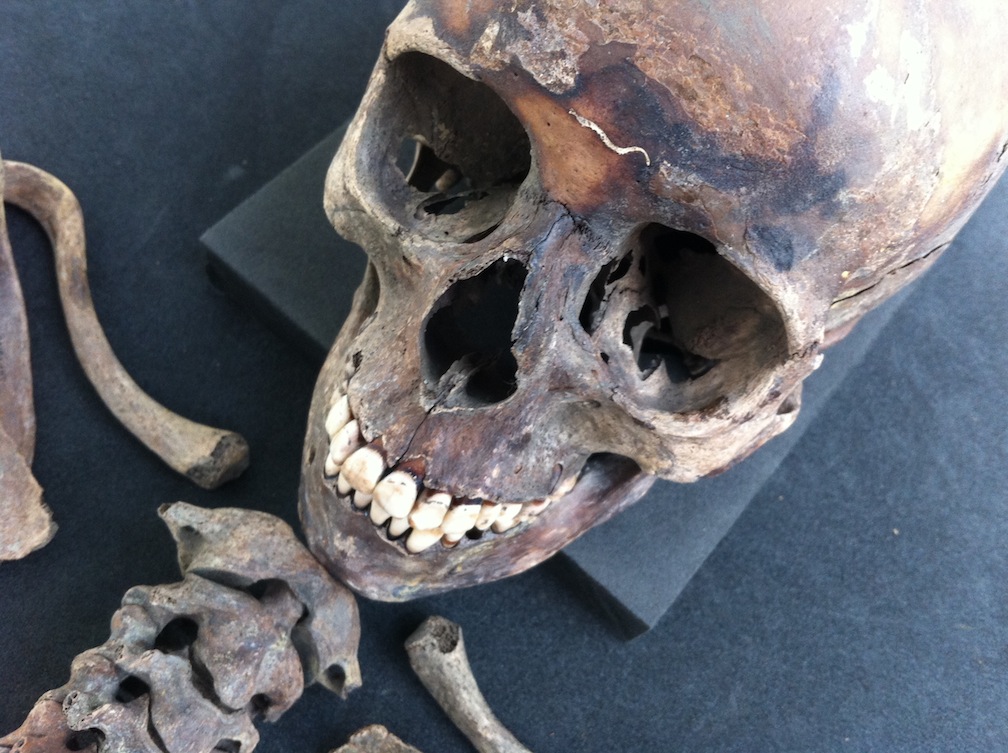
I didn't show the children in my audience any of the pictures of plaster casts made from the bodies of children who died in the eruption, but I did talk about the famous "dog of Pompeii" and I reassured them that he gained eternal fame through his few moments of suffering. And of course he inspired my first book: The Thieves of Ostia! This brought me to my four characters, based on the four elements of which Romans believed the world was composed.
And that brought me to perhaps the biggest differences in Roman times and modern: the concept of the four humours. Romans believed people were full of four basic juices which they called humours: blood, mucus, yellow bile and black bile. I quickly determined through raising of hands, if members of my audience were cheerful sanguine "otters", stoically melancholic "cats", faithfully relaxed phlegmatic "golden retrievers", or hot-tempered choleric leader-type "lions". You can take the Four Humours Quiz HERE.
And finally no talk about daily life in Ancient Rome would be complete without my discussion of What Romans Used for Toilet Paper! I showed images of various options to wipe, not forgetting my Roman "as" for scale. (It's the size of a 50p but much more fun to say than "50p"). I finished with my pièce de résistance: a demonstration of how the sponge-stick was used. And that was it!
If you liked some the things I talked about in this post and want to know more about life in first century Italy, you will love the Roman Mysteries books. For more info, go to my author page or my website.
 |
| Flavia Gemina, detectrix |
When a baby was born, it would be wrapped tightly in strips of cloth called swaddling to keep it safe, then placed at the feet of the seated father. If he took the baby onto his knee (Latin genu) that meant he acknowledged the child as his, i.e. the baby was genuine! If not, the baby might be "exposed", i.e. left to die outside the town wall! (The Secrets of Vesuvius tells a story of this happening). Babies were not usually named for the first week or two as so many did not survive. Nor did many children survive past infancy. In ancient Roman times you could die of something that is easily treatable today.
Romans did not have our concept of childhood as an idyllic time to have fun and be innocent. Children were essentially mini-adults, working as soon as they were able and, if you were a girl, marrying as young as 12!
 |
| sewing with a bone needle |

Working class boys would probably go to school until they knew the basics of reading, writing and maths. "School" was often just a screened-off part of a columned walkway in the forum, so it would have been quite noisy. Richer boys and occasionally girls might have enjoyed a private tutor. Greek-born or Greek-speaking tutors were highly sought after as Greek was the language every educated boy or girl needed to learn. In my books, Flavia and her friends are tutored at home by a handsome young Greek named Aristo. Most children would not be this fortunate.
 |
| gestures of an orator |
 |
| mosaic of a Roman ball! |
How did Roman kids have fun? We have found a few toys, but not many. Essentially Roman children had fun the same way adults did: a trip to the chariot races, arena, playing with dice, watching cockfights, hunting, etc. Even the Roman mosaic from Ostia of a startlingly modern-looking football (right) was probably for adults to throw around in the palaestra, the exercise area of the public baths.
As I prepared this talk, it struck me yet again that our lives would have seemed unimaginably luxurious and safe to ancient Romans. Even the most basic bathroom with its porcelain fixtures, cold and hot running water, scented soaps and clean towels would have been a luxury undreamt of by Alexander the Great or Augustus Caesar!
To illustrate how blessed we are, I showed objects that we have easy access to now which they did not have in Roman times. "Which one of these objects (below) on its own would have been worth an Emperor's ransom?" I asked.
 |
| Which of these on its own would have been worth an emperor's ransom? |
 |
| so-called "boat houses" Herculaneum |
 |
| eruption of Vesuvius as depicted in CBBC Roman Mysteries TV show |
 |
| They should have run away! |
And that brought me to perhaps the biggest differences in Roman times and modern: the concept of the four humours. Romans believed people were full of four basic juices which they called humours: blood, mucus, yellow bile and black bile. I quickly determined through raising of hands, if members of my audience were cheerful sanguine "otters", stoically melancholic "cats", faithfully relaxed phlegmatic "golden retrievers", or hot-tempered choleric leader-type "lions". You can take the Four Humours Quiz HERE.
 |
| sponge-stick and an "as" of the Emperor Domitian to show scale |
And finally no talk about daily life in Ancient Rome would be complete without my discussion of What Romans Used for Toilet Paper! I showed images of various options to wipe, not forgetting my Roman "as" for scale. (It's the size of a 50p but much more fun to say than "50p"). I finished with my pièce de résistance: a demonstration of how the sponge-stick was used. And that was it!
If you liked some the things I talked about in this post and want to know more about life in first century Italy, you will love the Roman Mysteries books. For more info, go to my author page or my website.