Showing posts with label British Museum. Show all posts

Thursday, July 22, 2021

Caroline Lawrence Membercast Objects

In July 2021 I was interviewed by fellow children's author Iszi Lawrence (left) for the British Museum Membercast. We talked about artefacts in the British Museum that have inspired my writing. For anyone who wants to know more, here are some of the objects we discussed. Click the photos for links to the objects. 

1. Rock crystal die. Find it in the Greek and Roman Life room (room 69) display case 9. This beautiful little object was a vital clue to the identity of a dog-killer in my first book, The Thieves of Ostia.


2. Wax-tablet and writing things. Greek and Roman Life room (room 69). I try to make some artefacts a matter of life and death, like a wax-tablet for Lupus, a character from my Roman Mysteries series of books. Lupus is mute and illiterate but as he learns to read and write his wax tablet becomes a vital means of communication. My replica wax tablet smells like honey because of the beeswax on it. 


3. Why would you put a scary actor’s mask on a baby feeder? I believe the answer is that it is apotropaic (turns away evil). A face like this, possibly called a mormolukeion, keeps malicious spirits from turning the milk sour. This becomes an object of life or death importance in my book Escape from Rome. Find it in the room next to the Greek and Roman life room, in room 70 and display case 14.


4. Hydria. This beautiful Greek jar for carrying water is one of literally thousands of Greek, Roman and Etruscan vases in the British Museum. Women and slave-girls would take a pot like this to the fountain and bring it back on their heads, full of water. Other Greek vases range from tiny perfume bottles to big mixing bowls for wine. The decoration on them gives us glimpses into daily life, customs and beliefs. For a scene where kids hide in a fountain, check out my book Adventure in Athens. 


5. Oil-lamps are like snapshots of the ancient world… Many of them also have apotropaic images on them, and the oil-lamps themselves – lights in the darkness – keep away evil. One of my favourite oil-lamps is in the Greek and Roman Life room (room 69) and shows what racing chariots really looked like. I incorporated that knowledge into Roman Mystery 12, The Charioteer from Delphi. 


6. This superb statuette of the ancient Greek philosopher Socrates informed my most recent historical thriller, The Time Travel Diaries, Adventure in Athens. Note that he is only wearing a cloak, probably light linen for those hot Athenian summers. Find him downstairs in Room 22 and display case 6. 


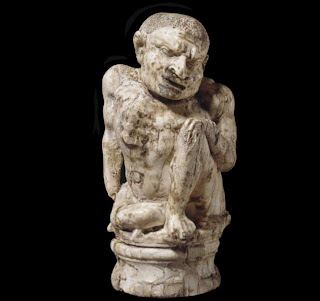
7. Another figurine, a little ivory hunchback from Alexandria, is inspiring my current work in progress, a retelling of Aesop’s Fables. (According to some ancient sources, Aesop was a hideously ugly hunchback.) Note that he is wearing nothing at all. You can find him near the Socrates figurine just mentioned in display case 6 in room 22. 

Thanks to Iszi Lawrence for letting me gush about some of my favourite objects and thanks to the British Museum for inspiring my writing. Find out more about my books at carolinelawrence.com. Find out more about Iszi's books at iszi.com.

P.S. All the photos on this post are copyright of the British Museum. 

Monday, March 15, 2021

Up Yours, Brutus!

by Caroline Lawrence (author of the Roman Mysteries)

One of the first things that greeted visitors to the Life and Death in Pompeii and Herculaneum exhibition at the British Museum in the summer of 2013 was a jolly fresco of a phoenix above two peacocks (below). On the audio guide, curator Paul Roberts called this fresco a pub sign. It was found on a wall of a popina or fast food joint in Pompeii. The slogan reads Phoenix felix et tu: The Phoenix is happy (or lucky), and you!

What caught my attention was the phrase et tu which immediately called to mind Julius Caesar's last words according to Shakespeare: et tu, Brute.  Of course, as any Classicist knows, Caesar didn't really say et tu. He spoke in Greek: Kai su, teknon, which means 'and you, my child'. This is often interpreted as the poignant words of a noble, betrayed Roman to the young assassin who might have been his illegitimate child: 'Even you, my son?'


But the phoenix pub sign hints that Caesar might not have gone down quite that submissively on the Ides of March in 44 BCE.

One thing the Pompeii exhibition brought home to me was how obsessed the ancient Romans were with keeping away evil. A little research showed me that the phrase 'and you' – whether in Greek or Latin – is apotropaic.

Apotropaic is Greek for something that 'turns away'. It usually refers to anything that averts evil or bad luck. Apotropaic images include the raised palm of the left hand, erect phalluses, the unflinching gaze of a full frontal face and the eye amulets that are still so popular in the Mediterranean. Also apotropaic is the peacock, which has a tail full of 'eyes'. All these things 'turn away evil'.

The phrase et tu ('and you') has a similar meaning. It reflects back. Our modern equivalent might be 'the same to you!'. In Roman times, if a person approached you with good intentions, saying 'et tu' would be a blessing. But if they came at you with evil intent, the phrase becomes a curse. So whether Julius Caesar said et tu or kai su to the young man stabbing him, it meant the same thing: 'Back at you, punk!' or better yet: 'Up yours, Brutus!'


Check out my 30 plus history-mystery books for kids at www.carolinelawrence.com!


Monday, September 29, 2014

Real Fake Antiques!

photo by David Emery (see comments below!)
When we visited Ephesus a few years ago, the stallholders had made a fine art of self-deprecatingly hawking their wares. One of their cheerful shouts as tourists passed was "Real Fake Antiques!" or "Genuine Fake Watches!" The good news is you don't have to go to Ephesus to find a brilliant replica Greek and Roman antiques. 

Opposite the British Museum, on the corner of Great Russell Street and Bury Place, is a fabulous shop called It’s All Greek where you can purchase replicas of objects from ancient Greece. Artefacts inspire my writing so I often go to press my nose against the window, admiring the treasures within: busts, statues, helmets, jewellery, figurines and crateloads of pottery. There is even a replica of a kylix – a kind of cup with a very shallow bowl – that featured in my book, The Pirates of Pompeii.

Last Friday I was showing some sixth-form fans around the Roman section of the British Museum when one of them asked if you could actually drink from a kylix. I took them to It’s All Greek to find out. An offer of free mulled wine – sadly not in a kylix – got us chatting to the owner, a Classicist and ex-teacher. Elinor Wynne Lloyd showed us something I had never seen on those occassions I had merely pressed my nose against the window: a room full of treasures downstairs. Whipping out my notebook, I commenced an impromptu interview, asking her questions I thought other History Girls might ask, including what it’s like to drink from a kylix and which historical novels are her favourites. 

downstairs treasure trove at It's All Greek near the British Museum

Me: You used to teach Latin, Greek and Classical Civilisation at Queen's Gate School in London. After that you ran a teaching business called Locus Classicus. What was that?

Elinor: After sixteen years or so in mainstream teaching, I decided it would be fun to teach a greater variety of ages and needs, so I set up Locus Classicus in a dedicated room at home. I taught Latin, Greek and Classical Civilisation to individuals and small groups. One day it could be a twelve–year old who had moved school and needed to catch up with a year's Latin, the next it would be a revision class for a small group of A level Class Civ students…

Elinor Wynne Lloyd in her shop It's All Greek

I also went out and about, teaching in a small specialist London school for children with special needs. They loved Latin, and I used to take in the occasional Greek pot, bronze figurine, owl or oil lamp collected on trips to Greece over the years. Just having these things to handle, draw and talk about made a huge difference to lessons. It meant we could do a bit of work on mythology and Greek and Latin roots in our languages. 

Me: Do you miss anything about teaching?

Elinor: There are many things I miss but perhaps the most lasting memory is of taking trips to Greece. It was an amazing experience for me to see the girls' reactions to the places and works of art that they had studied at school. Gasping in disbelief after climbing the steps on the Acropolis to look up and see the Parthenon for the first time; traipsing up to the stadium in Delphi, eyes on the ground, then to turn round and see that incredible view over the site and the theatre and right down in the distance to the sea; awestruck silence at seeing a full size bronze statue…. Each time, I relived my own reactions on that formative first trip to Greece when I was 12 years old and of the passion that grew from those experiences.


Girls from Queen's Gate form a Q and G in the theatre of Epidauros in 1997

Me: In what ways do you feel you are still a teacher?

Elinor: It’s All Greek is more than just commerce. Next to each artefact nestles a little ‘information card’. If a customer wants to know more, we are thrilled to oblige! My triad of staff at the moment consists of a former pupil, a Classics graduate and a third-year Classics student!

Me: Handling replica artefacts can give insight into what it would have been like to use the original ones. Can you share anything that has particularly struck you?

large bronze tripod
Elinor: Some twenty years ago now, I wandered into a shop in Delphi, where I saw a glorious bronze tripod. At that stage I was teaching about Delphi, Apollo, the Pythia, the oracle, the tripod and the laurel. My modern Greek was rudimentary at best, but the shop owner and I struck up a conversation and together we carried the tripod outside into his little courtyard. The coals were lit, the bay leaves snipped and the ouzo was poured. I remembered then that in the Odyssey, royal storerooms were full of tripods which were exchanged as tokens of hospitality between guest and host. Here was I, in the centre of the world, watching the scented fumes rise towards Parnassus. Twenty years on, by design and coincidence, we stock that tripod at It's All Greek!

Me: Have you ever sipped wine from a kylix? What was it like?

Elinor: A potter I met in Olympia some years back was a maker of functional vases. On one occasion he handed me a shiny black replica kylix with a band of decoration around the rim and a small circle in the tondo, within which was a gorgoneion with protruding tongue. Within moments, the open bottle of Santorini Assyrtiko was being gently poured into the kylix (enough to obscure the gorgoneion) and proffered. I closed my eyes and took a sip: a little one. I knew there was an art to drinking from a kylix, a skill acquired by the Greek upper classes, so I concentrated intently on balancing the cup so as not to tip and dribble. I opened my eyes to a grin of delight from my observer. Dignity had been maintained but, what's more, during that split second, I had been there amidst the chatter and the hilarity and the imminent kottabos... [a dinner-party drinking game played by flicking the dregs of wine in the bottom of one's cup at various targets.]

Greeks playing kottabos, from a replica red-figure rhyton

Me: Do you read historical fiction? If so, can you share some of your favourite books?

Elinor: I remember my parents doing a bit of their own nurturing of my new-found passion for Greece when we returned from that first trip. They made sure that I had Mary Renault's The King Must Die and The Bull from the Sea after going to Crete and Santorini for the first time.

Me: Snap! My parents gave me Mary Renault's book The Last of the Wine when I was eighteen! It sparked my interest in Classics and determined the whole course of my life. (I have blogged about it here). We've got to go now, but I have one last question: What is your current favourite piece in the shop?

Elinor: It's so hard to choose! When people ask where is my favourite place in Greece, I suffer from the same problem. If I'm in Delphi, it's Delphi, Olympia, Olympia and so forth. The silent Kerameikos with its rustling turtles is a favourite.

terracotta turtle and other artefacts
At the shop, there is similar fluctuation: the light one morning may strike a Cycladic figurine in such a way as to take my breath away. At dusk, the brooding shadows of a replica bronze helmet makes me stand to attention. A cheeky terracotta turtle – a replica of a child's toy – makes me smile. The cast of characters is alive, each with its own story to tell.

Caroline Lawrence with replica "Eye Kylix" at It's All Greek
Me: Thanks, Elinor! History Girls and other readers of this blog might like to know they can browse and order your treasures online as well as at the shop: It's All Greek! 

Caroline Lawrence writes history-mystery books for children set in Ancient Rome and the Wild West. Her motivation is the same as Elinor's: to bring history alive! This post was first published at The History Girls blog. 

Wednesday, June 04, 2014

Classics Bucket List


When you first became interested in Classics, did you have certain goals? Perhaps you dreamt of reading Homer in the original Greek? Or of learning to scan lines of Virgil? Did you hope your Classics degree might give you a grasp of Greek philosophy or insight into Roman politics? Did you imagine yourself doing certain things? Wandering ancient ruins in the shimmering heat of the Mediterranean sun? Drinking retsina under a grape arbour at dusk on the coast of some island? Swimming in the same dark waters sailed by Odysseus and Cleopatra?


How many of those dreams and goals have you realised? Maybe it's time to take stock. To ponder which can be ticked off a list and which can stay on. When I was thinking about this talk, I sent out a tweet asking Classicists what goals they still had. 80% of the answers were intellectual: e.g. to memorise a speech, learn a language, grasp a concept. Only 20% had to do with physical activity, usually a pilgrimage to some ancient site or trek along some famous road. We Classicists exist so much in our heads that I thought I would make most of the items on my list about the physical tasks rather than mental goals. My aim with this list of suggestions is to encourage you to use all five senses to reconnect with your original dreams and goals, so you can be inspired and inspire others. 

1. MEMORISE A PASSAGE - Learning something by heart is a precious thing. Memorise a speech or poem in Latin, Greek or Hebrew. Not only will you inspire your students, you will have something to recite when you find yourself in an ancient Greek theatre with those famously excellent acoustics. And a speech or poem is always more impressive than saying testing one two three when you’re trying out a microphone. Best of all, the passage becomes part of you. Tip: Recite it every morning while doing your push ups and crunches.

my kylix from the Vatican giftshop
2. START COLLECTING ARTEFACTS - It’s always fun to collect replica artefacts that you can play with and use in class. I like to buy one at every ancient site I visit. This can be costly at times, but it gives you a entry into the mindset of ancient Greeks or Romans as your teeth click on the ceramic rim of a kylix or as you hold a guttering oil lamp at night. Artefacts are an amazing way of bringing a text alive, of transferring knowledge from your head to your heart. The physician’s cupping instrument taught me about the four humours, the strigil about the baths, the sponge-stick about Roman hygiene.
my replica strigil and oil flask
3. TAKE YOUR STRIGIL TO THE BATHS - In Rome last year, I met two experts on ancient Roman thermae or baths. Neither one of them had ever been to a hammam or public bathhouse of any kind! How can you study Roman baths without ever trying out the nearest thing? A trip to a Turkish bath or hammam can be a sensory revelation. In a hammam in the old town of Fez, I once saw a boy shovelling sawdust into the underfloor furnace, just like a Roman hypocaust. I went to another Fez hammam at night and the electric lights glowed in the steam like oil-lamps. I almost fainted after the hot room because I got up too fast. With its cream and apricot marble and dome pierced with elaborate steam vents, CaÄŸaloÄŸlu Hamamı in Istanbul is so opulent that a visit makes you feel like a Roman emperor or empress. Tip: You don't have to go to Morocco or Turkey, there is a Roman Bath in Bayswater with rooms marked tepidarium, caldarium and laconicum. Take a flask of oil and your replica strigil to the Porchester Spa. 

Man on Market Street, San Francisco
4. TRY CUPPING - Cupping teaches you about the four humours, one of the ancient mindsets we've forgotten. The cupping instrument was such a common aspect of Greek and Roman life that doctors often hung replica ones outside their surgeries or put reliefs of them on their tombs. But many classicists wouldn't know a cupping vessel if they saw it. Cupping was designed to balance the humours bringing you back to health and stability. Reading Book VI of the Iliad, I suddenly realised that Hector is melancholy by nature and Paris – likened to a leaping stallion – is sanguine. Tip: Your local Chinese doctor or Acupuncture technician can do dry or wet cupping. 

Chris Lydamore
5. THROW A POT - I once attended a workshop in London where children in inner city primary schools were asked to make amphorae from plastic cups, masking tape and balloons! This was supposed to give them an grasp of the shape and function of amphorae in the ancient world. Arghh! How much better for them to have seen a potter at work or even had a go themselves to get a feel for the manufacture of real pots and jars. I was lucky enough to take pottery in high school. I still remember the feel of the lump of clay spinning between my hands, of how you have to pump the wheel with your foot making your thigh ache after a while, of how a pillar of wet clay grows and wobbles and tips if you haven't centred it. The slippery feel of clay water, the leathery texture of a partly dried pot, the chalky texture of a cup painted with glaze before the firing and its delightfully glossy durability afterwards. Tip: Your local community college or City Lit (in London) should offer courses in pottery or ceramics.


The Cambridge Greek play in 2013
6. ATTEND (OR STAGE) A GREEK PLAY - Oxford's Armand d’Angour dreams of seeing an authentic reconstruction of an Ancient Greek tragic chorus. He’s hoping to stage one himself in 2015. Those of you who are teachers have a captive cast and crew. You could always do an adaptation or a musical version. In Cambridge last year, I saw a superb double bill of Prometheus and The Frogs by Helen Eastman and others.  Personally, I would love to see the ancient version of a pantomime, in which a single pantomime dancer wearing a mask would dance out a story sung by accompanying musicians. We don't have any surviving examples, unfortunately, but you could put your own interpretation on it. 

with Andrew Ashmore 
7. TAKE PART IN A RE-ENACTMENT - You don't have to be in the front line. Re-enactments are not always about fighting. Sometimes they're about dressing up. You can be a poet or scribe or camp follower. If you don't take part in one, try to attend one. Wander from stall to stall, event to event. Talk to the re-enactors. They have insight into the classical world that can only be gleaned from sleeping in a field under a leather tent or cooking recipes from Apicius on a coal brazier or wearing a chain mail shirt all day. Tip: The British Museum and Museum of London stage regular re-enactment events. Check out this film clip about Gladiator Games held in London's Guildhall Yard. 


Ben Kane walks for charity
8. GO ON A PILGRIMAGE - Ray Laurence, professor of Classics at the University of Kent, tweeted his dream of following the Via Flaminia from Rimini to Rome. Liz Gloyn would walk Hadrian's Wall. Classics teacher Andrew Christie from Rugby School has the grand ambition to follow the footsteps of Alexander the Great. But why not aim high, like Andrew? You only live once. If you need an excuse to attempt a pilgrimage, why not go on a sponsored walk as author Ben Kane recently did. He and some dedicated friends walked from Capua to Rome in full armour! Tip: train for this one. 

Ostia Antica, numinous and magical
9. VISIT AN ANCIENT SITE - Have you stood in the ruins of Troy or climbed Vesuvius? Cambridge professor Mary Beard would like to go to Palmyra and Mons Porphyritus. Oxford professor Llewelyn Morgan dreams of climbing Mount Ilam in Pakistan. American Latin teacher Edward Zarrow wants to take his kids to Leptis. Many of my friends claim their interest in the subject was first sparked by a visit to an ancient site, not always an exotic or glamorous one. Tip: Ostia Antica is my favourite ancient site in the whole world. It has an almost numinous quality and is only an hour from Rome by train.


Santa Lucia fishing village in Naples
10. VISIT A CITY WITH A CLASSICAL HERITAGE - After many years of avoiding Naples, my husband and I spent a week there on the advice of Professor Andrew Wallace-Hadrill. We stayed in the peaceful Santa Lucia district – a hidden fishing village at the foot of the Castel dell'Ovo – and we fell utterly in love with the city. Vibrant, crowded, full of superstition and joie-de-vivre, Naples is probably the closest I will get to travelling back in time to Pompeii. Sadly, many Classicists avoid Naples apart from a half-day visit to the National Museum. Athens is another city that has a reputation of being hot and crowded, but if you go off-season, it can be a thrilling experience. We are living in a golden age of air fare and from the UK you can get to Classical cities more cheaply than any at other time in history. Tip: EasyJet.

Puy du Fou near Nîmes in France
11. ATTEND A BULLFIGHT OR CHARIOT RACE - You can't go back in time to the Colosseum for beast hunts and gladiatorial combats or to the Circus Maximus for chariot races. But the closest equivalent to a day in the amphitheatre is a day at a bullfight. If the idea of watching a bull being slaughtered offends you there are bullfights in France where the bull is not killed. This can be an eye-opening experience. The shape of the arenas is the same. Bull stadia are often draped in garlands, as we know the Colosseum was. You can rent a cushion and buy a snack, just like in Roman times. The most important person sits at the shady end of the oval nearest the sand (Latin harena = arena, of course). Dead animals are dragged off with hooks and the bloody sand raked over. Music was played then and is played now. Less evocative are modern chariot races. Health and safety means we will never legally watch twelve four-horse chariots race round a track at breakneck speed, but the Puy du Fou in France probably comes closest. Tip: You need a car for the Puy du Fou but not for the Great Roman Games at Nîmes. Just fly to Nîmes, get a bus to the city centre and you're there!  

The Amber Fury
12. WRITE A NOVEL OR SCREENPLAY - As a Classicist, you have enough insight and knowledge to write a book. Maybe you will write the next Eagle of the Ninth or The Last of the Wine. It could be a child’s picture book about the Trojan Horse, your own translation of Catullus' Love Poetry, or a tongue-in-cheek re-telling of Homer's Odyssey in the style of The Diary of A Wimpy Kid... Oh wait! That's been done. Classicist Natalie Haynes has recently written a contemporary novel based on a Greek tragedy template: The Amber Fury. Or, if a novel doesn't appeal, You could write a screenplay based on a updated Greek myth or re-telling of a fascinating incident from history. I am currently kicking myself that I didn't think of Ruby Sparks, the Pygmalion story from a writer's point of view, or Mark Wahlberg's upcoming The Roman, a filmed version of teenage Julius Caesar's abduction by pirates. If you're really ambitious, why not map out a whole TV series about Theseus or Hadrian? Tip: Find a good story structure method, like Save the Cat.

So those are 
my dozen suggestions of things you might want to do before you KICK THE BUCKET. If you don't like them, come up with your own! 

Tweet me @CarolineLawrenc to let me know how you get on. Or leave your suggestions in the comments section below.  Bona fortuna! Good luck!

P.S. My personal bucket list:
1. To memorise twenty lines of Homer's Iliad
2. Acquire a replica bronze age helmet with lining and crest
3. Take a pottery class and make a Geometric cup
4. Take part in a real Roman banquet, reclining on couches
5. Watch a Roman pantomime (or something close to it)
6. Climb Mount Vesuvius to the crater
7. Spend the night among the ruins of Troy
8. Visit Jerusalem
9. Witness a chariot race at Puys du Fou
10. Write an HBO television adaptation of the Aeneid

[This post is based on my presidential address at the JACT AGM and conference in May 2014.]

Wednesday, August 21, 2013

Last Chance for Pompeii Exhibition!

9.10 on a Sunday morning!
You've been meaning to go to the British Museum Pompeii Exhibition all summer but it finishes at the end of September. At time of posting this, pre-booked tickets are almost sold out – just a few left for September weekends – so you might have to show up early to get one of 500 tickets released first thing each morning (not necessarily for immediate entry) OR find a friend who is a Member (i.e. a Friend) with guest privileges to take you OR become a Member yourself. If you become a Member, you can go whenever you like, breeze past the queue and go straight in. Then you can check your emails over coffee or tea in the brand new Members' Room.

The exhibition has had rave reviews but one problem is that it is almost always too crowded to enjoy. My best tip is to get yourself a Membership, show up on Saturday or Sunday just before opening at 9am, join the orderly queue outside the gates, go straight in to the exhibition (no need to queue at that point), ignore the filmstrip (you can come back to that later) and go straight into the exhibition which you can then enjoy in blissful emptiness (above right). But don't blithely take my word for it: always check the latest on opening times.

I have already blogged about TWELVE FUN THINGS TO SEE but here are TEN MORE THINGS to look out for.


"PHOENIX FELIX ET TU"
1. ET TU, PHOENIX? One of the first things you see past the inscriptions and graffiti is this jolly fresco of a Phoenix above two peacocks. Peacocks are real, but the Phoenix is a mythical bird of fiery resurrection. Curator Paul Roberts calls this a "pub sign". It was found on a wall of a fast food joint in Pompeii. The slogan says "The Phoenix is happy (or 'lucky'), and you!" What interests me is the expression "Et tu" which is used elsewhere in Roman contexts as an apotropaic slogan. Apotropaic is Greek for "turns away evil" and it refers to anything that averts bad luck. Apotropaic images include the raised palm of the left hand, erect phalluses, eyes and the unflinching gaze of a full frontal face. All these things "turn back evil". The words "et tu" (and you) seem to have a similar meaning. Our modern equivalent might be "back at you!" In Roman times, if a person approached you with good intentions, saying "et tu" would be a blessing. But if they came at you with evil intent, then the phrase is a curse. This puts Julius Caesar's last words, Et tu, Brute*, in a whole new light!

2. COMIC RELIEF? Next to the famous fresco of Dionysus and Vesuvius in the atrium room is a small marble relief showing the earthquake of AD 62 or 63. If you look closely you will see it is quite comical. For example, the two men depicting equestrian statues look silly and are staring straight out (an apotropaic device) and their horses are actual long-eared donkeys.  Humour is another apotropaic device so I think this sculpture may be saying something like, "We laugh in the face of earthquakes!"


first time seen by public
3. PANTHER TABLE - Curator Paul Roberts said if he could take home one item when the exhibition finishes, it would be this one. That's probably because it languished in a storeroom for many years and he was the first to show it to the public. Like the goat, snake and dolphin, the panther is associated with Dionysus, the patron god of the region. This wonderful table probably would have been painted.

4. BALL 'O' PIGMENT - In a bowl just on the left as you enter the triclinium (dining room) you will see a bowl with two greyish balls. This is how fresco paint came. You would chip off some pigment, grind it in a mortarium, then add egg and water and perhaps a few other ingredients. Finally, the paint was applied to the still-damp plaster. The plaster sucked up the colour and when it dried the painting became part of the wall. That's why these paintings have survived so well. These are the less exciting "white" and "grey" pigments.

5. The NAVEL OF THE WORLD or omphalos is shown on a fresco in the far end of the triclinium room on the right. This fresco screams Apollo. Cupids (the lolcats of the Roman world) frisk around with his bow, his quiver, his lyre, his tripod and possibly a runaway patera. The tripod is especially linked with Apollo because the Delphic oracle sat on one to prophesy. And Delphi was the site of the navel of the world. If you want to know what the navel of the world looked like, there it is underneath the tripod, looking like a fat bollard.


2000 year old loaf of bread
6. Still in the triclinium room is a glass case full of Roman-type "samovars" and portable hearths. Look out for a BRONZE KRATER WITH ARGONAUTS. A krater was for mixing large batches of water and wine. I only noticed the argonauts on my fifth visit, mainly because this room is usually so crowded!

7. ANCIENT PIZZA - OK, it's not pizza because they had no tomatoes in Roman times, but this round loaf of bread looks like puffy pizza. But what's that strange dent around its perimeter? London-based Italian chef Giorgio Locatelli recreated the loaf and came up with a possible cause: a piece of string was tied around the dough, baked in and then used to carry the loaf home.

8. In the culina (kitchen), look out for a PESTLE SHAPED LIKE A THUMB. It is made of white marble and is found below the hare mould for terrine and next to the beautiful sieve with the maker's signature punched in holes. The mortarium containing the thumb pestle has a fun panther face for draining liquid and on the bottom a crude apotropaic Medusa face for turning away evil when it's hung up on the kitchen wall. (You can't see this in the current display mode).


"CACATOR CAVE MALUM"
9. Also in the culina you will see a giggle-inducing FRESCO OF MAN DOING A POO (right). This is often cited as an example of Roman belief that demons or other nasty things lived in the sewers. The naked youth is being protected by two lucky snakes and the goddess Fortuna. The curators have placed this fresco in the culina room, because that is where most private Roman latrines were found: in the kitchen, usually right next to the hearth. Paul Roberts says this was because Romans classed wet and smelly things together. (For more about this, see my post on Demon in the Toilet!)

10. Near the end of the exhibition – in the same case as a soldier's sword – is a collection of treasures found on a little girl's charm bracelet. Ironically, considering the cataclysmic bad luck she experienced, most of the objects had an apotropaic sense... but what's with the shrimp? I have heard of apotropaic farting, but never an APOTROPAIC SHRIMP! Answers and suggestions below, please.

*Clever clogs among you might know that what Julius Caesar really said was the Greek version, kai su, teknon, but it makes no difference: the Greek phrase has exactly the same sense as the Latin, maybe even more so! Also teknon can mean "child" or "son", but also more derogative "kid" or even "punk". So Julius Caesar's last words to his final murderer Brutus had a meaning of "You'll get yours, too, punk!"

For more apotropaic images including two "kai su" mosaics, visit my PG-rated Apotropaic Pinterest page.

Caroline Lawrence writes history mystery books for kids aged 8 to 80. No. Really! All the pictures in this post are © Soprintendenza Speciale per i Beni Archeologici di Napoli e Pompei / Trustees of the British Museum

Sunday, June 02, 2013

Children in Pompeii & Herculaneum

Recently I gave a family-friendly talk at the British Museum about Children in Pompeii and Herculaneum. This was part of the halfterm events accompanying Life and Death in Pompeii and Herculaneum Exhibition. Fans of my Roman Mysteries books who couldn't come asked if I could write a report... so here is a summary of my talk.


Flavia Gemina, detectrix
I started out with an illustrated reading from The Roman Mysteries Treasury called A Day in My Life, about a day in the life of a Roman girl, Flavia Gemina. Flavia is the main character of my Roman Mysteries books. Although she leads an unusually eventful life and lives in Ostia, rather than the Bay of Naples, many aspects of her life and the the lives of children in Pompeii and Herculaneum would have been similar: rising at dawn, washing in the garden by the fountain, a light breakfast, household prayers with paterfamilias in atrium, lessons in the morning, a light lunch, siesta or the baths after lunch, dinner at around four in the afternoon and bed at sunset. In a reversal of today, poor people would eat out, buying their food from "fast food joints" and only people rich enough for cook slave and kitchen would eat in. 

When a baby was born, it would be wrapped tightly in strips of cloth called swaddling to keep it safe, then placed at the feet of the seated father. If he took the baby onto his knee (Latin genu) that meant he acknowledged the child as his, i.e. the baby was genuine! If not, the baby might be "exposed", i.e. left to die outside the town wall! (The Secrets of Vesuvius tells a story of this happening). Babies were not usually named for the first week or two as so many did not survive. Nor did many children survive past infancy. In ancient Roman times you could die of something that is easily treatable today.

Romans did not have our concept of childhood as an idyllic time to have fun and be innocent. Children were essentially mini-adults, working as soon as they were able and, if you were a girl, marrying as young as 12!


sewing with a bone needle
Working-class girls, i.e. those from the plebs, would probably help with the family business as soon as they were able, until they got married and started having children. Some girls might learn enough reading and maths to make lists and do basic accounts. The wife of the baker Terentius Neo is famously holding a stylus and writing tablet in a fresco from Pompeii. She is obviously proud of the fact that she is a pleb who knows how to read and write. 


The proper occupation for unwed, upper-class girls (in the equestrian or patrician classes) was weaving. You would spin wool into yarn, then weave that yarn into cloth on a loom then stitch it into garments with a bone needle. 


Girls would marry at 14 or 15, then have a baby and very often die, as childbirth was the biggest killer of young women in Roman times. At my talk, I showed a picture of a birthing chair from Cairo such as pregnant Roman women might have used when they gave birth. When I asked the audience what they thought this was for, one cute little girl wondered if it was "a baby's cot"? But I think you will agree: there are a few flaws in that suggestion!

Working class boys would probably go to school until they knew the basics of reading, writing and maths. "School" was often just a screened-off part of a columned walkway in the forum, so it would have been quite noisy. Richer boys and occasionally girls might have enjoyed a private tutor. Greek-born or Greek-speaking tutors were highly sought after as Greek was the language every educated boy or girl needed to learn. In my books, Flavia and her friends are tutored at home by a handsome young Greek named Aristo. Most children would not be this fortunate.


gestures of an orator
The Roman version of University for boys would be the study of rhetoric. Many went abroad. Two popular destinations were Athens and Rhodes. That was the ancient equivalent of studying at Oxbridge in the UK or Stanford in America. Here they would learn how to be an orator so they could practise law and climb the ladder of honours to political office. This is the course that Flavia's patrician boyfriend Flaccus pursues. (For more about this, read The Slave-girl from Jeruslaem)
mosaic of a Roman ball!

How did Roman kids have fun? We have found a few toys, but not many. Essentially Roman children had fun the same way adults did: a trip to the chariot races, arena, playing with dice, watching cockfights, hunting, etc. Even the Roman mosaic from Ostia of a startlingly modern-looking football (right) was probably for adults to throw around in the palaestra, the exercise area of the public baths.

As I prepared this talk, it struck me yet again that our lives would have seemed unimaginably luxurious and safe to ancient Romans. Even the most basic bathroom with its porcelain fixtures, cold and hot running water, scented soaps and clean towels would have been a luxury undreamt of by Alexander the Great or Augustus Caesar! 


To illustrate how blessed we are, I showed objects that we have easy access to now which they did not have in Roman times. "Which one of these objects (below) on its own would have been worth an Emperor's ransom?" I asked.


Which of these on its own would have been worth an emperor's ransom?

One person suggested the tomato, because you could plant the seeds and grow more of this exotic fruit. Another suggested chocolate though Romans might have to acquire the taste. The electric plug reminds us they had no electricity so of course it would have been useless. The clock reminds us they had no batteries so that would have been useless, too. Glasses might be useful, but what if they didn't match your prescription? And who could you call with a telephone but no providers? For me, the object beyond price would be the Savlon. Although they didn't have a clear concept of infection, they did know about balms and ointments. In a time and place where the smallest scratch could become infected and kill you, that tube of antiseptic cream would certainly have saved many lives.

so-called "boat houses" Herculaneum
Assuming you lived to be 10 or 11, how would you have survived the eruption of Vesuvius? That was my next question. I described the not-too-scary beginnings of the eruption of Vesuvius – a lot of ash shooting up but no lava or flaming rocks – and I gave children in the BP lecture theatre a choice of sheltering in sturdy vaulted "boat houses" forming the foundations of the Herculaneum baths, or running away with nothing but pillows to cover their heads. Anyone who has grown up in the San Francisco Bay Area or Japan would know the safest place to shlelter during an earth tremor would be under a sturdy vault. But in this case the correct answer is "pillows" as death overtook those who sheltered in the vaulted storehouses of Herculaneum when the superheated air collapsed in a pyroclastic surge!

eruption of Vesuvius as depicted in CBBC Roman Mysteries TV show

They should have run away!
I didn't show the children in my audience any of the pictures of plaster casts made from the bodies of children who died in the eruption, but I did talk about the famous "dog of Pompeii" and I reassured them that he gained eternal fame through his few moments of suffering. And of course he inspired my first book: The Thieves of Ostia! This brought me to my four characters, based on the four elements of which Romans believed the world was composed. 

And that brought me to perhaps the biggest differences in Roman times and modern: the concept of the four humours. Romans believed people were full of four basic juices which they called humours: blood, mucus, yellow bile and black bile. I quickly determined through raising of hands, if members of my audience were cheerful sanguine "otters", stoically melancholic "cats", faithfully relaxed phlegmatic "golden retrievers", or hot-tempered choleric leader-type "lions". You can take the Four Humours Quiz HERE.
sponge-stick and an "as" of the Emperor Domitian to show scale

And finally no talk about daily life in Ancient Rome would be complete without my discussion of What Romans Used for Toilet Paper! I showed images of various options to wipe, not forgetting my Roman "as" for scale. (It's the size of a 50p but much more fun to say than "50p"). I finished with my pièce de résistance: a demonstration of how the sponge-stick was used. And that was it!

If you liked some the things I talked about in this post and want to know more about life in first century Italy, you will love the Roman Mysteries books. For more info, go to my author page or my website.