Showing posts with label Lupus. Show all posts

Thursday, July 22, 2021

Caroline Lawrence Membercast Objects

In July 2021 I was interviewed by fellow children's author Iszi Lawrence (left) for the British Museum Membercast. We talked about artefacts in the British Museum that have inspired my writing. For anyone who wants to know more, here are some of the objects we discussed. Click the photos for links to the objects. 

1. Rock crystal die. Find it in the Greek and Roman Life room (room 69) display case 9. This beautiful little object was a vital clue to the identity of a dog-killer in my first book, The Thieves of Ostia.


2. Wax-tablet and writing things. Greek and Roman Life room (room 69). I try to make some artefacts a matter of life and death, like a wax-tablet for Lupus, a character from my Roman Mysteries series of books. Lupus is mute and illiterate but as he learns to read and write his wax tablet becomes a vital means of communication. My replica wax tablet smells like honey because of the beeswax on it. 


3. Why would you put a scary actor’s mask on a baby feeder? I believe the answer is that it is apotropaic (turns away evil). A face like this, possibly called a mormolukeion, keeps malicious spirits from turning the milk sour. This becomes an object of life or death importance in my book Escape from Rome. Find it in the room next to the Greek and Roman life room, in room 70 and display case 14.


4. Hydria. This beautiful Greek jar for carrying water is one of literally thousands of Greek, Roman and Etruscan vases in the British Museum. Women and slave-girls would take a pot like this to the fountain and bring it back on their heads, full of water. Other Greek vases range from tiny perfume bottles to big mixing bowls for wine. The decoration on them gives us glimpses into daily life, customs and beliefs. For a scene where kids hide in a fountain, check out my book Adventure in Athens


5. Oil-lamps are like snapshots of the ancient world… Many of them also have apotropaic images on them, and the oil-lamps themselves – lights in the darkness – keep away evil. One of my favourite oil-lamps is in the Greek and Roman Life room (room 69) and shows what racing chariots really looked like. I incorporated that knowledge into Roman Mystery 12, The Charioteer from Delphi. 


6. This superb statuette of the ancient Greek philosopher Socrates informed my most recent historical thriller, The Time Travel Diaries, Adventure in Athens. Note that he is only wearing a cloak, probably light linen for those hot Athenian summers. Find him downstairs in Room 22 and display case 6. 


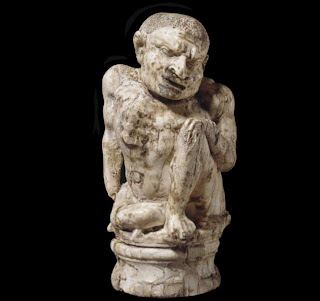
7. Another figurine, a little ivory hunchback from Alexandria, is inspiring my current work in progress, a retelling of Aesop’s Fables. (According to some ancient sources, Aesop was a hideously ugly hunchback.) Note that he is wearing nothing at all. You can find him near the Socrates figurine just mentioned in display case 6 in room 22. 

Thanks to Iszi Lawrence for letting me gush about some of my favourite objects and thanks to the British Museum for inspiring my writing. Find out more about my books at carolinelawrence.com. Find out more about Iszi's books at iszi.com.

P.S. All the photos on this post are copyright of the British Museum. 

Friday, January 24, 2020

Tabula Rasa

The lower leaf is a 'tabula rasa' or blank tablet
The Latin Programme has just announced a competition for kids to write a story or poem under 500 words. You have until 24 April 2020 and the pieces can tackle any theme and take any form as long as they use the Latin phrase ‘tabula rasa’ as a starting point. First prize is £100 in book tokens with two £25 runners up. And I am one of the two judges! 

But what is a TABVLA RASA? 

In Roman times, a ‘tabula rasa’ was a clean writing tablet. 

The word ‘rasa’ is a participle from the verb ‘rado’, I shave or smooth. We get the word razor from it. 

The word ‘tabula’ means a board or plank. We get the word tablet from it. 

Romans often made writing tablets from small, thin wooden planks coated with beeswax. They would then inscribe letters in the wax, using a the sharp end of a stylus made of metal, bone or wood. By the way, we get the word stylus from Latin ‘stilus’, which means stick, stake or pointed instrument

When Romans wanted to erase the words they had written on a tablet, they would use the flat end of the stylus to smooth the wax. Some frescoes show a triangular-shaped spatula that could be warmed and then pulled across the wax to smooth it and make it blank. 

Spatula (far left) on a fresco from Pompeii via @LiberalDespot

So the most literal meaning of ‘tabula rasa’ is a smoothed or ‘shaved’ wax tablet. 

Lupus with wax tablet holder (2007)
In my Roman Mysteries, one of my characters can’t speak so he uses a wax tablet to communicate vital messages. 

Maybe your hero needs a tablet to communicate like Lupus.

The phrase ‘tabula rasa’ has a metaphorical meaning as used by philosophers such as Aristotle and John Locke: a blank mind. Locke believed babies were born with a totally blank mind and that the things that happened after their birth were etched into their brains forever. 

So ‘tabula rasa’ can also mean blank mind

Maybe your hero has amnesia.

stylus and scraper via Peter Lorimer
‘Tabula rasa’ can be applied to the type of slate on which Victorian schoolchildren wrote with chalk, like a mini blackboard. For this reason ‘tabula rasa’ can also mean a clean slate like when all your debts (the money you owe) or sins (things you’ve done wrone) are cancelled and you can ‘start fresh’. 

Maybe your hero has a chance to start fresh. 

Finally, a fun idea for a mystery or spy story based on the phrase ‘tabula rasa’ is an ancient method of delivering a secret message where you write a message on the wood tablet, then put the wax on top to hide it. That way the writing tablet looks blank but actually contains a hidden message. 

re-enactor writing on a replica tablet of beeswax coloured with soot
Maybe your hero must get a message to a rescuer. Or intercept a message from a spy. 

So there are lots of meanings of ‘tabula rasa’. You might even think of a new one. 

Just make sure you put that phrase somewhere in your entry! 

HERE is the link to the competition. And HERE is a link to some ideas for how to start your story... Good luck! I cant wait to read your entries. 

Tuesday, July 16, 2013

The Risky Escape by Aya Kodmani

As the first spark of sun entered the sky, my eyes shot open, today was Wednesday, This day, like every day, I had to fill up my water pail and drive the horses to their stables, 1 hurried down the steep staircase, with the horses' dull brown leathery reins and out of the door, heading to the gravelly horsefield.

The surrounding city was silent now except for a few of the early working farmers, milking the cows and goats, and their wives cooking and churning the creamy thick lemon yellow butter.

I tied up Lupus and Nubia (our horses) and patted their soft, silky hazelnut coats, After that, I led them a long way from the field, into the wooden boarded stable, They happily trotted in through the loose-
hinged door, eager and hungry to eat their morning meal of mouth-watering hay.

I grabbed a hard wooden pail, skipped to the little river and scooped a clean fresh pail of water. By now, the sun was scorching down on my pale light skin. As I headed back to my house, I could hear the noisy chattering children charging out of their thatched cottages, like excited bulls heading for the ring, hoping to meet their friends on the way to the market.

Suddenly, I noticed the sky was darkening. Great, thick, gloomy clouds seemed to appear in the huge sky and partially covered the mid-day sun. I heard crackling sounds. 1 started running as fast as my legs could carry me, back to tell father that Mount Vesuvius was rumbling. A layer of thick, grey, puffy soot up to three feet high fell onto the hot stony ground

"Father, Father!" I puffed. "I’m pretty sure 'Mount Vesuvius is erupting!"

My father immediately rushed off to get the big wooden boat out of the shed I followed, out of breath. He carried it with my help, onto the old cart, which had four, large, iron wheels.

Father quickly called for my mother, and of course my two sisters, to hurry into the wooden cart. We all sat on the edge of the cart feeling frightened of the monstrous mountain, the wind was rapidly blowing
like a tornado.

My father was speedily hitching up Lupus and Nubia to the cart. When we were all ready, father steered the rocking cart towards the turbulent, rough, angry sea.

When we arrived near the water's edge it was so windy that Cleo and I had not enough strength to drag the boat onto the sandy shore so, my mother gave crying baby Flavia to Cleo, and she, father and I  shoved and pushed and shoved again until finally the boat slipped into the shadow water, with us jumping and leaping into the boat that tossed against the choppy waves.

As we all sailed away, I looked back at the huge volcano covered with laughing flames and cackling lava bursting out of Mount Vesuvius. As I turned to tell Cleo to look hack at Pompeii, we saw poor slaves and farmers choking on big, heavy puffs of thick, dusty grey smoke. Some were being submerged with ash, others were being hit by painful, rocky, hard pumice stones and all were suffering from the heat.
"Aren’t you so glad that we escaped that big moment of terror? Don’t you feel so bad for those poor suffering people? I find it so sad!" I said solemnly.

"Yes, I agree. It's very sad. Imagine if we were those terrified people!" replied Cleo.

"We're lucky, aren't we?" We both agreed at the same time.

The End

No prizes for guessing why I love this winning entry of the 2012 Golden Sponge-stick Writing Competition by 8 year old Aya from Pembridge Hall School for Girls. But a prize for Aya in the shape of a Golden Sponge-stick Trophy! 

Saturday, June 01, 2013

A Day in the Life of a Roman Girl

Flavia Gemina, 10, is an amateur detective. She lives in the Roman port of Ostia with her father Marcus Flavius Geminus, her ex-slave-girl Nubia, her tutor Aristo, two slaves and two dogs. (This interview was given in November AD 79)

My dog Scuto wakes me at sunrise. He presses his cold nose into my face and I open my eyes to see his face looming in a big, panting grin. If I've been up late the night before, I roll over and go back to sleep. Scuto knows it's no good trying to wake me if I'm tired, so he goes downstairs to help our cook Alma prepare breakfast. She goes out to buy bread at cockcrow and is usually back by dawn.

a lyre
Presently I hear music - the sound of flute and lyre. Nubia usually practises with my tutor Aristo first thing in the morning. Nubia's about 11 - a little older than I am. She used to be my slave-girl but she saved my life so many times that finally I set her free. She still lives with us though. Now she's like my dark-skinned sister. If Scuto doesn't get me up, the music does.

Nubia coifs Flavia
Nubia likes clothes and jewellery but I'm not too bothered about all that. I lace up my sandals and slip on any old tunic, a short one in summer and a long one in winter. Then I go downstairs. Our house has a secret garden inside: nobody on the street can see it. In the center is a fountain. I splash some water on my face and have a drink. Then I use the latrine. This month it's my job to empty the latrine bucket every morning - but that's another story.

We all eat breakfast whenever we come downstairs: usually a warm poppy-seed roll and a piece of cheese in summer and a hot poculum made of spiced wine mixed with milk in winter.

a lararium or shrine
By the time I appear, pater is usually up and at work in his study, preparing for the day ahead. He calls the whole household together into the atrium and we watch him make the daily offering at the household shrine. It might be a honey-cake, or a piece of fruit, or a hyacinth-scented candle. Just something to keep the household gods happy. My father didn't used to be so pious... but that's another story.

After morning prayers, pater goes out: to the barber first and then to call on his patron. Then he goes to the harbour to work on his ship and do whatever a captain does when he's not on a voyage. Of course he's home at the moment because the sailing season is over; it won't begin again until late April.

Jonathan and his sister Miriam
After pater leaves, about an hour past dawn, Jonathan and Lupus come over for lessons. Jonathan is my next-door-neighbour. He's Jewish. We became friends after he saved me from some wild dogs... But that's another story. I like Jonathan because he makes me laugh.

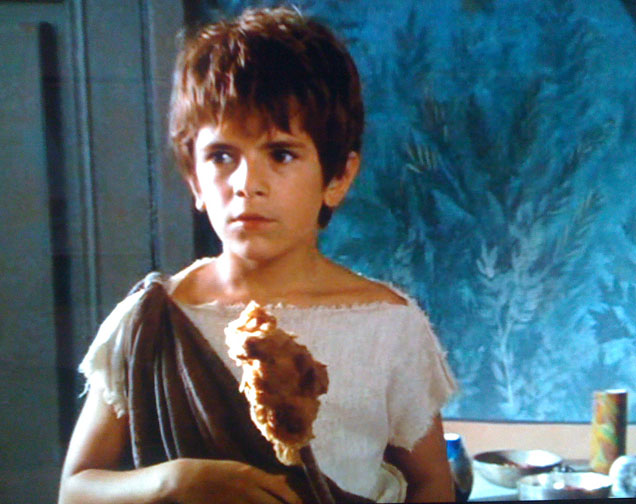
Lupus is a boy we discovered once in the necropolis outside the town walls. He has no tongue and can't speak. He's a bit wild but very clever. He learned to read in less than a month and now he can write, too. We think he's about eight or nine years old.


Lupus' name means "wolf" in Latin
Lupus lives with Jonathan at the moment and they have lessons with me and Nubia. Jonathan's father Mordecai and my father came to some arrangement. I think Mordecai gives us free medical care in return: he's an excellent doctor.  Jonathan's older sister Miriam used to attend lessons with us, but now she's preparing to get married. She's fourteen and the most beautiful woman I've ever seen.

Aristo the Greek tutor
Aristo is a brilliant tutor. He's young and Greek and very handsome. (When I was younger I wanted to marry him, but now I'm too mature for such childish ideas.) He teaches us Latin literature, Greek language, mythology, philosophy and maths. Ugh! I hate maths. I hate it almost as much as I hate emptying the latrine bucket.

Lessons last until noon, when the gongs announce the opening of the public baths. Then we have a light lunch of bread and cheese and olives. Afterwards the adults take a siesta or go to the baths. That's usually when we conduct our investigations. But during the winter months - like now - Nubia likes to go to the baths, too. She says the only time she feels warm is in the hot, dry laconicum or the steamy sudatorium.

dining Roman style
Pater usually goes out to dinner about four hours past noon. He dines with his patron or one of his friends. In that case, Nubia and I have something light with Alma and Caudex. (Caudex is our door-slave and sometimes my bodyguard.) Occasionally pater entertains at home and sometimes we are invited. We never recline - well, only at the Saturnalia. We sit at a table in the middle of the triclinium while pater and his friends recline on the three couches around us.


reading by lamplight
We go to bed at sunset, or shortly after, which is nice in the summer but very frustrating in the winter. Alma says it's bad for my eyes, but sometimes I smuggle a scroll up to my bedroom and read by the light of my little clay oil-lamp. My favourite scroll at the moment is one by Apollodorus. He tells lots of Greek myths. I finally fall asleep and dream that I'm going on a quest with Jason or helping Hercules complete his tasks. My dreams are always in colour and they are very exciting. But they are never as exciting as my real life!

This interview is an excerpt from The Roman Mysteries Treasury, a glossy book based on the TV series based on my 17 book series The Roman Mysteries, which covers almost every imaginable aspect of life in Italy at the time of Mount Vesuvius's eruption. The Treasury is now out of print but you can still get the books and the TV series on DVD
Please mention The Roman Mysteries if quoting and acknowledge photos © LEG Ltd 2007. Thanks! 

Sunday, May 19, 2013

Which Temperament Are You?

The ancient Greeks and Romans believed that the world was made of four elements: Air, Earth, Water and Fire. Many of them also believed that human beings were full of liquids or HUMOURS that matched up with these elements.

Use of dry-cupping to suck "bad humours" out of a man in San Francisco  

The ancients (and some moderns) thought that everybody tends to have more of one 'humour' than the others. This excess could determine your TEMPERAMENT. Knowing which of the four 'temperaments' you were would also help ancient doctors prescribe a cure when you were sick. They could 'balance your humours' by either taking away the excess humours (through bleeding, vomit, enema, dry-cupping, etc.) or by building them up through diet. For example, if you had too much mucus they might prescribe a hot, dry baked rooster!

Here are the FOUR HUMOURS. 

Blood = Sanguine temperament = AIR
Black Bile (found in poo) = Melancholy temperament = EARTH
Phlegm (mucus) = Phlegmatic temperament = WATER
Yellow Bile (found in vomit) = Choleric temperament = FIRE

Try this Roman Mysteries Questionnaire to see which of the Four Temperaments you are:

(To download this questionnaire, go to my DORMOUSE page)


If you mainly ticked “a” then you are SANGUINE, like FLAVIA with extra BLOOD.
Enthusiastic but overbearing, you are often impulsive and take risks. You are cheerful, energetic and optimistic but you can also be impatient. You get bored easily and sometimes find it hard to stick to one task, flitting from one thing to another. Although you are apparently friendly, your friendships can be superficial.
Fun Fact about Sanguine Temperament: Ancients believed the extra blood often gave you PINK CHEEKS.

If you mainly answered “b”, you are MELANCHOLIC like JONATHAN, who often has too much BLACK BILE.
You are likely to be a perfectionist who overthinks things. You spot all the mistakes and errors in a plan and so you can seem critical. You can be stubborn, reserved and aloof. On the good side, you are sensitive, thoughtful and often creative. You are also grounded. People might call you a pessimist, but like Jonathan, you maintain you are a “realist”!
Fun Fact about Melancholic temperament: In medieval times people thought CATS were melancholic!

Did you mainly tick “c”? Then you are PHLEGMATIC like NUBIA and your extra "humour" is MUCUS.  Those of a phlegmatic temperament were considered to be patient, calm, nurturing, thoughtful, loyal and non-demanding. The downside is that – like Nubia – you can be overwhelmed the force of stronger personalities.

Fun Fact: Mucus makes you brave and steadfast. According to Pliny the Elder, some soldiers in ancient times drank a concoction of bull mucus and goat mucus to calm them down before a battle. This mixture was called SNORTEUM.

If you answered mainly “d” then you are CHOLERIC like LUPUS.
People of a choleric disposition are often hot-tempered. They can be pushy, bold, insensitive and risk-takers. On the plus side they are adventurous, enterprising and brave. Natural leaders, cholerics are often too independent to accept help or advice.
Fun Fact: The ancients believed that CURLY HAIR was one mark of the choleric temperament.

Sanguine Pooh Bear!
Don't worry if you don't fit easily into one of these categories. The ancients believed your temperament could change throughout the course of your life and even in the course of one day!

And don't try balancing the humours yourself, especially through bloodletting, vomiting or laxatives!

P.S. There is a great summary of the four humours by Christopher Hedley. He matches the four humours with characters from Winnie the Pooh! Winnie-the-Pooh = Sanguine; Eeyore = Melancholic; Piglet = Phlegmatic; Tigger = Choleric. And here's my riff on the humours in super heroes (below)!


Caroline Lawrence writes time machine books which will transport you back first century RomeWestern America in the early 1860s and Roman Britain. For more information, visit www.carolinelawrence.com.

Saturday, April 06, 2013

12 Tasks for the British Museum

The British Museum at night
I am a bit of a nerd. I like lists. I like challenges. I like setting myself tasks.


In my Roman Mysteries Travel Guide I set 12 tasks for kids to achieve at some of the sites where my Roman Mysteries are set. You don't have to do them, but they could make your trip even more fun.

I've just been to the British Museum's fab new exhibition called Life and Death in Herculaneum and Pompeii. [N.B. This show has now finished!] For the benefit of teachers, parents and kids, I thought I would highlight twelve of my favourite objects, ones you could try to spot when you visit the exhibition!

famous plaster cast of a Roman dog
I. The plaster cast of the watchdog. So sad... yet so happy, because he is now one of the most famous dogs in the history of the world. Plaster casts like this were made when archaeologists poured liquid plaster of paris into empty cavities made by decayed bodies, then chipped away the hardened ash to get the shape of the person or animal who had been there. I used to think he was left by accident in the confusion, but now I think his master or mistress left him on purpose to guard the house. They expected to return in a few hours and didn't want anyone to loot their house while they were gone. Roman Mysteries link: my first Roman Mystery – The Thieves of Ostia – was inspired by the memory of a dog barking in the night and I asked the question: What would happen if someone started killing the watchdogs in Ostia, the ancient port of Rome?

herm of Caecilius
II. Caecilius's willy! This is the thing the Cambridge Latin Course never shows us and it came as quite a shock for me. This statue is called a herm and was set up by a freedman (ex-slave) of Caecilius. It shows a "warts and all" portrait bust of the banker Caecilius on top and then half way down are his private parts. The willy makes you giggle and thus turns away evil and bad luck! It's apotropaic. Roman Mysteries link: In the first scroll of The Colossus of Rhodes, Flavia's nursemaid Alma gives Lupus and his friends little willy amulets to keep away bad luck. Some of them have wings and bells on them for extra good luck. You will also see a teeny-tiny penis amulet in the last case of the exhibition. 

Lupus paints a fresco in book #6
III. Fresco of a garden with plants and birds - you can't miss this beautiful three-wall painting. A fresco was a painting done on fresh plaster. When the plaster is still damp, it sucks up the paint applied and the pigment becomes part of the wall. You can see some plants and birds they had in the first century CE. The hanging actors' masks at the top were probably used to keep away evil. You can see the casts of the family of four who lived here at the end of the exhibition. They were found cowering under the stairs. Roman Mysteries link: In Roman Mystery #6 The Twelve Tasks of Flavia Gemina, Lupus helps a fresco painter finish the labours of Hercules.

It's used for WHAT?!?
IV. Two portable toilets or chamberpots - one in clay with flanges for you to sit on, one in bronze with a lid so it won't slop when the slave goes to empty it in the gutter or (hopefully) down the cesspit. My husband Richard always says: "The first lesson of history is No toilet paper. What did they do when they went to the loo?" Romans often had toilets in their kitchens next to the hearth. And of course the communal multi-seater public toilets are famous. They have holes on top – for the obvious thing – and holes at the front  for a sponge-on-a-stick or spongia, the Roman version of toilet paper. (For a page of Pinterest images about Roman Toilet habits, go HERE.) Roman Mysteries link: In The Dolphins of Laurentum, Lupus doesn't realise what the sponge-stick is for and he uses it to beat a drum.

marble boy and dolphin fountain
V. Statue of a little boy in marble - this is a rare depiction of a real little boy. Notice his hair was painted reddish-gold. He was part of a fountain in someone's garden and held a dolphin from which water spouted. Stories of dolphins befriending humans were extremely popular in Roman times and dolphins were even a symbol for early Christians. Apparently there is a tragic tale associated with the archaeologists who discovered this piece but I have no more details. Roman Mysteries link: Also in Roman Mystery #5, The Dolphins of Laurentum, there are several tales of boys and dolphins, including a real one told by Pliny the Younger, who was 17 when the volcano erupted. He is one of our main eye-witnesses to the events of that terrible day. 

another puteal from Herculaneum
VI. Carbonised windlass and marble well-head - today we just go to our tap and turn it on. Back in Roman times they had several methods of getting water. In some houses, rain water fell through a rectangular hole in the roof (compluvium) into a rainwater pool (impluvium) and then drained down into a storage tank or cistern. Many Roman houses in Pompeii and Herculaneum have a well-head (puteal) so that you can draw water from the cistern. But Pliny the Elder warns that cistern water is often slimy and full of horrid things. Most Romans probably got drinking water from private or public fountains, where the water came straight from the aqueduct. The windlass was the wheel you wound the rope around. The carbonised windlass in case 46 is from Herculaneum. Roman Mysteries link: In Roman Mystery #2 The Secrets of Vesuvius, the well on Flavia's uncle's farm inexplicably dries up the day before the volcano erupted. This is something that really happened. 

oscilla in situ at Herculaneum
VII. Oscillum - nobody knows exactly what these marble discs were used for. They hung between columns of a peristyle and oscillated! (Yes, that's where the word comes from; it means to swing or twirl.) The discs may have been for decoration or to scare away birds or to keep away evil. My learned friend Prof. Girolamo Ferdinando De Simone says "90% of oscilla are connected with Dionysus, god of the region." Roman Mysteries link: One of my Roman Mysteries short stories "The Perseus Prophecy" (In The Legionary from Londinium and other Mini Mysteries) has a rich matron killed by a fallen oscillum. But was it an accident or murder? Flavia Gemina has to use her detectrix skills to solve the mystery! 

Bacchus & Vesuvius
VIII.  Fresco of Vesuvius with Bacchus - The god of wine makes his presence felt everywhere on the Bay of Naples. This marvellous fresco of Vesuvius before it erupted clearly shows it covered with vineyards. The guy inhabiting a cluster of grapes and wearing a vine-leaf garland is Bacchus, the god of wine, or perhaps his Greek equivalent, Dionysus. He is not giving his pet panther some wine; he is pouring a libation. This fresco was part of a lararium or shrine and you can see an altar near the front. Note the snake, too. You will see a lot of snakes in this exhibit, some with red crests. They were considered good luck. One Roman who did not like snakes was the poet Virgil. Just read book two of The Aeneid if you don't believe me.
Roman Mysteries link: In The Twelve Tasks of Flavia Gemina, our heroine detectrix gets a visitation by Dionysus the god of wine. Always a bit dangerous! 

IX. Skeleton mosaic - This black and white mosaic of a female skeleton (once a beautiful slave-girl?) holding wine jugs looks quite creepy and indeed it is. But it's a memento mori, a reminder that one day we will all be dead so we should eat, drink and be merry while we can. Roman Mysteries link: In The Sirens of Surrentum, my most romantic Roman Mystery, set one year after the eruption of Mount Vesuvius, a rich patron named Pollius Felix serves wine in silver cups decorated with skeletons to remind everyone that vita is brevis. You will learn about Stoics and Epicureans in this book. And also how to commit suicide with a sponge-on-a-stick. You can still visit the ruins of the remains of the fabulous seaside villa of Pollius Felix on the Capo di Sorrento. 

"Don't eat me!"
X. Glirarium - a clay jar to fatten dormice. (NB dormice with one "o" NOT "doormice") Everybody thinks Romans ate stuffed dormice all the time. In fact, they probably only ate them rarely as a special treat, if at all. But this jar shows they did eat them. This glirarium (in case #15, next to a wonderful carbonised loaf of round bread), looks like a portable toilet at first but if you look inside you see the spiral track for captive mice to run up to get food. The poor critters were fed and kept in the dark until they became nice and plump. Then you would kill them, roll them in honey and poppy seeds and bake them! By the way... nobody knows for SURE if that's what this pot is. Take everything with a grain of salt. Including dormice. Roman Mysteries link: Also in The Sirens of Surrentum, Flavia's father does not want her to visit decadent Baiae because it is "a glirarium of licentiousness". 

pouring plaster into man-shaped hole
XI. Resin woman - most of the casts you see in this exhibition were made with liquid plaster of paris, like the first cast of the dog at the beginning of this exhibition. But this one from Oplontis (a place between Herculaneum and Pompeii) was made of resin. The picture I've put on the right is from a 1954 film called Viaggio in Italia or Voyage to Italy. It shows the Bay of Naples as it would have looked nearly 60 years ago. There are even some (probably staged) shots of archaeologists making the plaster casts. If you look closely at the resin woman, you can see folds of the fabric she was wearing outside and some of her bones inside. You can also see some of the jewellery she had with her as she fled the eruption.

XII. Two books by me! Along with fun books like Dorkius Maximus and The Rotten Romans, you will find two of my Roman Mysteries in the children's bookshop at the end of the exhibition. Despite the "Famous Five-ish" cover, The Secrets of Vesuvius and The Pirates of Pompeii are full of accurate facts and they will transport you back to AD 79 so you can experience what children went through before – and after – the eruption of Vesuvius! You can also watch a BBC TV series based on the Roman Mysteries though it is not as accurate, and please visit my Facebook page where I post fun news about Ancient Romans regularly. Let me know YOUR favourite item in the exhibition by leaving me a comment below. And if you want to learn more about Roman kids or critters, read the summaries of two talks I gave in May: Animals in Herculaneum and Pompeii and Children in Herculaneum and Pompeii 

Want more? See TEN MORE THINGS, including curator Paul Roberts' fave item.

And visit my Pinterest pages: VesuviusRoman Children and Roman Toilet Habits...

P.S. This show has now finished.

Caroline Lawrence is a graduate of UC Berkeley, Newnham College Cambridge, SOAS and UCL, but has the mentality of an 11-year-old thus making her eminently qualified to introduce kids aged 7+ to the world of Ancient Rome. Best of all, she teaches through stories: The Roman MysteriesThe Roman Mystery Scrolls and the new Roman Quests series, set in Roman Britain!

Wednesday, January 26, 2011

A Day in Ostia


A Day in Ostia Antica: the ancient port of Rome
NB: The site of Ostia Antica is open almost every day of the year, EXCEPT Mondays

I first visited the site of Rome's ancient sea port one summer afternoon when I was a sixteen-year-old high school student on a study-tour from California. Like almost everyone I know who has visited Ostia, I fell in love with it. I wanted to go back in time so that I could wander its streets, watch a play in the theatre, visit one of its many baths complexes. That afternoon in Ostia was one of the experiences that prompted me to study Classics and become a Latin teacher. A few decades later, when I began planning my series of children's mystery stories set in ancient Roman times, I decided to have my main characters live in Ostia.


In Roman times Ostia would have been a busy port town, exotic and lively, brimming with people from all over the Roman empire: Greeks, Egyptians, Nubians, Jews, Syrians and Gauls. In the first century AD, Ostia's main function was to receive grain from Egypt and Sicily and to ship it on to Rome and its one million inhabitants. This grain was stored in Ostia's many warehouses and sometimes made into bread before being transported by barge along the winding Tiber to the capital city, fourteen miles away. In addition to the usual residents of a first century Roman town there would have been sailors, stevedores, ship-owners, storehouse managers, customs officers, rope-makers, sail-makers, and plenty of unsavoury types. When I asked one Classical scholar what ancient Ostia would have been like, he replied 'nowhere to bring up my child if I could avoid it!'

Today, Ostia is no longer bustling and dangerous, but quiet and peaceful. Over the past two thousand years the mouth of the Tiber has silted up, pushing the coastline away from Ostia. The site is landlocked and long deserted. Wandering around its ruins, you will find the remains of baths, temples, houses, shops, taverns, latrines and even a theatre. You can see traces of frescoes on the walls, half standing columns, marble thresholds and millstones from bakeries. One of the most distinctive features of Ostia are its black-and-white mosaics. They are everywhere.

Although Ostia is not as well-preserved as Pompeii, it's much more accessible (a single one way ticket will take you all the way from Rome) and much less crowded. If you are based in Rome, an excursion to Ostia is the perfect day trip. Wear a sunhat and trainers, and dress in layers. Ostia can be cool and foggy in the morning and blazing hot by the afternoon. From Rome, take the metro's Linea B to the stop called Piramide, then change by going up the escalator and down the steps into Porta San Paolo station for the 'light railway' to Ostia Antica. The last station on the Rome-Ostia line is Cristoforo Colombo. (Ostia Antica is the stop after Acilia and before Ostia Nord.) Get off at Ostia Antica and go out of the station and over the blue footbridge. Continue straight along a residential street and carefully cross the busy road on a blind curve opposite the restaurant called Allo Sbarco di Enea. Go past the restaurant (which will be on your right) and follow the road to the parking lot and ticket kiosk. For more detailed instructions go HERE.

Parents travelling with children might enjoy THIS ARTICLE by Nick Trend, a dad who took his children to Ostia.
Allo Sbarco Di Enea - The first thing you notice on your right, after crossing the main road, is a restaurant with chariots parked in its vine-shaded courtyard. Peer through the fence and you'll also notice statues, frescoes and a fountain. This is a touristy but fun place where all the waiters wear tunics. It's called Allo Sbarco Di Enea, which means 'Where Aeneas Got Off'. Aeneas was the Trojan hero who fled his burning city and eventually settled in Italy to become the father of the Roman people. The food is mediocre and the place only comes alive after 9.00pm - Italians eat late - but it can be a fun experience if you go with a big group.

The Thieves of Ostia, first in the Roman Mysteries series

Umbrella pines - Something else you notice about Ostia even before you enter the site are the pines. With their rough textured bark in shades of caramel, nutmeg and honey, their lofty fragrant canopies provide homes to chittering birds in winter and spring, chirring cicadas in summer and autumn. These trees offer cool shade in the summer and shelter from rain in the winter. Today, there are thousands of these beautiful trees in and around Ostia, making it one of the greenest suburbs of Rome.

The umbrella pine - pinus pinea - was a striking feature of the Italian coast even in Roman times. Pliny the Younger says the cloud emerging from Vesuvius looked like an umbrella pine, ie. a trunk-like column of smoke rising up and then flattening out at the top. Of course there are other trees in Ostia: cypress, poplar, oak, mimosa, myrtle, oleander and other species of pine, but for me the umbrella pine is Ostia's trademark. In my first book, The Thieves of Ostia, Flavia, Jonathan and Nubia catch their first glimpse of Lupus when he is trapped up one of these Ostian pines by some wild dogs. Today you can still see (tame) dogs lolling in the dappled shade among the tombs.

The Tombs - Romans were not allowed to bury their dead within the city but to made sure their departed relatives and friends were as close as possible, they placed tombs along main roads right up to the town walls. So tombs are the first thing you'll see when you enter the site of Ostia. They are fascinating, but leave them for later. Lupus, the youngest member of Flavia's gang, lived wild among the tombs of Ostia for two years after he escaped the clutches of Venalicius the slave-dealer.


The Roman Gate - There's not much left of the Porta Romana. In Flavia's time it would have been an impressive arch, faced with marble and flanked with statues of Victory and Minerva. Once you are 'inside' the town walls, look ahead and to the left. Beneath some umbrella pines, you can still see a long water trough for the thirsty mules that pulled carts to and from Rome. It is under the shade of those very trees that Flavia approaches two gaming cartdrivers to arrange transport from Ostia to Rome in The Assassins of Rome.


The Baths - The Romans loved their baths. In Flavia's time Ostia had a population of about 20,000 making it a relatively small town. But it was served by no less than 18 public baths complexes. Before you carry on down the main road, have a look at my favourite baths in Ostia: the Cartdrivers' Baths. You'll find them on your right, opposite the mule trough. Walk behind the remains of storehouses until you reach the modern tree-lined road giving access to archaeologists and site workers. Also known as the Termii Cisarii, the Cartdrivers' Baths were exclusively for the muleteers who drove carts to and from Rome. Look for the delightful black-and-white mosaic of four mules with their names written beside them. If you've read The Assassins of Rome, you'll know what their names mean: Pudes (Modest), Podagrosus (Lame), Barosus (Dainty) and Potiscus (Tipsy).

The Decumanus Maximus - Go back to the main road and carry on past the ancient shopping arcade towards the Baths of Neptune with their impressive black-and-white mosaics of tritons and sea-nymphs. A platform here gives a wonderful view not only of the mosaics but of the whole site. This road is the main road of Ostia and it's called the Decumanus Maximus. As at Pompeii, you can see the ruts made by a hundred thousand carts which carried grain and other goods to and from the port. (The round wishing-well in the centre of this road is medieval. Ignore it.) The Decumanus Maximus will take you past brick granaries and the marble theatre to Ostia's forum. Lupus runs down the Decumanus Maximus in The Assassins of Rome when he is trying to catch a cart and he almost knocks over a slave carrying a jar of urine. This liquid was very useful in the cleaning and bleaching of cloth, so ancient laundries (known as the fullers') would not have smelled very pleasant.

The Theatre - This was the one of the first buildings in Ostia to be excavated, over a hundred years ago, because its ruins were visible, poking up above ground. It has been heavily but accurately restored. As you enter beneath a cool arch, look up to see the elegant stucco decorations on the ceiling. In Flavia's time, the theatre held 2,500 people. Today it attracts cats, doves, wood pigeons and tourists of all nationalities. 


I was sitting here in May of 2000 eating pistachio nuts and an apple when I saw a party of Italian schoolgirls skipping rope on the grassy disused stage. One of the girls reminded me of Flavia. The mosaic portrait of Flavia on the front of the British editions is based on a drawing I made from my photo of Francesca. Sometimes, plays are still put on here in the summer months. Information and tickets can be obtained from the Ostia ticket kiosk at the entrance to the site. For more information check the Official Ostia website.

This elephant marks the office of beast importers of Sabratha
The Forum of the Corporations - located directly behind the theatre, this large complex was built on several storeys around a temple of Ceres. This is where guilds (or 'corporations') of ship-owners, marine-suppliers, importers and grain-traders had their offices and did business. Shaded by ancient umbrella pines, the delightful black-and-white mosaics illustrate the different offices. Elephants, boar, tigers marked the offices of wild beast importers, ships and images of Ostia's famous lighthouse indicated ship owners, and baskets with their leveling rods were for the grain-traders. Flavia and her friends come here in search of clues and interview a wild beast importer in The Twelve Tasks of Flavia Gemina.

The Forum - Go back to the Decumanus Maximus and into the forum, the main business centre of ancient Ostia. Here the dominating landmark is a big brick building atop a stepped platform. This temple to the Capitoline triad - Jupiter, Juno and Minerva - would have been faced with marble to cover the brick. Called the Capitoleum, this temple would have had a treasury in its basement. It is in the shadow of this temple that the evil slave-dealer Venalicius parades his slaves -- including the beautiful young Nubia -- in The Thieves of Ostia.

The Basilica - to the right of the Capitoleum - if you are standing on its steps looking out - is the Basilica of Ostia. Every Roman town had a basilica to house law-courts and magistrates' offices. Ostia's junior magistrate Marcus Artorius Bato works here. Flavia first meets him in The Thieves of Ostia but he appears again in later books to help the four with their investigations.

The Temple of Rome and Augustus - opposite the lofty red-brick temple of Jupiter, Juno and Minerva you will see the remains of the temple of Rome and Augustus. Flavia and Nubia come here in The Twelve Tasks of Flavia Gemina and find a clue in the face of the cult statue of Rome, personified as a beautiful Amazon with her foot on the globe of the world.

Roman Toilets - while you're in the Forum, don't miss Ostia's most amusing landmark, the twenty-four seater forica or public toilets, near the Temple of Rome and Augustus by the Forum Baths. Ancient Romans did their business right next to each other, with no doors or dividing walls. They sat chatting, gossiping, even extending dinner invitations. The holes on top of the cool marble bench are for the obvious thing. The holes at the front are for the sponge-stick, ancient Roman toilet paper. When you finished wiping your bottom with it, you put it in a basin of water for the next person to use! Lupus has obviously never been here, or he'd know a sponge-stick is not for beating a drum as he thinks in The Dolphins of Laurentum.

Shrine of the Crossroads - just past the Forum, the Decumanus Maximus ends in a fork. Crossroads were sacred places in Roman times and there was a temple here, where two lofty cypress trees stand today. Lupus comes here one cold December dusk during the festival of Saturnalia, and he makes some exciting discoveries.

The Museum - Ostia's museum only opens in the morning but doesn't take long to explore, so make sure you have a quick look before lunch. Ostia's finest statues have been brought here to keep them safe from robbers and from the elements.

The Bakeries - near the museum you can find a relatively well-preserved bakery. Ostia was the bread-basket of Rome. Huge shipload of grain from Egypt and Sicily were stored in beautiful red-brick warehouses before being towed on mule-powered barges up to Rome. Sometimes the grain was made into bread before it was transported, hence the many bakeries in Ostia. Notice the distinctive hourglass mills (grain grinders.) These would have been operated by blindfolded donkeys going round and round for hours. You can still see the circular trace of their hoofprints in the herringbone pattern of the brick floor. The Code of Romulus is a Roman Mystery short story partly set in an Ostian bakery.

The Synagogue - Built in the middle of the first century AD, this one of the oldest in the world. You will find it at the edge of the site, near perimeter fence. See the modern highway? That's where the ancient shoreline would have been. In fact, as you pass Ostia in a car, the synagogue is the building you can see most clearly. All that's left of it today are a few pillars and blocks of marble, but you can see Latin inscriptions in some of the marble paving stones. In spring swifts and swallows swoop in the warm air feasting on tiny bugs, and you can see butterflies fluttering among the columns and minuscule red spider mites on the coloured marble floor. Jonathan and his friends seek refuge in the synagogue when they are being chased by slave-dealers in The Thieves of Ostia. Later, in The Gladiators from Capua, the friends 'borrow' a disused cube of marble from beside the synagogue to make a tomb.

Flavia's house - Use your map to find your way through the long grasses from the synagogue towards the Laurentum Gate. Here in a quieter residential area of Ostia (these houses date from the time of Julius Caesar) you'll find the residence of Cartilia Poplicola, a young Roman widow who fancies Flavia's father. Moving back towards the entrance of the site, parallel with the Decumanus Maximus, you'll find a fullers', a mithraeum and more storehouses. What you won't find is Flavia's house, or Jonathan's, or even Green Fountain Street. I made a conscious decision to have my characters live in an unexcavated part of the town. One day I hope they'll build a life-sized reconstruction of their houses - complete with Roman frescoes, fountains, mosaics, furniture and fittings. Until then, you can sit in the shade of an umbrella pine munching olives, cheese and bread. Imagine that you are sitting in the tablinum (study) of Flavia's father, looking into the inner garden. (Another route to the site of Flavia's house is the little side road leading off the Decumanus Maximus just before the theatre.)

If you haven't brought a picnic lunch you can go back to the new snack-bar near the Museum. Here you can eat a delicious pasta or salad at parasol-shaded table on a pleasant terrace only a stone's throw from the Tiber River. Just the other side of this sunny courtyard is a bookshop where you can buy guide books and souvenirs, including a kit to make your own black-and-white mosaic of a dolphin. Oh, and the (modern) toilets are here! After lunch, explore the site. Let your feet guide you. Lose yourself in Flavia's world. Look out for landmarks from The Twelve Tasks of Flavia Gemina: inscriptions mentioning Cartilius Poplicola, a covered fountain, a many-spouted fountain, baths, stables and - near the Capitoleum - the wonderful Inn of Diana, just like the one where Lupus games with some men in a little courtyard.

Ostia Lido - After a day exploring Ostia, treat yourself to an ice cream and orangina down by the sea. Lido Centro (Central Beach) is only one more stop on the train line. Walk from the train station down to the seafront where you'll find dozens of beachside cafés with roofs of slatted bamboo and further north a marina with shopping. In the summer months its very lively here in Lido Centro, this is where modern Romans come to cool off. Off-season it's deserted, but you can still find somewhere to sit and wonder at how brave Roman sailors were. On blustery spring days the wind marches whitecaps across the brown water and makes the canvas awnings flap and crack. It was on this beach, or its ancient equivalent, that Flavia and her friends rescued Pliny the Elder, and received a Latin riddle that would set in motion an exciting adventure in The Secrets of Vesuvius. And of course the port plays an important part at the end of the last book of the series, The Man from Pomegranate Street, when the friends sail away for new adventures.


Caroline Lawrence on the beach at Ostia Lido (a few miles from Ostia Antica)

Some of the photos on this site are from The Roman Mysteries TV series. The rest are mine!

[The Roman Mysteries books are perfect for children aged 9+, especially those studying Romans as a topic in Key Stage 2. Viewers in some regions can watch season one of the Roman Mysteries on iTunes. For more fun things to do in Ostia, Rome and Pompeii, download the Roman Mysteries Travel Guide to your Kindle or tablet. Carrying on from the Roman Mysteries, the Roman Quests series set in Roman Britain launched in May 2016 with Escape from Rome.]