Showing posts with label Latin. Show all posts

Tuesday, January 27, 2015

Why Study Latin?

Why Study Latin*

Parents often ask me why their children are studying Latin in this day and age.  It's a good question.

Latin is a dead language.  That means no one speaks it any more. So why on earth is it still taught?
Just because of a huge weight of tradition?  Because Daddy and Grandaddy both learned Latin? Because of its intellectual prestige? Because once it was the lingua franca of educated Europeans? 

These reasons aren't relevant anymore, but there are some real benefits to be had from learning Latin, for adults and children alike.

At the beginning of term I usually give the parents of my Latin pupils a piece of paper listing some of the reasons for learning this 'dead language':

1.  Learning Latin increases mental ability. In a recent study in America, children at a primary school were divided into two random groups. One group did a small amount of Latin per week, the other didn't. At the end of a term, the children who did Latin were doing consistently better at ALL subjects than the children who didn't do Latin. It has long been maintained that Latin helps develop logic and language skills. In fact, every few years a flurry of articles are published stating that a new study has shown the benefits of learning Latin. 

2.  Learning Latin teaches grammar and syntax. When I was at the University of London studying German with other post-graduates, it soon became evident that about half the class had no idea what grammatical terms like definite article, case and conjunction meant.  The teacher had to stop and ask how many of us wanted to review these basic grammatical terms before we started the course properly.  These were all adults with at least one University degree behind them, going on for an MA or  MSc, yet several of them raised their hands.  What did those particular students have in common?  They HADN'T studied Latin.  Those of us who had studied Latin didn't need to review grammatical terms.  

3.  Learning Latin helps us learn English itself.  One of my ten-year-old pupils, Ian, was in the hospital with an eye problem.  He noticed the word lachrymal on one of his forms.
'Does that have anything to do with tears?' he asked the staff nurse.
'Why, yes, it's the department that deals with tear duct problems. How did you know that?' she asked.
'I study Latin,' he replied.
Ian and three eleven-year-olds helped me make a diagram of the cases. (right)

Over 60% of all English words are derived from Latin (or Greek).  

4.  Learning Latin helps us learn the so called Romance Languages. A Romance language isn't one you speak with a guitar in your hand and a rose between your teeth; it's a language which developed from the language spread by Roman soldiers and colonists: Latin! Romance languages include Italian, Spanish, Portuguese, French and Romanian. Compare the Romance words for 'friend':

Latin: amicus
Italian: amico
Spanish: amigo
French: ami

and some non-Romance words for 'friend':

Hebrew: haver
Russian: dryg
Japanese: tomodachi
Swedish: vaen

It is particularly relevant, now that the UK is part of Europe, to familiarise ourselves with the cultural and linguistic heritage of the Roman colonists. :-( 

5.  Learning Latin helps you learn other 'dead languages'.  What are some other dead languages? Biblical Hebrew and Greek, if you want to be a Bible scholar. Ugaritic, Akkadian or Egyptian Hieroglyphics, if you want to become an archaeologist like Indiana Jones.  

6.  In fact, learning Latin helps you learn almost any other language, because to learn Latin you must learn HOW to learn a language.  You learn to analyse words and sentences; you learn how to memorise vocabulary; you learn to put aside preconceived ideas (based on English) of how a language should work.  

7.  For this reason, anyone who wants to be a novelist, travel writer, pilot, journalist, diplomat, missionary or international business person – in other words, someone who will need to learn other languages – would benefit from learning Latin.  

8.  Anyone who wants to become a doctor, nurse, physiotherapist or vet would benefit from knowing Latin because the parts of the body are still referred to by their Latin terms.  The word valve means 'a folding door' in Latin, the atrium in the heart is a 'hall' or 'chamber', and it's easy to picture the structure of certain bone cells when you know the word trabeculae means lattice-work.   

9.  Anyone who wants to become a gardener, botanist or zoologist would benefit from Latin.  Most flora and fauna are known by their Latin names.  In fact the words 'flora' and 'fauna' are both Latin.

10.  Finally, Latin is fun.  Learning the language is like solving a giant puzzle.  Anyone who likes crosswords, codes or cryptograms will derive great pleasure from making sense of it.  Latin literature tells of myths and battles, love stories and philosophies, comedies and tragedies, poetry and prose. Latin history is full of fascinating men and women: Caesar, Cleopatra, Hannibal, Cicero, Nero, Hadrian, Spartacus, Marcus Aurelius, St Augustine, St Jerome and many more.  

I think this last reason is the most important for the children, and just to make sure they are convinced of this point, I start off each new school year with a Latin banquet.  We spend one or two lessons discussing what food the ancient Romans or Pompeiians would have eaten. Once we have eliminated chocolate, bananas, potatoes and tomatoes, I get each student to volunteer to bring a 'Roman' food. 

On the day, we spread out a large sheet or rug to catch all the crumbs and spread cushions to recline on. We put our food on plates in the middle. For greater authenticity you could wear tunics and garlands, and have a couple of children volunteer to be slaves. We serve well-watered red and white 'wine' - grape juice in jugs - as our beverage. Then we all recline on our left side, leaving the right hand free. No forks are allowed; they were unknown in Roman times. So we eat with spoons and our fingers.  

Our Roman Banquet menu could look like this: 

Gustatio (Starters)
hard boiled eggs with salt
black olives
pomegranates
almonds or pistachio nuts

Mensa Prima (Main Course)
smoked fish
cold roast chicken
warm pitta bread and hummus

Mensa Secunda (Dessert)
grapes
figs
pistachio halva
honeycomb
honeycakes

During the banquet we each take turns reciting a poem or telling a story. Play some of Synaulia's ancient Roman music to help set the mood.
For end-of-term parties, I screen a Roman movie. My personal all-time favourite and the film I believe most accurately portrays ancient Rome is A Funny Thing Happened on the Way to the Forum

'Oh, Mother,' grumbled my teenage son the other day, 'You really shouldn't throw Latin banquets and show films; you'll give those poor kids the idea that Latin is fun.'


*This is a slightly updated version of an article I wrote way back in 1997, in the pre Minimus days when I was teaching my own ad hoc Latin course to primary school aged kids in London. Feel free to use it; I only ask that you give me credit. 1997 © Caroline Lawrence

[Caroline Lawrence's Roman Mysteries books are perfect for children aged 9 - 90. Carrying on from the Roman Mysteries, the Roman Quests series set in Roman Britain launched in May 2016 with Escape from Rome.]

Sunday, October 21, 2012

Golden Sponge-Stick Comp 2012!


Are you a budding young writer?

Could you create the next Flavia Gemina or Falco?

Well, here's your chance.

Burgess Hill School presents to you a national writing competition for all UK and international school and college students, The Golden Sponge-Stick Competition.

To enter the quest for this coveted prize, please read on:

The story itself:
1. Your story should be a Roman story and based in Roman times. It can be set in any part of the Roman world. It can be either a Roman short story or a Roman mystery/detective story/thriller.
2. Your story should be an individual entry and written entirely by you. Please would a parent or guardian/carer sign your entry at the end or on the back to verify this.
3. Your story should not exceed 1500 words in length. Handwritten and typed entries are both welcome but please ensure that the handwriting is legible.
4. Knowledge of Latin is certainly not essential but you should display some historical research and/or knowledge of Roman daily life in you story. If you do study Latin then it would be excellent to use some in your story or dialogue.
5. Your story should have a clear, logical point, a set of characters, possibly including a hero/heroine and ideally a series of twists and a striking ending!


Please send your entries by email or post to:

Jerry Pine
Burgess School for Girls
Keymer Road
Burgess Hill
West Sussex
RH15 0EG

email: j.pine610 [at] btinternet.com

Good luck in your quest for the golden sponge-stick!

COMPETITION RULES AND DETAILS:

1) A panel of judges will choose the winning entries for each age category.
2) The age categories will be split into four:
ages 8 and below; ages 9-11; ages 12-13; ages 14 and above.
3) In each category three prizes will be awarded; the best in each will receive the prestigious golden sponge-stick. Other classical prizes including books and vouchers will be awarded.
4) Entries are welcome now and the closing date for all entries is Friday December 21 2012.
5) The judges reserve the right to keep all entries unless a stamped addressed envelope is included for return of your entry.
6) All winners will be notified of the result by Friday January 18 2012.

Note from Caroline: Although I am posting details of this competition here on my blog, it is run entirely by Jerry Burgess and is his invention. I can neither read submissions nor give advice, but I can point you to my WRITING TIPS page.

And three points of clarification:
1. The competition is open to children from all over the world, not just the UK. But the submission must be in English. 
2. The competition is open to home-educated children as well as those attending day or boarding schools.
3. The cut-off age is 18 (i.e. entrants should still be 18 years old on 31 Dec 2012)

I will be announcing the winners here on this blog in February 2013. Bona fortuna! Good luck!

P.S. If you don't know what a sponge-stick is, go HERE!
P.P.S. You could do this for NaNoWriMo for Kids

Tuesday, February 14, 2012

Romance in Ancient Rome - a Quiz


Cupid on a crab

I) St Valentine was most probably
a) a Jewish priest
b) a Roman soldier
c) a Greek freedman
d) a Byzantine emperor

II) The Lupercalia was a mid-February Roman fertility festival. Which of these was NOT a feature?
a) setting doves free
b) half-naked youths
c) goat sacrifice
d) striking people with leather thongs

III) In first century Rome, the most popular month for marriage was
a) April
b) May
c) June
d) July


14 yr old Miriam the bride
IV) Who was Cupid's mother?
a) Minerva (Athena)
b) Venus (Aphrodite)
c) Juno (Hera)
d) Helen of Troy

V) When Pliny the 'Younger' was older he married
a) a besotted 14-year-old girl
b) his niece
c) the Emperor Domitian's niece
d) Cleopatra's niece

VI) The Romans believed the best finger for a wedding ring was
a) the middle finger of the left hand
b) the middle finger of the right hand (the left was unlucky)
c) the fourth finger of the left hand (like today)
d) the fourth finger of the right hand (the left was unlucky)

VII) The legal age for a girl to marry in first century Rome was
a) 10
b) 12
c) 14
d) 16


The Sirens of Surrentum
VIII) The legal age for a girl to become betrothed (engaged) in first century Rome was
a) any age
b) not younger than 6
c) not younger than 8
d) not younger than 10 (decreed Augustus)

IX) The most common cause of death among young women in ancient Rome was
a) malaria
b) measles
c) Latin
d) childbirth

X) The word 'genuine' comes from the Latin
a) genu 'knee' - because the father took his newborn on his knee to acknowledge it was his.
b) genus 'noble birth' - because if you were of noble birth you were a genuine aristocrat.
c) gens 'family' - because only the genuine members of the family could inherit.
d) genius 'guardian spirit' - because this spirit only protected the genuine family members.


Flaccus gives Flavia a love-poem
Bonus fact: Did you know the words 'Roman' and 'Romance' are linked? Also, Roma backwards is amor!

[If you want to learn more about Roman romance, read The Roman Mysteries, especially The Sirens of Surrentum, which has kissing from the very first line. You might also want to check out a blog I wrote about Romantic Roman Artefacts. Some of the pictures in this blog are from the Roman Mysteries TV series, available on iTunesUKCarrying on from the Roman Mysteries, the Roman Quests series set in Roman Britain launched in May 2016 with Escape from Rome.]

P.S. The answers: 1 (b); 2 (a); 3 (c); 4 (b); 5 (a); 6 (c); 7 (b); 8 (d); 9 (d); 10 (a)

Sunday, July 31, 2011

Golden Sponge-Stick Comp '11

A winner & a runner-up from 2010
Are you a budding young writer?

Could you create the next Flavia Gemina or Falco?

Well, here's your chance.

Burgess Hill School presents to you a national writing competition for all UK and international school and college students, The Golden Sponge-Stick Competition.

To enter the quest for this coveted prize, please read on:

The story itself:
1. Your story should be a Roman story and based in Roman times. It can be set in any part of the Roman world. It can be either a Roman short story or a Roman mystery/detective story/thriller.
2. Your story should be an individual entry and written entirely by you. Please would a parent or guardian/carer sign your entry at the end or on the back to verify this.
3. Your story should not exceed 1500 words in length. Handwritten and typed entries are both welcome but please ensure that the handwriting is legible.
4. Knowledge of Latin is certainly not essential but you should display some historical research and/or knowledge of Roman daily life in you story. If you do study Latin then it would be excellent to use some in your story or dialogue.
5. Your story should have a clear, logical point, a set of characters, possibly including a hero/heroine and ideally a series of twists and a striking ending!

Please send your entries by email or post to:

Jerry Pine
Burgess School for Girls
Keymer Road
Burgess Hill
West Sussex
RH15 0EG

email: j.pine610 [at] btinternet.com

Good luck in your quest for the golden sponge-stick!

COMPETITION RULES AND DETAILS:

1) A panel of judges will choose the winning entries for each age category.
2) The age categories will be split into four:
ages 8 and below; ages 9-11; ages 12-13; ages 14 and above.
3) In each category three prizes will be awarded; the best in each will receive the prestigious golden sponge-stick. Other classical prizes including books and vouchers will be awarded.
4) Entries are welcome now and the closing date for all entries is Friday December 16 2011.
5) The judges reserve the right to keep all entries unless a stamped addressed envelope is included for return of your entry.
6) All winners will be notified of the result by Friday January 13 2012.

Caroline with sponge-stick
Note from Caroline: Although I am posting details of this competition here on my blog, it is run entirely by Jerry Burgess and is his invention. I can neither read submissions nor give advice, but I can point you to my WRITING TIPS page.

And three points of clarification:
1. The competition is open to children from all over the world, not just the UK. But the submission must be in English. 

2. The competition is open to home-educated children as well as those attending day or boarding schools.
3. The cut-off age is 18 (i.e. entrants should still be 18 years old on 31 Dec 2011)

I will be announcing the winners here on this blog in January 2012. 
Oh, and if you don't know what a sponge-stick is, go HERE.
Bona Fortuna! (Good luck!)

[The 17 books in the Roman Mysteries series are perfect for children aged 9+, especially those studying Romans, Greeks or Egyptians as a topic in Key Stage 2. There are DVDs of some of the books as well as an interactive game.]

Monday, January 31, 2011

Themes & Topics

Themes and Topics in the Roman Mysteries
compiled by the author herself: Caroline Lawrence

These are the various themes and topics I had in mind while writing the Roman Mysteries. But writing is as much an intuitive right-brain exercise as a logical left-brain one. In other words, even the author doesn't always know everything he/she is doing. So if you think you've seen something new or different, you are probably right!


Book 1: The Thieves of Ostia (theme: fear of the unknown)
Roman topic: introduction to a Roman town (Ostia port of Rome) & Roman social structure.
Real historical characters: Cartilius Poplicola (resident of Ostia attested in inscriptions)
Sources: The Aeneid, the Bible, Ostian inscriptions
Greek myths: Aeneas, Cerberus, Perseus and Medusa
featured food: snails, stuffed dormice, dates, fruit
key artefacts and objects: signet ring, wax tablet & stylus, oil lamp, tombs, amphoras, quartz dice
ROMANS Key Stages 2 & 3 - relevant blogs: How to Make a Stola, A Day in Ostia

Book 2: The Secrets of Vesuvius (theme: parentage & adoption)
Roman topic: the eruption of Vesuvius and destruction of Pompeii & surrounding towns
Real historical characters: Pliny the Elder, Titus Tascius Pomponianus, Rectina
Sources: Pliny the Younger, Pliny the Elder, Catullus, Ostian graffito
Greek myths: the return of Vulcan, Thetis, Achilles
Roman festivals: Vinalia, Vulcanalia
Pliny's simple fare: cheese, fruit, eggs; Tascius's rich fare: turbot in dill sauce
key artefacts: scrolls, portable inkpot & pen, flute, pan-pipes, parasol, cushions

Book 3: The Pirates of Pompeii (theme: slavery & freedom)
Nubia's book
Roman topic: Patrons and clients, slaves and freedmen
Real historical characters: The Emperor Titus, Pollius Felix (attested in a poem of Statius)
Historical site: the villa of Pollius Felix on the Cape of Sorrento, Scraio (spa town near Sorrento)
Sources: Pompeian graffiti, Statius's 'Silvae' (poems)
Greek myths: Dionysus and the pirates, Ariadne & Theseus
food: lemons (recently introduced); goat stew, flat bread, chickpeas, mineral water, sage tea
key artefacts: earrings, hairpins, theatrical masks, lyre, flute, kylix (Greek drinking cup)

Book 4: The Assassins of Rome (theme: guilt)
Jonathan's book
Roman topic: Nero's golden house, the destruction of Jerusalem, Jewish slave labour, chariot races
Real historical characters: Emperor Titus, Berenice, Domitian, Josephus
Sources: Suetonius, Cassius Dio, Homer, Josephus, the Bible
Greek myths: Odysseus, Polyphemus the cyclops, Penelope the faithful wife
Jewish festivals: Rosh Hashannah, Yom Kippur, Succot
featured food: exotic oranges; buttermilk; honey dipped apples for Rosh Hashanna
key artefacts: wax tablet & stylus, alabastron, loom & weights, bass lyre, tambourine

Book 5: The Dolphins of Laurentum (revenge & forgiveness)
Lupus's book
Roman topic: a real maritime villa, sponge-diving on the Greek islands
Real historical characters: Pliny the Younger
Sources: Pliny the Younger's letter about his Laurentum villa (letter II.xvii)
Greek myths: Medusa, Arion & the dolphins, Neptune & Amphitrite
Roman festival: Meditrinalia
featured food: honey glazed prawns, chicken soup
key artefacts: sponge-stick, sea-sponges, dolphin earrings, anchors, ball games

Book 6: The Twelve Tasks of Flavia Gemina (love & marriage)
Flavia's book
Roman topic: Love, betrothal and marriage in first century Rome
Historical site: notable buildings in and around Ostia
Sources: Ostian inscriptions, Ovid, Martial, Apollodorus
Greek myths: Twelve Tasks of Hercules, Pygmalion, Cerberus, Atalanta
Roman festival: Saturnalia
food: lentil stew, eggs, plums, oysters, mushrooms, quail pie, boar, ostrich, love potion!
key artefacts: sigilla (figurines), dice, objects in household shrine, strigil & bath set

Book 7: The Enemies of Jupiter (theme: hubris)
Jonathan's book
Roman topic: medicine and doctors in first century Rome
Real historical sites: Tiber Island, Palatine Hill, Capitoline Hill and the Temple of Jupiter
Sources: Suetonius, Cassius Dio, Galen, Pliny the Elder, Hippocrates
Greek myths: Prometheus & Pandora, Aesculapius, Niobe and her children
featured food: food for medicinal properties, light, medium & heavy foods, etc
key artefacts: bleeding cup, votive parts of the body, medical instruments

Book 8: The Gladiator from Capua (theme: blood & sacrifice)
Nubia's book
Roman topic: gladiators, beast-fights and the opening of the Colosseum in spring of AD 80
Real historical sites: the Flavian Amphitheatre (the Colosseum), Domus Aurea, Mons Testaccio
Real historical figures: Titus, Domitian, Carpophorus the beast-fighter, Martial
Sources: Martial, Suetonius, Cassius Dio, Ovid, Statius, Seneca, Pliny
Greek myths: Orpheus, Ganymede, Prometheus, and more
Jewish festival: Passover
featured food: barley porridge for gladiators, snacks sold at games, etc.
key artefacts: gladiatorial arms & armour, ancient souvenirs, lottery balls thrown to crowds

Book 9: The Colossus of Rhodes (theme: vows & promises)
Lupus's book
Roman topics: the seven wonders of the world, ancient 'tourism'
Historical sites: Rhodes, Symi , Kalymnos
Sources: Pliny the Elder, Apollonius of Rhodes, Homer
Greek myths: Jason and the Argonauts by Apollonius of Rhodes
GREEKS KS2 & 3 - relevant blogs: Colossus of Rhodes, Ancient Gum, Hylas

Book 10: The Fugitive from Corinth (theme: jealousy)
Nubia's book
Roman topics: Greeks in the Roman world
Historical sites: Corinth, Delphi, Athens
Sources: Pausanias, Apollodorus, Herodotus, Aeschylus
Greek myths: Theseus's Athenian adventures, Eumenides

Book 11: The Sirens of Surrentum (theme: sex & decadence)
Flavia's book
Roman topics: Roman philosophy and the failed plot to kill Nero
Historical characters: Nero, Seneca, Lucan, Polla Argentaria, Flaccus
Sources: Seneca, Lucan, Suetonius, Tacitus, Statius, Propertius
Greek myths: Dido and Aeneas, Odysseus and the Sirens
ROMANS KS3 - relevant blogs: Villa Limona, Serendipity in Surrentum, Poison
(N.B. THIS BOOK CONTAINS ADULT THEMES)

Book 12: The Charioteer of Delphi (theme: faithfulness)
Nubia's book
Roman topics: chariot races and factions
Historical site: the Circus Maximus
Historical characters: real charioteers like Scopas, Hierax and Crescens
Sources: Ovid, Juvenal, Martial
Greek myths: Pelops and Oenomaus
Roman festivals: Ludi Romani
ROMANS KS2 & KS3 - relevant blogs: Fun Chariot Facts, Roman Horse Names

Book 13: The Slave-girl from Jerusalem (theme: death & birth)
Jonathan's book
Roman topics: childbirth, funerals, wills, Roman law courts, gestures of a rhetor
Historical backstory: destruction of Jerusalem and siege of Masada
Sources: Josephus, Quintilian, Cicero, Juvenal, Seneca, Roman legal documents
Greek myths: Jason and the Argonauts by Apollonius of Rhodes
featured food: pea and leek soup, mastic chewing resin, sage tea, chestnut flour
key artefacts and objects: birthing chair, funeral pyre, bier, tombs, seal-box for wills

Book 14: The Beggar of Volubilis (theme: piety)
Flavia's book
Roman topics: Roman theatre, Cleopatra's descendants, sightings of Nero
Historical sites: Sabratha, Tripolis, Volubilis, Ghadames
Sources: Strabo, Pliny the Elder, Plutarch
Greek myths: Diana and Actaeon
featured food: millet porridge, roast locusts, lizard meat, camel-milk pancakes, senna tea, cola nuts
key artefacts and objects: bow, arrows, quiver, betrothal ring, bath-set, Nero's emerald, lens
EGYPT KS2 & KS3 - relevant blogs: Volubilis, Ugly Cleopatra

Book 15: The Scribes from Alexandria (theme: going home)
Nubia's book
Roman topics: Roman Egypt especially Alexandria, eunuchs, the Great Library, the Nile
Historical sites: Canopus, Alexandria, Giza, Edfu, Aswan, Nubia
Sources: Strabo, Martial, Juvenal
Egyptian myths and legends, including story of Isis, Osiris and Seth
featured food: sun-bread, bean porridge, palm wine, onions, leaf-cups, dom-fruit
key artefacts and objects: hieroglyphs, graffiti, riddles, codes, treasure map

Book 16: The Prophet from Ephesus (theme: redemption)
Jonathan's book
Roman topics: early church in Asia Minor
Historical sites: Halicarnassus, Ephesus, Hierapolis, Laodicea, Heracleia
Historical characters: St John the Evangelist, Tychichus
Sources: Strabo, the New Testament
Greek myths: Pluto and Persephone, Endymion and Selene
featured food: grapes from the vine, cucumber, sour cherry juice, sheep entrail kebabs, pomegranates
key artefacts and objects: dolls, travel baskets, reed flute, lyre, carpets, looms

Book 17: The Man from Pomegranate Street (theme: resolution)
Flavia's book
Roman topics: mysterious death of Titus in September AD 81
Historical sites: Rome, the Sabine Hills, Palace of Domitian and the 'Emissario' on Lake Albanus
Historical characters: Titus, Domitian, Ascletario, Gaius Valerius Flaccus, Gaius Suetonius Tranquillus
Sources: Suetonius, Babylonian Talmud, Apollonius of Tyana
Greek myths: Romulus and Remus, Rape of the Sabine Women, Death of Odysseus
featured food: Sabine olive oil, brown bread, honey, grapes, imported oysters
key artefacts and objects: needle-sharp stylus, graffiti, wedding veil and the spear to part the bride's hair

[The Roman Mysteries books are perfect for children aged 9+, especially those studying Romans as a topic in Key Stage 2. You can watch a television adaptation of some of them on Amazon Prime. For more information about Caroline's other books, go to carolinelawrence.com.]

Saturday, December 05, 2009

Saturnalia Quiz

Saturnalia in The Roman Mysteries TV series
Would it surprise you to learn that many of the customs we observe at Christmas go back to Roman times and have nothing to do with the birth of baby Jesus?

Here is a quiz for you to test your knowledge of the Roman SATURNALIA and its influence on modern Christmas.

1. The followers of which deity celebrated his birth on 25 December?
a) Sol Invictus
b) Mithras
c) Jesus Christ
d) all of the above


2. Three days before 25 December, what event occurs?
a) Summer Solstice
b) Summer Equinox
c) Winter Solstice
d) Winter Equinox
e) Easter

3. The Romans gave gifts on the Saturnalia. Which of the following did they NOT give?
a) chocolate
b) silver objects
c) preserved fruit
d) small clay or wooden figures
4. Mottoes and riddles in Christmas crackers might go back to the Roman practice of
a) hiring comic actors to deliver gifts
b) writing epigrams for Saturnalia gifts
c) Roman singing telegrams (in dactylic pentameter)
d) memorizing and reciting lines from Virgils Aeneid as a Saturnalia party trick


5. Which ONE of the following Christmas customs did NOT orignate in the Saturnalia:
a) feasting
b) drinking
c) putting up lights
d) putting up greenery
e) Santa and his reindeer
f) giving gifts
g) taking time off work

6. In first century Rome, which illegal practice was permitted only during the Saturnalia?
a) murder
b) theft
c) witchcraft
d) gambling


7. The paper crown in British Christmas crackers reminds us of the Roman custom of:
a) choosing a King of the Saturnalia
b) Caesar wearing a wreath
c) the Etruscan king Tarquin
d) It has nothing to do with any Roman custom

8. Santa's red conical hat might well be traced back to hats worn during Saturnalia by:
a) Trojans
b) Greeks
c) Persians
d) Smurfs
e) freedmen

9. Here are some more Christmas customs which might go back to the Saturnalia. Which one is bogus?
a) mulled wine
b) Christmas stockings
c) singing songs
d) pantomime

10. Which of the following foods was certainly NOT part of the Saturnalia feast?
a) hot chestnuts
b) honey-glazed ham
c) turkey and mashed potato
d) roast peacock
To find out more about the Saturnalia, check out my blog about A Roman Christmas!

Some fun kids
 book set in first century Rome during the Saturnalia are The Twelve Tasks of Flavia Gemina in my Roman Mysteries series and The Thunder Omen in my Roman Mystery Scrolls series; it features dancing Saturnalia chickens and illustrations by Minimus Latin Course artist Helen Forte.  The episode of the BBC TV series based on The Twelve Tasks of Flavia Gemina shows what the Saturnalia might have looked like.  

Answers: 1 = d; 2 = c; 3 = a; 4 = b; 5 = e; 6 = d; 7 = a; 8 = e; 9 = b; 10 = c

Wednesday, July 08, 2009

Narcissus by Waterhouse

The myth of Narcissus is a famous one.

Narcissus was a beautiful Greek shepherd of fifteen who cruelly scorned all those who loved him, including a nymph called Echo. She followed him around, echoing the final words of his sentences but was so thoroughly ignored that she pined away to nothing until only her voice remained. The Roman poet Ovid is one of those who tells the story and Waterhouse has almost certainly used his account. Here is the story as Ovid told it and Waterhouse painted it.


One day, while hunting in the woods, Narcissus comes to a pristine pool of water and bends over it to drink. Mirrors were almost unknown in those times - especially to rustic shepherds - and when he sees his reflection, he thinks there is a beautiful youth under the water. The youth seems to be alive and responding. When Narcissus smiles, so does the youth. The youth is so beautiful that Narcissus falls in love. He bends forward to kiss the boy in the water and the 'boy' rises up to meet him. But just when the moment of consummation should occur, just when their lips should touch, the boy's image blurs and ripples and Narcissus gets a mouthful of water.

Eventually Narcissus realises it is his own reflection in the water but he still cannot bear to pull himself away. He has fallen in love with himself. Like Echo, who is watching him, he will pine away to almost nothing. He will become a flower, nodding its head over the reflection in a pool. You can see the flower at his feet. The narcissus is another name for a daffodil, which I have always thought is a rather boring flower for Narcissus to turn into.

Notice that Waterhouse has used the same boy model as he used for Hylas and the Nymphs. That dark hair, the well-shaped head, those perfect features, the smooth limbs. He is not at all feminine, but he is beautiful. Waterhouse has painted his sunhat on the ground to his right and his quiver of arrows on his left, just by the edge of the painting. The quiver makes us think of the god of love. In Roman art, Cupid is often shown as a baby with bow and arrows, but in Greek mythology Eros was an adolescent, like Narcissus. He was beautiful and smooth enough to be desired by both men and women.

Today we call someone a 'narcissist' when they are obsessively self-centered and have no empathy for others.

I am basing my next book, Brother of Jackals, around the myth of Narcissus, but in a way it's never been done before. This painting is one of my inspirations. Thank you, Ovid. Thank you, Waterhouse.

P.S. J.W.Waterhouse: The Modern Pre-Raphaelite was an exhibition at London's Royal Academy in 2009. It has now finished.
.

Thursday, May 21, 2009

The Mystery of the Latin Pillow

Or: The Curious Case of the Classical Cushion
by Caroline Lawrence, author of The Roman Mysteries


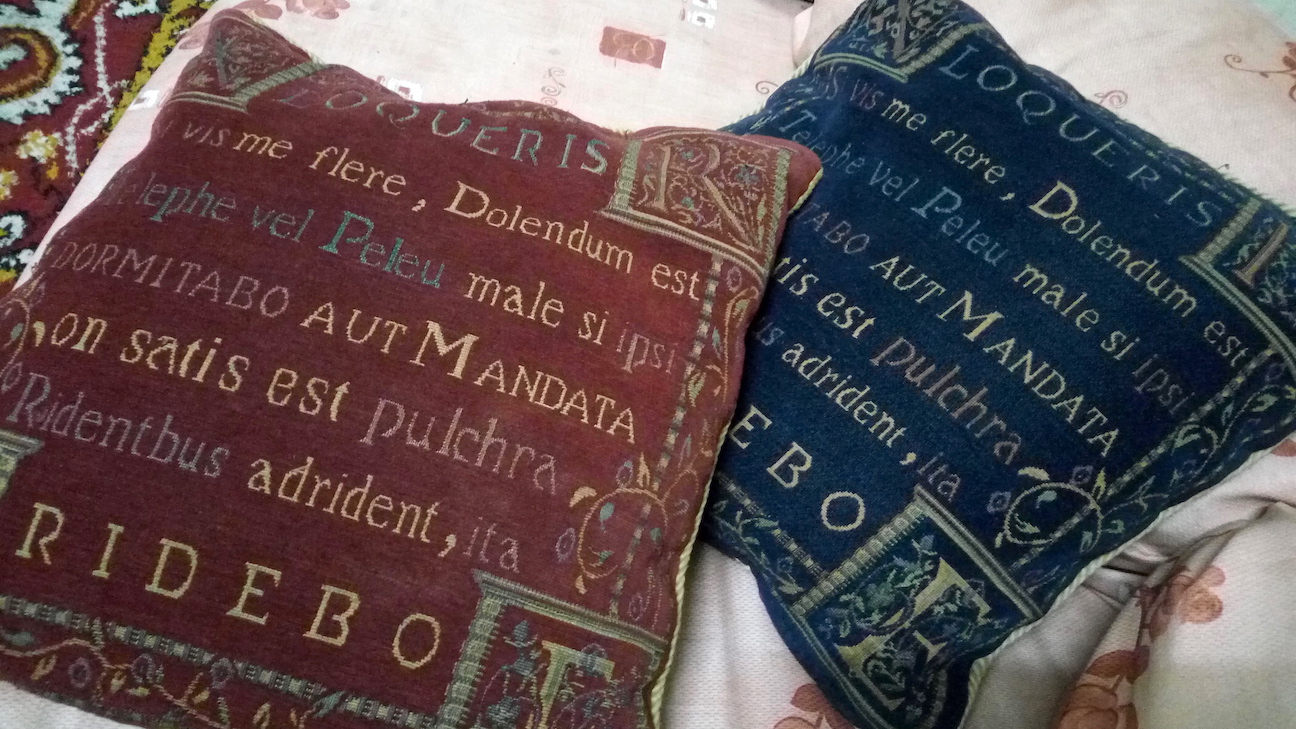
It all started when a keen fan from Tasmania asked me to translate a cushion in her house.

This happens a lot.

Not necessarily being asked to parse a pillow, but I am often asked to help with Latin homework, compose mottoes and translate inscriptions.

Top Fan Julia had a tapestry cushion with Latin on it.
She diligently copied down the Latin and sent it to me:

LOQUERIS
Si vis me flere, Dolendum est

Telephe vel Peleu male si ipsi

dormitabo aut Mandata

on satis est pulchra

Ridentibus adrident, ita

RIDEBO

The Latin looked extremely dodgy so before launching in on a translation, I did what any self-respecting scholar should always do first: I googled it. Sure enough, a search of si-vis-me-flere took me straight to several pages of chat about these pillows. It seems to be a few verses from Horace’s Ars Poetica, but badly garbled.

Quintus Horatius Flaccus AKA Horace was a poet who lived in the time of Julius Caesar and the first emperor Augustus. He is most famous for his Odes and Epodes and for coining the phrase Carpe diem! or 'Seize the day!' His Ars Poetica, 'The Art of Poetry', was actually a letter to a friend, written about 20 BC. A hundred or so years later, the orator Quintilian was the first one to call it the Ars Poetica. The Oxford Classical Dictionary describes it as ‘a most puzzling work … [saying] little that is worthy of Horace.’

So here we have an obscure passage from an obscure Latin treatise. The passage from which the pillow phrases are taken comes about a hundred lines into the letter. If you look at the cushion you can see phrases have been chopped and changed, words have lost initial letters or dropped out altogether.

Here is the non-garbled version:

Non satis est pulchra esse poemata: dulcia sunto
Et quocumque volent animum auditoris agunto.
Ut ridentibus adrident, ita flentibus adflent

humani vultus. Si vis me flere, dolendum est

primum ipsi tibi: tunc tua me infortunia laedent,

Telephe vel Peleu; male si mandata loqueris,

aut dormitabo aut ridebo: tristia maestum
vultum verba decent; iratum, plena minarum
ludentum lasciva, severum seria dictu.


And here is a rough translation:

It’s not enough for poems to be beautiful: they must be persuasive
and able to lead the soul of the hearer wherever they want.
As we grin among those who are smiling,
so we tend to well up around those who weep.
If you want me to cry, you yourself must first feel anguish
Then your misfortunes will move me, O Peleus or Telephus;
if you speak inappropriately, I will doze off or laugh out loud:
sad words require a mournful expression,
angry ones need a face full of menace,
Naughty words suit a playful mood,
serious words go with sober topics.


(By the way, Horace names Telephus and Peleus as examples of mythic characters tragic tales to tell. Telephus was a son of Hercules, famous for a fresco from Pompeii that shows him suckling from a deer. He had a miserable life which included suckling from said deer, being a beggar, almost sleeping with his mother, suffering for many years with a would not heal, etc. Peleus was a prince from Aegina – the island near Athens – and had to become an exile after accidentally killing his brother. Although he later became father of the great warrior Achilles, several tragedies were written about him.)


According to several online discussions, the guilty fabric is manufactured in China. But in the guise of cushions, upholstery, wall-hangings and curtains, it has found its way all over the world: Australia, Germany, Norway, Chile, Oxford, South Yorkshire and Tasmania.

I was at Alderley Edge School for Girls (Greater Manchester area) last week to talk about my series of books set in ancient Rome, when the librarian Ruth pointed at the heavy curtains in the hall. ‘Look!’ she said. ‘Latin curtains!’ I stepped closer and peered at the letters. Sure enough, it read: ‘Loqueris 
Si vis me flere…etc.’

If someone asks you to translate their cushion, and you recognise some of the words I’ve been talking about here, tell them it's garbled but that it says something like: ‘If you want to be a poet, laugh with those who laugh and cry with those who cry.’

How on earth a Chinese manufacturer got hold of the random and rather obscure piece of Latin poetry remains a mystery.

P.S. Someone has recently translated another piece of Latin gobbledygook – the famous lorem ipsum text filler – into English.


[The Roman Mysteries are perfect for children aged 9+. Carrying on from the Roman Mysteries, the Roman Quests series set in Roman Britain launched in May 2016 with Escape from Rome.]