 |
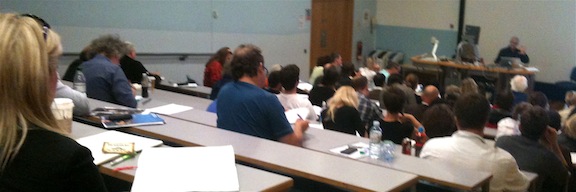
John Truby gives his Master Class in London 9 -11 July 2011 |
I have just finished attending my third Master Class with Hollywood script doctor John Truby. I came away with a list of ten practical tips to keep in mind as I plot out my next book. Most of them are things I already know from using Truby's principles over the past dozen years. A few are new to me.

1. Be aware of the "character web" In a great story, all the characters are connected to each other in some way. This seems obvious, but it will be a good point for me to keep in mind as I start writing my third Western Mystery, which is a detective story set in a community.
2. Not every hero has a "moral need". Especially in children's fiction, the hero's weakness does not have to be one that hurts the people around him. Examples of great heroes without a "moral need" are Rocky, Harry Potter, WALL-E, The Dude and any "travelling angel" like Mary Poppins or Crocodile Dundee. My hero, P.K. Pinkerton, has plenty of psychological weaknesses and doesn't necessarily need a moral weakness.
3. When writing Detective genre, figure out the opponent's plan first.
This also seems obvious but is easily forgotten.
This also seems obvious but is easily forgotten.
4. The evolution of the Story World should reflect that of the hero.
This is new to me and it's going to be exciting to try to do this. I already have some good ideas.
This is new to me and it's going to be exciting to try to do this. I already have some good ideas.

5. 3-track dialogue is a valuable tool.
Track 1 dialogue is exposition or drives the story;
Track 2 dialogue presents values and concepts;
Track 3 dialogue employs key words and symbols.
6. Make each "reveal" bigger than the previous one.
7. Start the hero's "desire" low and raise it with each "reveal".
8. Indirect & direct approach in dialogue.
9. Figure out the theme and main plot points before you start writing.
As Truby says, once a story is written "it's like cement. It hardens in your mind and is much harder to fix the problems."
As Truby says, once a story is written "it's like cement. It hardens in your mind and is much harder to fix the problems."
10. The seven beat structure (with added "ghost" & "story world") rules.
More detailed that the three-act structure but simpler that the Hero's Journey or Truby's own 22 plot beats, the seven beat structure is the one that works best for me. Its power lies in its accuracy and also in its simplicity. There is plenty of room for "right-brain" creativity, historical detail and real events.
Writing is like baking a cake while at the same time juggling the ingredients and implements. There are so many aspects to keep in mind and you've got to get the proportions and timing exactly right. Every book is a fresh adventure and a new challenge, and it never seems to get any easier. That's why being a writer is such a great job.
More detailed that the three-act structure but simpler that the Hero's Journey or Truby's own 22 plot beats, the seven beat structure is the one that works best for me. Its power lies in its accuracy and also in its simplicity. There is plenty of room for "right-brain" creativity, historical detail and real events.
Writing is like baking a cake while at the same time juggling the ingredients and implements. There are so many aspects to keep in mind and you've got to get the proportions and timing exactly right. Every book is a fresh adventure and a new challenge, and it never seems to get any easier. That's why being a writer is such a great job.

