Showing posts with label writing. Show all posts

Sunday, July 14, 2013

Golden Sponge-stick Winners 2012

the coveted trophy
(guest post by Jeremy Pine)

‘pater’

This year’s competition attracted 200 entries nationally and internationally. Again there was a very wide range of schools and colleges competing. Many thanks to regular participants who keep the life blood of the contest pumping. Popular storylines continue to feature slavery, the Roman army, gladiators and the eruption of Mount Vesuvius. Yet each year it is a revelation to witness how these well trodden paths are imaginatively retraced. Other innovations such as murder plots involving the emperor and Ovid’s love poetry showed meticulous historical research and heightened drama.  Fresh literary blood has also raised the energy, humour and creativity of the sponge stick enterprise and it is this youthful enthusiasm which is its golden heartbeat.

Prizes:  The allocation reflects the very popular 11-13 age category.

Under age 9 category winner :

Aya Kodmani, Pembridge Hall School for Girls

11-13 age category:

Winner: Lucy Johnson, St John’s School, Cambridge

2nd: Sophie Littlewood, St John’s School, Cambridge

3rd: Megan King, Stockport Grammar School

Commended: Jacob Freda, Bristol Grammar School

14 and above age category:

Winner: Ruby Osman, Sancton Wood School, Cambridge

2nd: Mia Forbes,  Nonsuch High School, Cheam

3rd: Adam Stanley, Cheadle Hulme School

Best International entry:
Marina Macklin, Highland School, Virginia, USA

Prizes for schools :

St John’s School, Cambridge (winner of Golden Sponge Stick school award)

Commended :  George Abbot School, Guildford, Norwich High School for Girls  

Special thanks :

To all the participating schools and pupils (whether you won on this occasion or not), Burgess Hill School for Girls, Barbara Johns (Head of Classics), Caroline Lawrence, Lorna Robinson and the iris project, Friends of Classics, Association for Latin Teachers, The Classics Library, JACT, Oxford University Classics Outreach, Cambridge University School Classics Project, Classical Association (for funding the prizes). Much love and thanks to my family, Carol (my mother) and my brothers, Neil and Robert for their continual encouragement.

Finally, one of this year’s winners, Jacob, wrote a story called ‘pater.’ I dedicate the youthful spirit and vision of this competition to my own ‘pater’, Malcolm, whose love of learning and the Classics inspired me and also to the teaching gifts of my sister, Lisa.

Caroline says: And I would like to thank Jeremy Pine for all the time and love he put into setting up and judging this competition. I will post some of the winning entries here over the next few weeks. Watch this space. To see some winning entries from this year – and from previous years – go HERE

Friday, June 21, 2013

My Life Stories by Caroline Lawrence

Mark Wallace and Helen Cleaves
This evening I gave a speech at the Kingston Grammar School prize-giving. Librarian Helen Cleaves invited me. Principal Deputy Head Mark Wallace gave me a great brief: "Just tell them what led you to where you are today."

The moment he uttered those words, I realised how much stories have determined the course of my life thus far. Here are twelve of the most important.

1. Nancy Drew Mysteries
The first books I devoured as a child. Not great literature but a girl with a brain who is empowered and independent despite her youth. I know now that I loved these books because Life is Mystery and we are all Detectives trying to solve it!

2. Star Trek
I loved the idea of space travel and going to exotic places and studying aliens. I also liked the idea of wearing a red mini-skirt while carrying a clipboard and working for Captain Kirk. Unfortunately I was rubbish at maths and had to abandon the idea of becoming an astronette.

Elsa Martinelli and baby elephants in Hatari!
3. Hatari!
This unlikely John Wayne film totally captured my imagination. I realize now it was the chic camaraderie of the khaki-clad game hunters, Henry Mancini song and elegant Italian photographer Dallas that captured my imagination as much as the East African landscape and animals. I dreamt of giving my bedroom a safari-theme and of studying baboons when I got older. (Jane Goodall had chimps and Diane Fossey had gorillas so that left baboons!). In my imagination my grown-up self would resemble Elsa Martinelli (right) and marry a blond gamekeeper who looked like Hardy Kruger. Unfortunately I was rubbish at biology and had to abandon that idea.

4. The Last of the Wine
I was on my gap year, working in Switzerland but it was too expensive for me to do any skiing and I was trapped in a winter chalet room. I was toying with the idea of travelling around Europe, Morocco and Greece. My parents sent me two books to prepare me for Greece, should I make it there: The Iliad in translation and Mary Renault's historical novel The Last of the Wine. That glimpse of Ancient Greece was like a bolt from Zeus's hand. I became totally fascinated by people like us yet not like us in a richly-painted, sensory world. The ancient Greeks were even more fascinating than aliens or baboons! I signed up to study Classics at U.C. Berkeley and finally found something I wasn't rubbish at.

Marrying a second time in 1992
5. The Bible
A scholarship took me to Cambridge but I found academia too dry. It was taking me away from the sensory world of ancient Rome. So I abandoned the idea of Classics as a career and looked for other work. A friend suggested getting a part time job in a London stockbroking firm. If you could design a job to be antithetical to my skills and interests, that would be it. But they hired me! A whirlwind romance with one of the partners ended in marriage and a baby. A chance conversation at a dinner party spurred me to try an experiment and see if God would answer a prayer, the first one I had ever made. He did. When I woke up the next morning, the whole world looked fresh and new. It really was like a "veil had been taken from my eyes." When my husband left me and our young son a few years later, my faith and my Christian friends were a huge consolation. They still are.

6. Drawing on the Right Side of the Brain
Visiting my family in Stanford when my son was about four, I was wandering the campus bookshop when Betty Edwards' brilliant book caught my eye. Sometimes you have to travel halfway around the world to find a book you could have bought at your corner bookstore. This literally eye-opening guide helped me teach children at my son's school how to draw. This led to a position for me teaching Latin as well as art. And teaching Latin to kids aged 8-11 revived my love for the Roman world.

Caroline and Richard 20 years on
7. Back to the Future
I loved this movie, but the thing I'll never forget is the pang of envy I had when Marty's dad gets delivery of a box of his latest book. I was jealous! Then I realised. Jealousy tells you the desires of your heart! Don't be green. Be grateful and befriend your rivals. They can be your best allies.

8. Master and Commander
My first marriage had broken up and when I met Richard Lawrence (above and right) on a church holiday. We immediately clicked. On our first date we discovered we were both reading and loving the fairly obscure (at that time) Aubrey-Maturin historical novels of Patrick O'Brian. That's when I knew it was "meant to be". Richard studied art and history at Cambridge so that was good too. Plus he was blondish and looked like Hardy Kruger if you squinted.

9. Becoming a Writer
Teaching was fun, but exhausting. I thought if I ever wanted to see if I could be a writer, I'd better make a start. Searching for books on how to write, I found this classic by Dorothea Brande. Written way back in 1934, Becoming a Writer taught me the most valuable lesson: it's all about self-discipline. But I still needed a method.

10. John Truby Story Structure
Sometimes God (or the Universe or Serendipity) puts things in your path right when you need them. A friend from church told me about John Truby's story structure audio course back when it was still on plastic cassettes. It was exactly what I needed, providing a structure upon which I could hang my ideas about ancient Rome and four children who might have lived there. My lightbulb concept was "Nancy Drew in Ancient Rome", and Truby's structure helped me write the first book of my Roman Mysteries series in the last two weeks of the summer holiday of 1999.

11. The Man Who Mistook his Wife for a Hat
I got a five-book publishing deal! But I still needed to work until royalties started coming in. This book by Oliver Sacks about anomalies of the brain helped me tutor kids as I phased out teaching and started writing full-time. It also also prepared me for the day when in 1996 - four years after we married - Richard had a massive stroke. I understood exactly what he was going through and my knowledge kept everything slightly removed, as if Richard was one of Sacks' case studies. Richard has since made an extraordinary recovery. He now illustrates my books, helps me with research and is the cook of the house.

Assistant head Graham Yates and KGS head Sarah Fletcher
12. True Grit
A librarian friend gave me this book. "You'll like it," she said. I didn't like it. I adored it! It was partly responsible for my latest series set in the American West. I dedicated The Case of the Deadly Desperados "to my friend Penny, who started me on this dusty trail when she gave me a copy of True Grit by Charles Portis."

During tonight's prize-giving at Kingston Grammar, head teacher Sarah Fletcher finished her speech with the words "Work hard and have fun." That's a rough translation of the Latin motto of the school bene agere ac laetari. I couldn't think of any better advice to give. Except maybe this:

Be careful what you read; a book could change your life!


Sunday, May 27, 2012

12 Useful Writing Tips for your Second Draft

University of Westminster
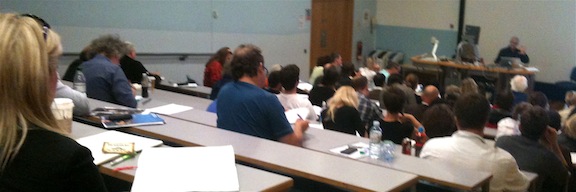
On a recent glorious sunny summer Saturday in London I attended a Raindance course with Linda Seger on writing SCENE and DIALOGUE.

Yes, I've been a published author for over a decade but it's always good to have reminders, things to check as you go through a draft. And no, her class wasn't for novelists like me but for screenwriters. Still, I reckoned I might be able to adapt some of her tips. "Great writers are both artists and craftspeople," said Seger at the start of her one-day seminar. "Technique is what you fall back on when the writing doesn't flow naturally."

She didn't really give us techniques, but she did show examples of good scenes and dialogue. While she was speaking, I swished her advice around in my head with stuff I already know from studying John Truby and Blake Snyder, and came up with the following DOZEN USEFUL WRITING TIPS which I will apply to the second draft of my current work in process.

TIP 1. The main job of a SCENE is to move the story forward. If a scene doesn't move the story forward, bin it! A scene should also be specific, accurate and visual thus letting the reader/viewer know WHERE & WHEN the story is taking place. One of Seger's favourite CATALYST SCENES is the murder scene from Witness.

TIP 2. A TURNING POINT in a scene is when circumstances make it impossible for the character to keep doing what he's doing. Most scenes have two but some have more. We watched the Rolling Bus/Oncoming Train scene in The Fugitive.

TIP 3. Don't forget to ESTABLISH where your action is taking place and show the GEOGRAPHY of the location (house, town, spaceship, etc) if necessary. Seger showed us the opening sequence of Downton Abbey as an impressive example of this.

"Crossing the Threshold"
TIP 4. You often get a SHOW STOPPER scene at the end of Act One. Christopher Vogler would call this CROSSING THE THRESHOLD, Snyder would call it Fun and Games and Truby might remind us that act divisions are irrelevant. Seger showed the Family Dance Scene from Billy Elliot. She also talked about what she called MAGIC & WONDER scenes. These all seemed to involve flying and music. Her example was the flying and music scene from Out of Africa.

TIP 5. Be creative in transitions from one scene to another, try using an EMOTION instead of an OBJECT to ease the segue. A relative of Seger's claimed people only have four main emotions: MAD, GLAD, SAD OR SKEERT (scared). However, the emotion Seger chose for her example was more subtle; she showed us transitions showing characters being REFLECTIVE (i.e. pensive) from the Paul Haggis film Crash.

TIP 6. When in doubt, use an odd number of pages/minutes, turning points, or characters in a scene. Seger claims the optimum length for scenes seems to be 3 1/2 minutes or multiples thereof: 7 minutes, 14 minutes or -- rarely -- 21 minutes long. (eg. the Opera Scene in Moonstruck)

TIP 7. Like SCENES, the job of DIALOGUE is to advance the story. Your main character will often have a MISSION STATEMENT (e.g. Jerry Maguire). Truby would call this the PLAN. Sometimes it can be stated quickly and simply.

TIP 8. Seger then breaks her own rule by suggesting an easy trick of making EXPOSITION dialogue more interesting: have two characters question your protagonist, (or bring him the problem), instead of just one. Then they can bicker, interrupt each other, show different agendas, etc. A good example of this is the exposition scene in the lecture hall near the beginning of Indiana Jones and the Last Crusade. (I kept thinking of Blake Snyder's POPE IN THE POOL technique.)

TIP 9. Add excitement to a scene by giving some of the characters ATTITUDE. (Presumably this increases conflict, which is always interesting.)

TIP 10. We all know about using different rhythm, sentence length, vocabulary, dialect, etc, to differentiate one character's dialogue from another but what about introducing SOUNDS? A character could sniff, snort, slurp, grunt, even imitate animals as Helen Mirren and Christopher Plummer do in The Last Station. (A good example of this in literature can be found in True Grit, where author Charles Portis has one of Lucky Ned Pepper's gang make animal noises instead of speaking. It's funny and memorable.)

TIP 11. Dialogue can even communicate a story's THEME, via two characters putting forth their world views: Character A is the mouthpiece of the author and presents the theme, while Character B presents the contra-theme. Seger showed us a scene from Amadeus, where Salieri defends his hatred of Mozart to a priest. Truby would call this the OPPONENT ARGUMENT and suggest that a story's TAGLINE is another way to present THEME. Blake Snyder would argue that this is the job of the OPENING IMAGE. I say: why not use all three?

TIP 12. As the author of a series where my hero has to learn how to understand people, I especially liked Seger's reminder that SUBTEXT in DIALOGUE could be expressed in non-verbal BODY LANGUAGE. She ended by showing us clips from the episode of Frasier where Frasier and Lillith have an innuendo-packed debate on television, with amusing hair-loosening and body language.

Unlike many of my more talented writer friends, writing rarely just flows with me. I need all the techniques I can get. I hope you find some of these useful as well.

For more info on Raindance Courses visit www.raindance.com

Wednesday, July 13, 2011

Story Structure Masterclass

John Truby gives his Master Class in London 9 -11 July 2011
I have just finished attending my third Master Class with Hollywood script doctor John Truby. I came away with a list of ten practical tips to keep in mind as I plot out my next book. Most of them are things I already know from using Truby's principles over the past dozen years. A few are new to me. 

1. Be aware of the "character web" In a great story, all the characters are connected to each other in some way. This seems obvious, but it will be a good point for me to keep in mind as I start writing my third Western Mystery, which is a detective story set in a community.

2. Not every hero has a "moral need". Especially in children's fiction, the hero's weakness does not have to be one that hurts the people around him. Examples of great heroes without a "moral need" are Rocky, Harry Potter, WALL-E, The Dude and any "travelling angel" like Mary Poppins or Crocodile Dundee. My hero, P.K. Pinkerton, has plenty of psychological weaknesses and doesn't necessarily need a moral weakness. 

3. When writing Detective genre, figure out the opponent's plan first.
This also seems obvious but is easily forgotten. 

4. The evolution of the Story World should reflect that of the hero.
This is new to me and it's going to be exciting to try to do this. I already have some good ideas.

5. 3-track dialogue is a valuable tool.  
Track 1 dialogue is exposition or drives the story; 
Track 2 dialogue presents values and concepts; 
Track 3 dialogue employs key words and symbols. 

6. Make each "reveal" bigger than the previous one.

7. Start the hero's "desire" low and raise it with each "reveal".

8. Indirect & direct approach in dialogue.

9. Figure out the theme and main plot points before you start writing. 
As Truby says, once a story is written "it's like cement. It hardens in your mind and is much harder to fix the problems." 

10. The seven beat structure (with added "ghost" & "story world") rules. 
More detailed that the three-act structure but simpler that the Hero's Journey or Truby's own 22 plot beats, the seven beat structure is the one that works best for me. Its power lies in its accuracy and also in its simplicity. There is plenty of room for "right-brain" creativity, historical detail and real events.

Writing is like baking a cake while at the same time juggling the ingredients and implements. There are so many aspects to keep in mind and you've got to get the proportions and timing exactly right. Every book is a fresh adventure and a new challenge, and it never seems to get any easier. That's why being a writer is such a great job.

Wednesday, February 02, 2005

A Writer's Life

Sometimes people ask me what its like being a writer.

The room where I write
I am really blessed because about five years ago my husband Richard and I moved to a riverside flat here in London. It has been a lifetime dream of mine to live by the River Thames. To quote the actress Joanna Lumley, 'If I wasn't married to my husband, I might be married to the river Thames.'

We're on the second floor so the Thames is right there, flowing back and forth, two tides a day, always different. There is also a huge sky and my arched window faces northwest so I can see the sunset in summer. Sometimes in the winter when I get up early to write, there is a huge full moon sinking down towards the apartments over on the other side, it makes a silver path in the inky water. There's also a disused docking platform outside our window, from when these flats were warehouses receiving goods from the East Indies. This wooden platform is abandoned by people, but not by birds. At any one time I can see cormorants, ducks, geese, swans, coots and usually a heron.

On Saturday and Sunday mornings the skiffs and eights slide by, a coach with a megaphone urging his oarsmen on up the river. I also see tugboats carrying London's garbage up and down, and the occasional river cruise boat. But usually it's very peaceful and unbelievably quiet. At the moment all I can hear is a goose calling to his friends on the foreshore; it's low tide.

The river is on my left. At first I couldn't take my eyes off it but now I'm content to glance over and reassure myself that it's still there. I sit at a table with my iMac facing a wall covered with images.

I am a very visual person so I need to SEE what I'm writing about. I have images of things like a Roman ship, a calendar of the year 80 AD showing phases of the moon on each day, frescoes, mosaics, film posters and portraits of people I base my characters on. I often use jazz musicians rather than actors to inspire me. I don't know what they're like so I have to deduce it from their faces. For example, in my fourth book The Assassins of Rome, I base a character called Simeon on a jazz bass player called Slim Man. Actually I did see him play in a jazz club and that informed his character as it appears in the book.

I never listen to music or the radio while I'm writing but when I'm not writing music is a huge source of inspiration. I like smooth jazz, chill, lounge, whatever you want to call it. I usually don't like songs with words because that gets in the way of the picture that music alone can create. One of my favourite musicians is Larry Carlton. I've based songs in my books on some songs of his from the album Fingerprints, in particular a song called Slave Song which is Nubia's theme.


On either side of my chair is a stool with papers, letters and reference books in piles. On the wicker coffee table behind me are more piles of papers, at the moment they are mixed with postcards and receipts from a recent research trip to Athens.

Richard's map of Ostia Antica
My husband is a non-fiction writer and graphic designer and he works out of the living room next door. He does all the little maps and diagrams at the front of my books. We have a game where he brings me what he's done in his mouth – like a dog – and drops it on my desk. I mark up the changes and tell him to 'fetch!' A moment later he is back, wagging his tail, with the latest version in his mouth.

The one thing a writer must have is self-discipline. You have to fashion a routine that works for you and this can take years. Over the five years I've been writing full-time, this is the routine I've developed.

I get up between 5.00am and 6.00am, go straight to the computer and write until 10.30, 11.00 or 12.00 noon at the latest. Of course I get up to make a cup of coffee or get some toast and an apple, and I dress in phases (preferring to stay in comfy track trousers and sweatshirt as long as possible), but by the time Richard is up and the post arrives and the phone starts ringing, I have put in five or six hours. Then I'm done with the creative, focussed part of the day.

I have made a rule, which I occasionally break, never to look at my emails until after noon. Once I'm online I'm caught up in the demands and business there.

Late mornings I either go out to the gym or go for a long walk. Writers sit around all day so you have to be self-disciplined to keep fit. Walking is one of my best ways of getting ideas or solving problems. I'll put on a jazz tape or John Truby story structure tapes and walk and ideas just come to me. I have a circuit I do along the river, over Battersea Bridge, back along the river and over Wandsworth Bridge. It takes me about an hour and a quarter and usually I come back with my problem solved or a great idea for a future book.

"Vespasian" at the BM
I have been paid an advance for ten more books in the series and I have little folders on my computer for each one. I don't know exactly what each book will be about but I have a working title and setting and at least one idea for each. If I get a good idea while I'm walking I'll decide which of the books it would fit best with and put it on my ideas document for that book. If I can't decide which of the books it would be best for, I have one hold-all document called Ideas for the Future. Every time I get a good idea or come across a great turn of phrase or see a fascinating character I type it into this document, which is now 144 pages long. Running out of ideas is NOT one of my worries.

Want an example? Here's just one of the hundreds of quotes I've jotted down in this document. It's a quote by Buffy creator Joss Whedon: 'What's your favourite movie? What's one of your most memorable experiences? Now mix them...'

After my walk I have lunch, usually a cheese sandwich and apple, or a salad.

Then, in the afternoon I maintain my website, and answer emails. They're usually either from fans or requests by schools for me to visit. I limit my months for UK school events to two per year. It's really hard work and I can't write when I'm doing promotion.

A couple of afternoons per week, during my writing period, I go to the cinema. I love movies and all my writing methods are based on screenwriting techniques and story structure used in films. Here in London we have the NFT, the National Film Theatre, so I can go see classics like Nashville and La Dolce Vita on a big screen with lots of other film buffs. On Valentine's Day I'm taking my husband Richard to see Casablanca. I love the fact that in London you can see hundreds of good films, and for a reasonable price, if you go before 4.00pm.

replica wax tablet
Another thing I love about London are the Roman re-enactment events. The British Museum and Museum of London are both great for these. I've made many friends and now can order anything from a gladiator pen-knife to a wax-tablet.


When I am doing UK promotion (usually March and October) or overseas promotion (Spanish international schools in May) my day is completely different and I have to abandon writing, though I do jot down thoughts in my little notebook. I usually can't wait to get back to my riverside flat and my writing and my movies.

My holidays are spent doing research. In the past few years I've been to Rome, Ostia, Pompeii, Sorrento, Naples, Rhodes, the Turkish coast and Athens. My holidays are devoted to my writing, but my writing is like being on holiday. So that's OK.

P.S. The Roman Mysteries books are perfect for children aged 9+, especially those studying Romans as a topic in Key Stage 2. There are DVDs of some of the books as well as an interactive game. I am also writing a series called The Roman Mystery Scrolls for kids aged 7+ and the P.K. Pinkerton Mysteries...