Showing posts with label London. Show all posts

Wednesday, May 09, 2018

Interactive Mithras by Caroline Lawrence

The evening of Thursday 17 May 2018, just over a week from the date of this post, is your chance to meet me, Caroline Lawrence. I will be welcoming children (and their guardians) to an ancient Roman underground temple: London’s Mithraeum. This is the first #MuseumsAtNight session at the Mithraeum which only opened to the public last year. 

I am honoured to have been invited and will be doing some fun interactive activities to prepare kids aged 8-13 for the Mithraeum’s Immersive ExperienceThere will be four separate sessions, each lasting about half an hour. 

To brainstorm ideas for a new book I am writing called The Time Travel Diaries, I will be trying to recreate some of the sensations of being a worshipper of Mithras. 

This will be difficult in one sense. Mithraism was a Mystery Cult which means that lots of its rites and rituals were purposely kept secret, like a secret club. 

On the flip side of the coin, because we know so little, we can play around with various ideas based on the evidence and what we think we know. 

Here’s my script for what I hope to say:

First you need to know THREE BASIC THINGS.

Who Was Mithras? 


We think that Mithras was a new god created out of different older gods. This is called syncretism and is something the Greeks and Romans often did to link cultures together. Serapis was a blend of Dionysus, Hades, Osiris and Apis for Greeks in Egypt. Sulis Minerva linked a Roman god to a British deity. Mithras was certainly partly inspired by the Persian god Mithra (no ‘s’) and a creation story involving the stabbing of a cosmic bull. The Greek goddess of victory – Nike – is sometimes shown stabbing a bull. Mithras wore distinctive Persian clothes, which happens to be the same thing the Trojans wore, a long-sleeved tunic over leggings and the famous Persian cap which looks like a Smurf hat. He also has a billowing cloak, a dagger and sometimes a bow and arrow. Mithras looks a lot like Paris, the Trojan who started the Trojan War and killed Achilles by firing a poisoned arrow into his heel. 

What Did Worshippers Want?

The worshippers of Mithras wanted part of themselves to live forever. They may have believed that a series of initiations took the soul on a journey whose goal was immortality. There is lots of evidence for seven grades of achievement. Why seven? Because the Greeks and Romans believed in seven planets: the five they could see and also the sun and moon. They thought each ‘planet’ and the god who went with it ruled a sphere, or a ‘heaven’. So when you reached the highest level you were in the seventh heaven. One ancient document encourages the worshippers to say ‘stella sum’ or ‘I am a star.’ I wonder if they imagined the soul getting purer and purer as it rises through the grades until it is a little twinkling star, looking down on earth and waiting go into another body. (Yes, Mithraists probably believed in reincarnation) But, like every journey, there is often a battle or an ordeal. Each time a follower of Mithras wanted to go to a higher grade he had to go through a scary initiation.  

What’s with the bull?


If the cross is the symbol of Christianity, this very complicated and mysterious image of Mithras stabbing a bull is the symbol of Mithraism. It’s called a ‘tauroctony’ (tar-AWK-tony) which is Greek for ‘bull-slaying’, though that word never appeared in ancient times and we’re not even sure he was actually killing a bull. People have written whole books about the ‘tauroctony’ but for now just know that some of them have the signs of the zodiac around it, along with two men holding torches. The signs of the zodiac are linked to planets of course and the guys with torches might be guarding the gates to the heavens. The one with his torch up ushers the soul in its upward journey towards the stars. The one with his torch down is showing the immortal soul the way back down to a mortal body.  

Did you notice I keep saying ‘men’? That’s because, unlike almost every other religion known to us, Mithraism was for men only. So the first thing I will do is to give all you girls a sex change and grow you up real fast. Imagine you are a Roman man, probably a soldier. 

Next, I will assign you your grades or levels. As I said, there are seven. The avatars are Raven, Bridegroom, Soldier, Lion, Persian, Sun-Runner and Father. Each has its own ruling planet and the god who goes with that planet. They each had their own attributes. And each probably had a special colour and sound. 

Who wants to be a Raven?

You get a black wristband. You are the lowest and possibly most common grade. You are under the protection of the planet/god Mercury. Your code name is Corax. Several accounts talk of Ravens flapping their arms and making a ‘cawing’ noise. Everybody flap your arms and make a cawing noise!

Who want to be a Bridegroom?

Your attributes are a lamp and a garland. You get a yellow wristband. Bridegrooms are under the protection of the planet/goddess Venus. Your code name is Nymphus. The sound you made might have been ‘Yo!’ which was the ancient equivalent of ‘Yay!’


Who wants to be a Soldier?

You get an orange wristband because the soldier’s colours were red and yellow and when you mix red or yellow you get… orange! Soldiers were under the protection of the planet/god Mars. Your code name is Miles (MEE-layz). The sound you made might have been ‘Sin dex!’ Or maybe you just stomped. Everybody stomp and say Sin dex, which is short for sinister, dexter or ‘left, right’!


Who wants to be a Lion?

Lions get a red wristband. You were under the protection of the planet/god Jupiter. Your code name is Leo for one and Leones for more than one. Leonibus means ‘to or for the lions’ and you will hear it in the salutation ‘Nama, leonibus!’ or ‘Hail to the lions!’ No prizes for guessing the sound ‘Lions’ made! Everybody roar!


Who wants to be a Persian?

You get a white wristband because of your protective planet. Any guesses? Yes, the moon. Of course you know the moon isn’t a planet, but the Mithraists counted it as one. Your code name is Persis. Nobody has a clue what sound the Persians made but we know that sometimes worshippers made vowel sounds like Aahh, Eh, Ayyy, Eeee, Oh, Oooh, Ohhh because each planet had its own vowel: alpha, epsilon, eta, iota, omicron, upsilon & omega! So maybe the Persian made a vowel sound mentioned in one papyrus text: Or maybe they purred like a Persian cat. Everybody purr!


The sixth grade is very mysterious and we think very few people reached this level. Who wants to be a Sun-Runner?

 You get a gold wristband. You are under the protection of the ‘planet’ Sol, the sun! Your god is ‘Sol’ in Latin and ‘Helios’ in Greek. Your code name is Heliodromus. Your attributes are a torch, a crown with rays like the statue of the sun god (the Statue of Liberty wears a sun crown) and a whip. Why a whip? Because the sun was often imagined driving a fiery chariot. What sound did you make? Perhaps a whip-crack, or maybe a neigh! Everybody whinny! Now everybody say ‘Nama, Heliodromis!’ Which means ‘Hail to the Sun-Runners!’

The seventh and highest grade was the Father. 

Their colour was the purple of royalty so you get a purple wristband. But there was only one for each Mithraeum. So only one of you can be Father. Fathers were under the protection of the planet/god Saturn. Their code name is Pater. Their sound might have been ‘Hey, you kids! Get off my lawn.’ (joke!) Now everybody say ‘Nama, patri, tutela Saturni.’ Which means ‘Hail to the father, under the protection of Saturn.’

(If you want to see all the chants in Latin and English go HERE


You’re about to go down into the Mithraeum for the Immersive Experience. The word mithraeum has not yet been found, but we do know they said ‘Cave of Mithras’. They called it this because the temple was designed to look like a cave. In Roman times you had to go down seven steps, (natch!) into a dark space mysteriously lit by torches. Today you have to go seven meters below street level, because you usually go down to go back in time.

Because this temple was restored to almost the exact position it occupied in Roman London, I had an idea that it would be the perfect spot for a time portal. When you go to another time, it’s like beaming to a planet in Star Trek. You don’t want to beam into a wall or ceiling. So, if you want to travel to Roman London in the mid third century, the Mithraeum is the perfect place to put a portable portal. (Say that three times quickly!)

The premise for my work-in-progress is this: When 12-year-old London schoolboy Alex Papas is recruited by eccentric bazillionaire Solomon Daisy to go back to Roman London, his mission is to get information about a mysterious blue-eyed girl whose bones were discovered in a cemetery in Southwark. But things go wrong almost from the start and when Alex finds the girl he is totally unprepared for what happens next.


BUY THE BOOK!

P.S. Ten Fun Things About London's Mithraeum.   


Thursday, December 14, 2017

Ten Things You (Probably) Didn’t Know About London’s Mithraeum

by author Caroline Lawrence


Sophie Jackson, Catharine Edwards, Fiona Haarer & Michael Marshall
A few days ago I went to see London’s Mithraeum, recently reopened in the basement of Bloomberg’s new building. I’m fairly jaded by museums and wasn’t expecting anything special, but it was great. Coming up out of the ‘experience’ I ran into Sophie Jackson and Michael Marshall of MOLA – two of the archaeologists responsible for the display – along with Catharine Edwards, Professor of Classics and Ancient History from Birkbeck College and lecturer Fiona Haarer of the Roman Society. Although I am one of MOLAs archaeology ambassadors, I had booked the normal way and our meeting was totally serendipitous. Chatting with them, I learned a couple of facts which I share below, along with a few other things you might not know. 

I do urge you to go and I hope this short list enhances your experience!


1. Exit 8. It’s easiest to reach London’s Mithraeum via Bank station exit 8. If you’re coming from Waterloo just get the Waterloo & City line. One stop is all it takes. Exit via the travelator and when it ends make a sharp left to reach Exit 8 which now has London Mithraeum added at the bottom of a list of landmarks. Go up the stairs to street level and continue straight ahead for less than 200 meters, passing the Starbucks on your left. You’ll see entrance to the Mithraeum on your right. It’s on the ground floor of Bloombergs brand new European headquarters. It doesn’t look like a Mithraeum from here; it looks like a modern art gallery because it is a modern art gallery called SPACE. N.B. As of 2019, you can take the brand new Walbrook Exit and emerge literally next door to the entrance!


2. Dead Time. Entry to London’s Mithraeum is free but you have to book a visit. They won’t just let you roll up. But sometimes if you roll up at their ‘dead time’ of 3pm they might let you in. N.B. Never show up on Monday, when the exhibition is closed. 

3. Three Parts. Like Gaul, the London Mithraeum is divided into three parts. The first part is in the art gallery reception where a guide will give you a Samsung tablet and point you at a modular wall displaying around six hundred roman artefacts all found within a few metres of where you are standing. Tap the outline of an object on your tablet and up comes a superb hi-res image of the artefact. Swipe right and find a line or two about what it is in a nice big, easy-to-read font. Why do you need a tablet when you can just look? Because some of the pieces are quite high up and/or small, and the imagery is superb. 


4. Special Glass. The piece of glass in front of the modular display of Roman objects is state-of-the-art. According to Sophie Jackson, Director and Archaeologist at MOLA, (Museum of London Archaeology), it is the biggest piece of glass you can get of that thickness and with the non-reflective properties. Hidden hinges on the left allow the slab of glass to swing open so that the modular displays can be regularly updated. 

5. Lucky Amulet. The tiniest object in the modular display wall is an amulet of amber shaped like a gladiator’s helmet. It is minuscule, about the size of your little fingernail. According to Michael Marshall, Senior Finds Specialist at MOLA, it was put in a day before we were there, replacing a less sexy pair of tweezers. Michael also told us that this tiny object was spotted by an archaeologist the old-fashioned way, with the naked eye. (Near the amulet is the famous LONDINIO tablet, also recently added by popular demand.) 


6. Go Down to Go Back. Someone at MOLA or Bloomberg had the very clever idea of showing how you have to descend to go back in time. As you go down the black marble stairs you see what the ground level would have been for important moments in Londons history such as the WWII bombing level and the Great Fire of 1666. There is a similar graphic on the back of the elevator. The Temple of Mithras dates from about 240 AD, almost 200 years after Londinium was first established. 

7. Famous Actress Joanna Lumley narrates some of the commentary on the mezzanine level, which is the second part of the experience where ‘clues to what form the cult took are explored in light and sound.’ Listen to the commentary as you watch a ghostly light show on the walls. 


8. Please Touch. You are allowed to touch the three resin casts: the head of Mithras, a tondo with inscription and a 3-D plan of the temple. As a cheerful guide named May explained to me: The exhibition is meant to be touchy-feely!’ The head of the mysterious god Mithras with its distinctive Persian cap was found in 1954 on what was intended to be the last day of excavation of just one of hundreds of bomb-exposed sites in London. Planned building on the site was halted so that the Mithraeum could be excavated and eventually removed to another site. Bloomberg and MOLA have brought it back to exactly the place it was originally found. 


Get Well card by Roman glassmaker David Hill
9. Just Theories. Don’t swallow the written explanations or spoken commentaries whole. Our understanding of this mysterious cult is changing all the time. We don’t really know what they did at these ceremonies. We don’t even know if Mithras was actually killing the bull or just wounding it. In a recent article, scholar Christopher Faraone claims the word ‘tauroctony (i.e. bull-slaying scene) is a nice-sounding Greek noun that appears nowhere in Mithraic inscriptions or literary testimonia and in fact nowhere in ancient Greek. JRS 103, pp 1-21 


10. The Experience. The third and final part of London’s Mithraeum is an ‘experience’ on the site of the ruins themselves. I don’t want to spoil it for you but it involves sound, light and mist. And although it was one of the coldest days of the year this underground space was comfortably warm. 

case.londonmithraeum.com
There is a superb free guide to the history of London as revealed in the Archaeology at Bloomberg co-produced by MOLA. You can download it HERE. (Spoiler alert: There are some images in the final pages of the brochure which might spoil the third part of the experience.) 

You can also get an interactive guide to the wall of artefacts on your smartphone or tablet by going to case.londonmithraeum.com

Bravo to Bloomberg, MOLA and Foster + Partners Architects! You did a great job. 

Book your FREE tickets to the Mithraeum HERE

Friday, May 19, 2017

Caroline's Autobiography

18 May 2017

Dear Caroline


We are learning about you and your life story we are writing a biography and i was wondering if you could give me any information about your life as an Author. I know you studied Latin at Cambridge University but our main points are

- Life as a child
- Studying
- Author Life 
- Life now

Thank you, James (aged 9)

Dear James, Here it is! 


- Life as a child


Caroline with brother Dan & sister Jennifer c. 1960
Caroline Lawrence was born in London, England in 1954. Her American parents returned to the United States shortly afterwards and she grew up in Bakersfield, California with her younger brother Dan and her little sister Jennifer. (Her surname was Weiss which means her sister is NOT Jennifer Lawrence but Jennifer Weiss.) Caroline's father taught English, French and drama in a local high school and her mother was a stay-at-home mum and a talented artist.

During the long hot summers, Caroline and her brother and sister would go swimming in one of Bakersfield's several public pools or play in prickly golden fields under a desert sun. Caroline's parents made a conscious decision NOT to have a TV, but some nights as a treat they would all pile in the car – Caroline and her siblings in their pyjamas – and go to a Drive-In movie. (A Drive-In movie is where you stay in your car and watch a film on a big outdoor screen. Here is a LIFE report about Drive-Ins.) This is where Caroline first fell in love with movies. 


- Education 


Hoover Tower at Stanford University, California
When Caroline was twelve, her family moved to Stanford University in northern California so that her father could study Linguistics there. Stanford is now famous as being part of Silicon Valley. At the age of 18, Caroline fell in love with the world of Ancient Greece and Rome after reading a book that changed her life: The Last of the Wine, by Mary Renault. Because of that book she decided to study Classics at Berkeley. (Classics is the study of Greek and Latin and the culture of Ancient Greece and Rome). She enjoyed decoding Greek and Latin so much that she managed to win a Marshall scholarship to study at Cambridge University. In 1977 she was flown to England and began studying Classical Art and Archaeology at Newnham College, Cambridge.

She has been in England ever since, with short trips home to California or to the places where her books are set.   


- Life in England


Caroline & Simon in 1982
After taking a first class degree from Cambridge, Caroline moved down to London to work as a trainee stockbroker. This was NOT a success but she met her first husband at that job. They got married, moved to a village in Essex and had a little boy named Simon. Sadly the marriage did not last. Caroline returned to London when her son was five years old and lived as a single mum for five years. When Simon was ten, Caroline married a graphic designer she met through her church, Holy Trinity Brompton. His name is Richard Lawrence and he is English. Their wedding was at the Chelsea Registry office with a blessing afterwards at St Paul's church in Onslow Square. They will celebrate their 25th anniversary in October 2017. 

- Becoming a Author 

For a few years, Caroline helped out at her son’s school, first as a volunteer, later as a paid teacher. Her subjects were Latin, French and art. After she had been teaching for about ten years, she decided it might be fun to be a writer. She started getting up an hour early every day to write before she went to school to teach. 

Caroline's original goal was to write screenplays for movies, but in August of 1999 on one of her visits home to California her sister Jennifer said, ‘Why don’t you write a book for kids set in Pompeii?’ At that moment Caroline had what she calls a lightbulb moment. (In old-fashioned cartoons whenever a character had a good idea a lightbulb appeared over their head: BING!


Nubia, Flavia, Lupus & Jonathan in a chariot
This was Caroline's idea: Nancy Drew in Ancient Rome. That month she wrote the first draft of the Thieves of Ostia, which was accepted by Orion almost immediately but not published until September 2001. The stories follow the adventures of clever Roman girl named Flavia Gemina and the three friends who help her solve mysteries: her next-door-neighbour Jonathan ben Mordecai, a beautiful slave-girl named Nubia and Lupus, a half-wild beggar boy with no tongue. Over the following ten years Caroline wrote sixteen more Roman Mysteries, some of which were televised by the BBC in 2007 and 2008. You can see pictures from the filming of the Roman Mysteries TV series HERE.  

Since finishing the Roman Mysteries Caroline has written 17 more books, including four books set in America’s Wild West, The P.K. Pinkerton Mysteries. She is now working on The Roman Quests, a series set in Roman Britain about three children who must flee Rome. In Britannia they meet grownup Flavia, Jonathan, Nubia and Lupus. 

- Life now


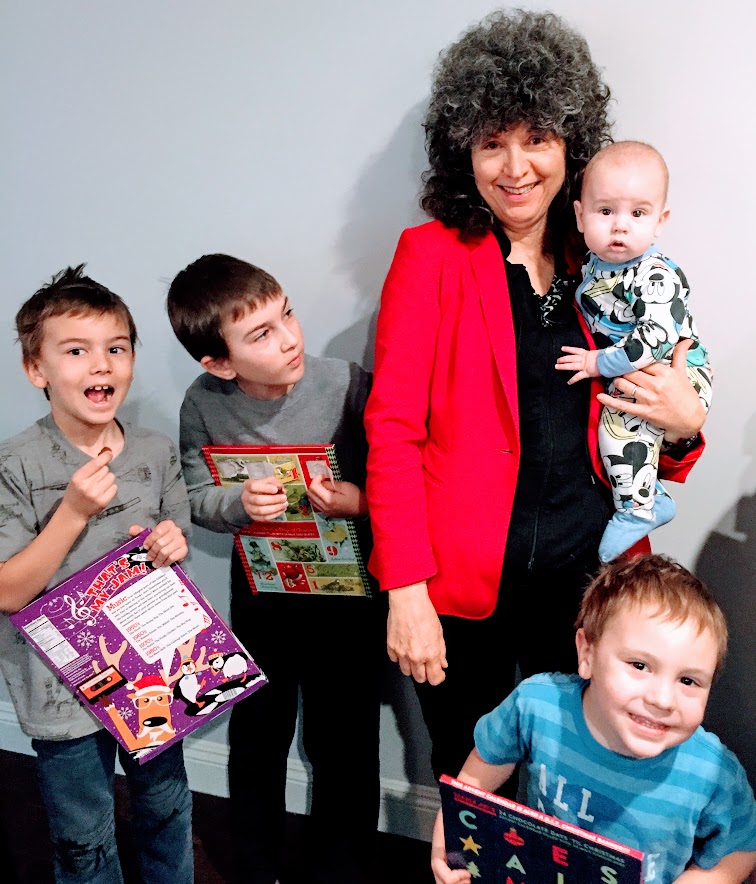
Caroline and grandsons December 2016
Caroline loves being a writer of historical fiction for kids because it combines her love of art history, ancient languages and travel. She lives by the river in London with her husband Richard, who helps her with ideas and illustrations, and who feeds her. Caroline’s son Simon is now grown up, living in Los Angeles California and working in the film industry. He has an Australian wife named Brooke and four sons. Caroline’s favourite thing is still going to the movies, and she still hopes to write the screenplay for a successful film one day. 

P.S. You can also see a long blog about How I Write and lots more info about me and the Roman Mysteries on my FAQS page.

Monday, July 25, 2005

Poison in the Garden


It is July 2005. The middle of a beautiful balmy British summer.

The book I'm currently working on – The Sirens of Surrentum – has a lot about poison. Luckily I live in one of the greatest cities in the world – London – so last week I left a phone message with the curator of the Chelsea Physic Garden to ask if they had anybody who could tell me more about poisonous plants known to the Romans. I know all the names but I don't know what they look like. Or smell like. Or taste like. (Actually that last one might not be strictly necessary!)


The curator, Rosie Atkins, returned my call and was very charming and helpful. After a short chat about hemlock, rhubarb (leaves extremely poisonous, stems completely edible) and the trade route from China to Rome via India, she encouraged me to come round and have a look for myself.


St Mary's Battersea
So I do. It's a half hour walk along the river via Albert Bridge and the Boy on a Dolphin sculpture. I love walking in London, especially beside the river. When the sun is shining Londoners are so cheerful and you see amazing snapshots of life. Yesterday I saw a just-married couple spilling out of St Mary's Battersea and – on my way back two hours later – an ambulance taking someone away from one of the houseboats moored beside it. Today I see two beer-bellied men fishing beside the river, assorted joggers, dog-walkers, bike-riders, and four boys cheerfully molesting a stuffed-toy rabbit before tossing it in the Thames. I also see a young dad crouched down beside a pushchair. For more than a minute he remained absolutely still, staring at his little boy's sleeping face as if he wanted to imprint it on his memory forever.

ancient Yew tree
The Chelsea Physic Garden is the second oldest botanical garden in England, after Oxford. It was established by the Society of Apothecaries who have a funky image of Apollo on their crest. It's a bit like a secret garden in the heart of Chelsea between the Thames and the Royal Hospital.

I am just in time for the 4.00pm tour. Christine, our guide, is a volunteer, like almost everyone who works here. She takes us around and makes a special effort to point out poisonous plants the Romans would have known.

We see acanthus, tansy, rhubarb, agapanthus, oleander, and a magnificent yew tree with its fatal red berries.

"Deadly Nightshade"
Deadly nightshade has fatal dark-blue berries. If you eat them or their juice you will die, but opticians used to use its juice to dilate the pupils of the eye. It's also known as belladonna ('beautiful woman') because Italian women use this juice to make their eyes look big and dark and liquid.

After the tour has ended, Christine helps me find some hemlock. The specimen in the garden isn't very healthy but I get a good sense of it's height and the hollow nature of its stem, and the little spray of white blossoms.

Everyone at the Chelsea Physic Garden is so helpful and erudite. Christine herself mentions two books which feature poison (Hartley's The Go-Between and Dorothy Sayer's Strong Poison) and she also quotes from two poems: one by Auden called Roman Wall Blues, and one by Houseman that ends like this:

There was a king reigned in the East:
There, when kings will sit to feast,
They get their fill before they think
With poisoned meat and poisoned drink.
He gathered all that springs to birth
From the many-venomed earth;
First a little, thence to more,
He sampled all her killing store;
And easy, smiling, seasoned sound,
Sate the king when healths went round.
They put arsenic in his meat
And stared aghast to watch him eat;
They poured strychnine in his cup
And shook to see him drink it up;
They shook, they stared as white's their shirt:
Them it was their poison hurt.
-I tell the tale that I heard told.
Mithridates, he died old.


Curiously enough, I mention old Mithridates in The Sirens of Surrentum...

[The 17 books in the Roman Mysteries series are perfect for children aged 9+, especially those studying Romans as a topic in Key Stage 2. The BBC TV series is available on Amazon Prime in Europe and the UK.]

Wednesday, February 02, 2005

A Writer's Life

Sometimes people ask me what its like being a writer.

The room where I write
I am really blessed because about five years ago my husband Richard and I moved to a riverside flat here in London. It has been a lifetime dream of mine to live by the River Thames. To quote the actress Joanna Lumley, 'If I wasn't married to my husband, I might be married to the river Thames.'

We're on the second floor so the Thames is right there, flowing back and forth, two tides a day, always different. There is also a huge sky and my arched window faces northwest so I can see the sunset in summer. Sometimes in the winter when I get up early to write, there is a huge full moon sinking down towards the apartments over on the other side, it makes a silver path in the inky water. There's also a disused docking platform outside our window, from when these flats were warehouses receiving goods from the East Indies. This wooden platform is abandoned by people, but not by birds. At any one time I can see cormorants, ducks, geese, swans, coots and usually a heron.

On Saturday and Sunday mornings the skiffs and eights slide by, a coach with a megaphone urging his oarsmen on up the river. I also see tugboats carrying London's garbage up and down, and the occasional river cruise boat. But usually it's very peaceful and unbelievably quiet. At the moment all I can hear is a goose calling to his friends on the foreshore; it's low tide.

The river is on my left. At first I couldn't take my eyes off it but now I'm content to glance over and reassure myself that it's still there. I sit at a table with my iMac facing a wall covered with images.

I am a very visual person so I need to SEE what I'm writing about. I have images of things like a Roman ship, a calendar of the year 80 AD showing phases of the moon on each day, frescoes, mosaics, film posters and portraits of people I base my characters on. I often use jazz musicians rather than actors to inspire me. I don't know what they're like so I have to deduce it from their faces. For example, in my fourth book The Assassins of Rome, I base a character called Simeon on a jazz bass player called Slim Man. Actually I did see him play in a jazz club and that informed his character as it appears in the book.

I never listen to music or the radio while I'm writing but when I'm not writing music is a huge source of inspiration. I like smooth jazz, chill, lounge, whatever you want to call it. I usually don't like songs with words because that gets in the way of the picture that music alone can create. One of my favourite musicians is Larry Carlton. I've based songs in my books on some songs of his from the album Fingerprints, in particular a song called Slave Song which is Nubia's theme.


On either side of my chair is a stool with papers, letters and reference books in piles. On the wicker coffee table behind me are more piles of papers, at the moment they are mixed with postcards and receipts from a recent research trip to Athens.

Richard's map of Ostia Antica
My husband is a non-fiction writer and graphic designer and he works out of the living room next door. He does all the little maps and diagrams at the front of my books. We have a game where he brings me what he's done in his mouth – like a dog – and drops it on my desk. I mark up the changes and tell him to 'fetch!' A moment later he is back, wagging his tail, with the latest version in his mouth.

The one thing a writer must have is self-discipline. You have to fashion a routine that works for you and this can take years. Over the five years I've been writing full-time, this is the routine I've developed.

I get up between 5.00am and 6.00am, go straight to the computer and write until 10.30, 11.00 or 12.00 noon at the latest. Of course I get up to make a cup of coffee or get some toast and an apple, and I dress in phases (preferring to stay in comfy track trousers and sweatshirt as long as possible), but by the time Richard is up and the post arrives and the phone starts ringing, I have put in five or six hours. Then I'm done with the creative, focussed part of the day.

I have made a rule, which I occasionally break, never to look at my emails until after noon. Once I'm online I'm caught up in the demands and business there.

Late mornings I either go out to the gym or go for a long walk. Writers sit around all day so you have to be self-disciplined to keep fit. Walking is one of my best ways of getting ideas or solving problems. I'll put on a jazz tape or John Truby story structure tapes and walk and ideas just come to me. I have a circuit I do along the river, over Battersea Bridge, back along the river and over Wandsworth Bridge. It takes me about an hour and a quarter and usually I come back with my problem solved or a great idea for a future book.

"Vespasian" at the BM
I have been paid an advance for ten more books in the series and I have little folders on my computer for each one. I don't know exactly what each book will be about but I have a working title and setting and at least one idea for each. If I get a good idea while I'm walking I'll decide which of the books it would fit best with and put it on my ideas document for that book. If I can't decide which of the books it would be best for, I have one hold-all document called Ideas for the Future. Every time I get a good idea or come across a great turn of phrase or see a fascinating character I type it into this document, which is now 144 pages long. Running out of ideas is NOT one of my worries.

Want an example? Here's just one of the hundreds of quotes I've jotted down in this document. It's a quote by Buffy creator Joss Whedon: 'What's your favourite movie? What's one of your most memorable experiences? Now mix them...'

After my walk I have lunch, usually a cheese sandwich and apple, or a salad.

Then, in the afternoon I maintain my website, and answer emails. They're usually either from fans or requests by schools for me to visit. I limit my months for UK school events to two per year. It's really hard work and I can't write when I'm doing promotion.

A couple of afternoons per week, during my writing period, I go to the cinema. I love movies and all my writing methods are based on screenwriting techniques and story structure used in films. Here in London we have the NFT, the National Film Theatre, so I can go see classics like Nashville and La Dolce Vita on a big screen with lots of other film buffs. On Valentine's Day I'm taking my husband Richard to see Casablanca. I love the fact that in London you can see hundreds of good films, and for a reasonable price, if you go before 4.00pm.

replica wax tablet
Another thing I love about London are the Roman re-enactment events. The British Museum and Museum of London are both great for these. I've made many friends and now can order anything from a gladiator pen-knife to a wax-tablet.


When I am doing UK promotion (usually March and October) or overseas promotion (Spanish international schools in May) my day is completely different and I have to abandon writing, though I do jot down thoughts in my little notebook. I usually can't wait to get back to my riverside flat and my writing and my movies.

My holidays are spent doing research. In the past few years I've been to Rome, Ostia, Pompeii, Sorrento, Naples, Rhodes, the Turkish coast and Athens. My holidays are devoted to my writing, but my writing is like being on holiday. So that's OK.

P.S. The Roman Mysteries books are perfect for children aged 9+, especially those studying Romans as a topic in Key Stage 2. There are DVDs of some of the books as well as an interactive game. I am also writing a series called The Roman Mystery Scrolls for kids aged 7+ and the P.K. Pinkerton Mysteries...